Municipal heads say that the army's request for data on matters that fall within the purview of the local level is against constitutional practice and the spirit of federalism.
We use Google Cloud Translation Services. Google requires we provide the following disclaimer relating to use of this service:
This service may contain translations powered by Google. Google disclaims all warranties related to the translations, expressed or implied, including any warranties of accuracy, reliability, and any implied warranties of merchantability, fitness for a particular purpose, and noninfringement.
Local government heads have expressed objections after the Nepal Army wrote to various municipalities across the country to provide the records of squatters. The army has written to various municipalities across the country to provide the records of squatters. In particular, municipalities in Morang, Sunsari, Jhapa and Bardiya have opposed this and said that they will not obey the army's instructions.
Shyam Prasad Rajbanshi, mayor of Sunbarshi Municipality in Morang, says that the army's writing to ask for data on matters that fall within the local level's jurisdiction is against constitutional practice and the spirit of federalism. 'The management of landless and squatters falls within the jurisdiction of the local government, why is the army involved in this?' Rajbanshi expressed his anger, 'Why give the data to the army? We are capable of it ourselves.'
The district administration, district police, Nepal Army and other security agencies are in a race to collect the records of squatters in Jhapa, Morang and other places. The District Police Office has written to all the police offices under its jurisdiction on April 10, directing them to send the records of squatters across the district.
The District Administration Office has written a separate letter and issued a direct instruction to the local government. Municipalities including Jhapa, Damak, Mechinagar and Dharan in Sunsari have expressed dissatisfaction, saying that the local level has been pressured to ‘use dozers immediately’ through the Chief District Officer as per the directive. They have objected to the directive saying that a commanding style has been adopted rather than coordination. ‘We are not the CDO’s watchmen,’ said Damak Municipality Chief Ram Thapa, ‘We are not obliged to obey the CDO’s orders.’
Thapa said that managing squatters is a complex and long-term process and made it clear that a solution will not be found by using dozers in a hurry. ‘First, measurements, verification and identification of the real facts should be done, only then can a solution be reached,’ he said. Acting Mayor of Dharan Sub-metropolitan City, Aindra Begha, has also reiterated his stance that no settlement will be removed based on external pressure. According to him, the responsibility of managing landless citizens lies with the local government and it should be resolved in a humane manner.
Similarly, the mayors and chairmen of all eight municipalities in Bardiya have said that they will not cooperate with the government until the proper management of the real landless squatters is provided. Since it is seen that there has been no coordination between the concerned bodies and no due process while respecting fundamental rights, the heads of the municipalities have drawn the government's serious attention to this.
A meeting was held in Madhuban town with the mayors of Gulariya, Madhuban, Thakurbaba, Rajapur, Basgadhi, and Barbardiya municipalities and the chairmen of Geruwa rural municipality. The meeting issued a statement expressing anger at the government's attitude. The statement said, 'The Nepal Army under the Ministry of Defense has sent a P.S. In the context of the letter dated 13921/2083/01/12 requesting updated details of squatter settlements in local areas of Bardiya district, our serious attention has been drawn to this as it appears that the letter was sent without following the necessary procedures and procedures as per the prevailing law.’
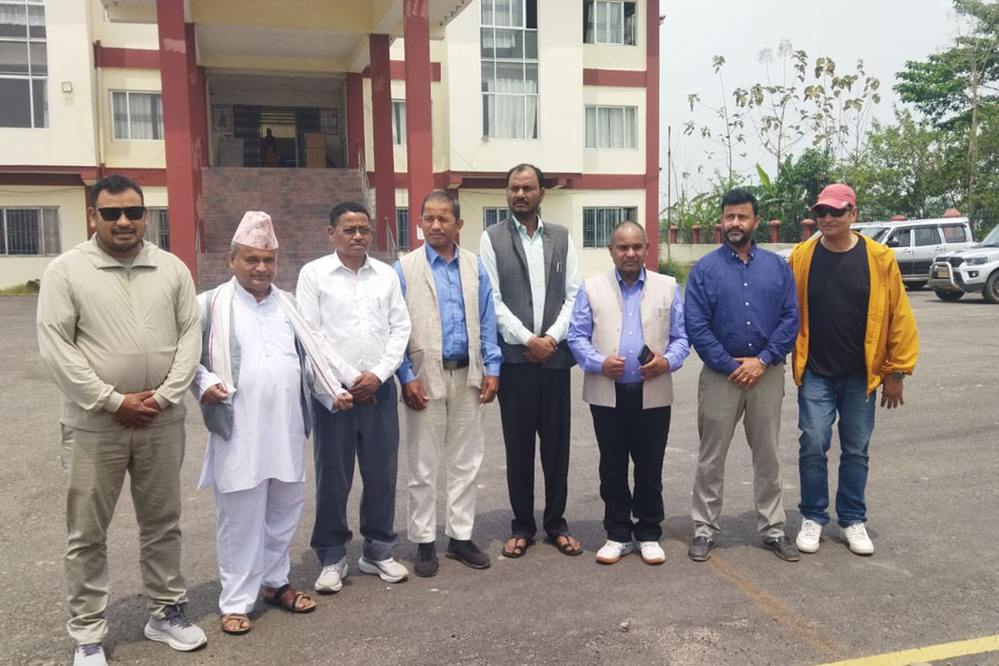
Basgadhi Nagar Chief Khadga Bahadur Khadka said that it is difficult to understand whether it was run by the government or the army. He said that the army did not follow the prevailing law in demanding updated details of the squatters. However, the Division Forest Office, Bardiya has issued a notice to vacate the encroached forest area. The Division Forest Office issued a 15-day notice on Monday to vacate the forest area.
The notice has mentioned the removal of houses and huts built by illegally encroaching on the forest area including Kothiyaghat, Machadchowk, Sangam Basti of Gulariya, Khurkhurephanta of Barbardiya, Rambasti, Amar Mahila Community Forest and other community forest areas. Ramgopal Chaudhary, Senior Assistant Forest Officer of the Division Forest Office, said that encroachment and cultivation are prohibited under Section 49 (c) of the Forest Act, 2076 BS. The Division Forest Office has warned through a notice that if the land is not cleared within the stipulated period, the cost of clearing the encroached land as per the prevailing law and the punishment as prescribed by the Forest Act, 2076 BS will be incurred.
The Division Forest Office, Bardiya, has stated that about one thousand hectares of forest has been encroached on in the name of landless people, including government and non-government organizations. Thakurbaba Municipality Mayor Tilak Lamsal said that no assistance will be provided by the municipalities until the actual squatters are managed in the name of removing encroachments. ‘The municipality does not support the non-landless,’ he said, ‘The management of the actual landless is our issue.’ The landless should not be left in a state of distress during the onset of the rainy season.' Badhaiyatal Gapa Chairman Himalaya Tripathi said that it is the state's responsibility to properly manage the landless who have been living there for 40 years.

