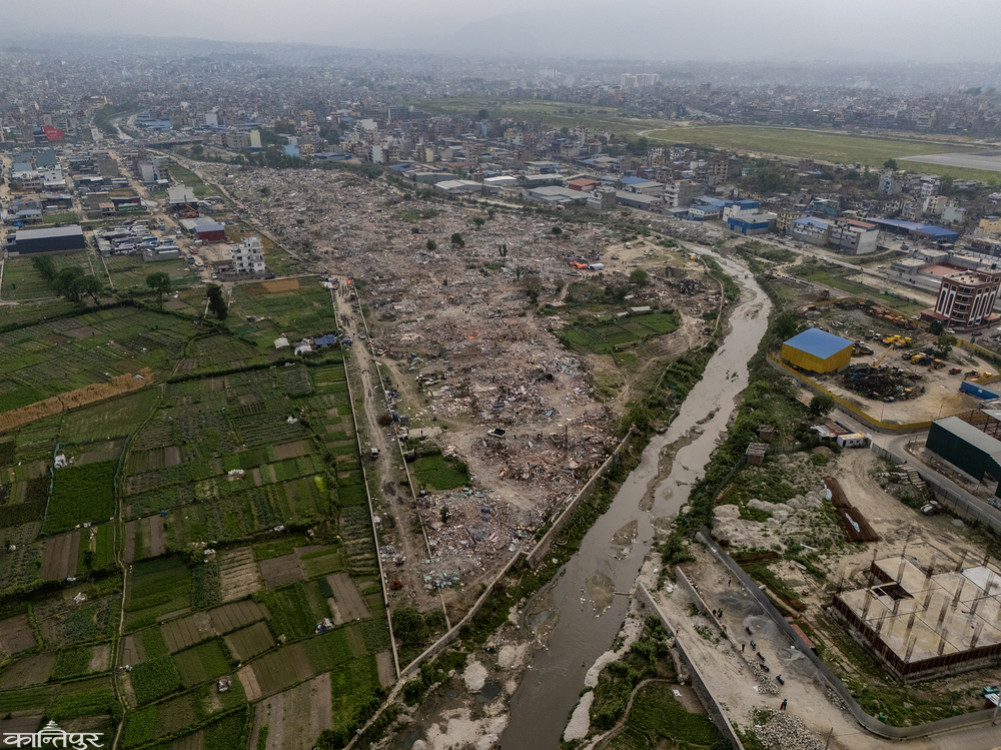
The army has written a letter to the Land Problem Resolution Commission and the district-based municipal offices, requesting details of squatters from military units in various districts.
We use Google Cloud Translation Services. Google requires we provide the following disclaimer relating to use of this service:
This service may contain translations powered by Google. Google disclaims all warranties related to the translations, expressed or implied, including any warranties of accuracy, reliability, and any implied warranties of merchantability, fitness for a particular purpose, and noninfringement.
The Nepal Army has written to various agencies asking them to provide details of squatter settlements. Letters have been written from army battalions in various districts to the Land Problem Resolution Commission and the district-based municipality offices requesting details of squatters.
The letter written by the Bajradal battalion in Banke on April 12 states that ‘updated details regarding unorganized squatter settlements are required and should be provided to the battalion by April 14’. It states that the location of the squatter settlements, date of settlement, number of households, contact numbers of settlement officials and other details, if any, should be provided.
The letter states that the government’s ‘100-point agenda for governance reform includes preparing a register of landless and squatter and unorganized settlers across the country, and providing security to actual squatters in a phased manner, which is in the process of implementation’. ‘In the same sequence, on 12 and 13 Baisakh, security personnel were mobilized to remove squatter settlements that had encroached on rivers, banks and public settlements within the Kathmandu Valley,’ the letter signed by General Cholendra Karki states.
Among the municipalities to which such letters were sent, Chairman of Geruwa Rural Municipality in Bardiya, Jaman Singh KC, told Kantipur that he had prepared and sent the details after the request was made. ‘It is not just us, all municipalities have been asked for such information,’ he said, ‘I had asked to send the details.’
The Pipaltar Barracks of the Army’s Pashupati Prasad Battalion in Udayapur has written a letter to the Land Disputes Resolution Commission asking for details of the squatter settlements. The letter, signed by Operations Officer Lieutenant General Pramod Adhikari, states that security personnel have been mobilized to provide information and mike information for the removal of squatter settlements encroaching on rivers, banks and public places in the Kathmandu Valley, and demands details from within the district.
Sanat Kumar Karki, Vice-Chairman of the Land Problem Resolution Commission, says that they have received information that the army has asked for details from Darchula and other districts. ‘The Land Commission was formed by the previous government, the interim government abolished it, and we were working after the court reinstated it,’ he told Kantipur. ‘This government has also written a letter to the commission stating that it will complete the work of collecting names, applications and verification within the 60 days as per its action plan.’ Meanwhile, on the one hand, the army is demanding a list of squatters, on the other hand, they are removing squatters and unorganized settlers using dozers, and there has been no coordination with the commission in this process.'
Stating that the government's action plan also mentions distributing land deeds within 1,000 days, he said that the commission is working according to the rules. 'When the current Prime Minister was the mayor, the commission had also signed an agreement with Kathmandu Metropolitan City for the verification of squatters. We had started work by signing agreements with a total of 751 municipalities,' Karki added, 'If the work had progressed according to the agreement made in 2079 BS, there would have been no problem of who is a squatter now? Who is a squatter.' He says that it is not necessary to proceed through the same method when a lot of money has already been spent on applications and other processes. 'The fact that squatters have been removed from many places including Thapathali and Manohara due to non-compliance with the process does not seem to be legal,' Karki added.
The presence of the army was also seen during the evacuation of squatter settlements in the valley. Nepal Police Chief IGP Dan Bahadur Karki himself reached the place where the dozer was being operated. There is a provision that the National Security Council should decide for the mobilization of the army. The military base had given a clarification that the mobilization was not done, saying that the same decision was not made even during the Gen-G movement. ‘Even now, the civilian authority has not been heard to mobilize the army, and the council meeting has not been seen,’ says Dr. Indra Adhikari, an expert in military affairs, ‘It is not good if the army automatically moves forward in an area where the work, action and responsibility of the civilian authority are specific.’
She says that the mobilization of the army has led to a situation where the country’s ‘civilian authority’ cannot function even in the collection of details of squatters.’ ‘If not, the Prime Minister, who is responsible for both the Ministry of Defense and the Ministry of Home Affairs, should answer this issue,’ she added. ‘He should clarify whether the Prime Minister does not trust civilian organizations and thinks that the army should be involved or whether the army itself is trying to go outside its jurisdiction.’
Army spokesperson Rajaram Basnet claims that he was seen walking with relief materials in Kathmandu and went to the settlement because he was caught. ‘That is a coincidence, no matter how you put it together, but the army team went to Manohara in Bhaktapur,’ he told Kantipur. ‘Suryabinayak Ganapati was also present at the District Security Committee meeting in Bhaktapur. After the meeting, he said that he would go for monitoring, and the army was seen there.’ He said that since the army should be deployed even in the event of a disaster in the district, there is no need to go for monitoring.
Senior advocate Raju Chapagain, who has been arguing on the issue of squatters, says that it is the responsibility of the ‘civilian authority’ not only to request details of the squatters but also to manage them. ‘The constitution and law do not recognize the presence of the army during the evacuation of the squatters’ settlements. Even if any other body had asked for data, it should have been said that it was not our jurisdiction,’ he told Kantipur. ‘They are not criminals. The state’s laws and regulations have said that consultations and discussions should be held, the court has said that verification should be done. In such a case, the use of both the army and the police is wrong in the first place.’
In the case of the letters being cut off from the army battalions in various districts, Army spokesperson Basnet insisted that it was only for disaster risk reduction. ‘During disasters, data is collected based on the decision of the security committee, and work is done accordingly,’ he said. ‘I don’t think it should be taken otherwise, there is no other reason.’
He said that he had also worked in various districts as a Ganapati before, and said, ‘Before disasters, there is a task of identifying high-risk settlements, and accordingly, work is done by identifying high-risk, risk and low-risk areas. Details may have been sought in that regard.’
However, the heads of the district security committee have said that no such meeting has taken place. Udayapur Chief District Officer Dharmaraj Joshi says, ‘No decision has been taken by the security committee on issues related to the squatters, it would be better to ask the relevant body about this.’