Passengers are complaining that the problem of public buses in Kathmandu charging more than the prescribed fare, arbitrarily granting student discounts, and even refusing to show the fare list is increasing day by day.
We use Google Cloud Translation Services. Google requires we provide the following disclaimer relating to use of this service:
This service may contain translations powered by Google. Google disclaims all warranties related to the translations, expressed or implied, including any warranties of accuracy, reliability, and any implied warranties of merchantability, fitness for a particular purpose, and noninfringement.
Pratima Sapkota has been living in Thankot, Kathmandu. She is studying for her master's degree. Every morning, she takes two buses to reach Balkhu. But every time she pays different fares. She said, "Some buses from Thankot to Kalanki charge 30 rupees, some charge 35. Some buses from Kalanki to Balkhu charge 25 rupees, some charge 30."
She said that arbitrary fares in public transport should be monitored. She said that some vehicles do not even have fare lists.
Laxman Poudel, 22, who lives in Futung, is an information technology student. Every day, he takes two public transports to go to college for his studies. "Some co-drivers said that there will be no discount on the card on some days when the fares have increased. But when they say that there should be a discount for students by showing their ID card, they give a discount, but they don't get a 45 percent discount,' he says.
He also says that the discount that students should get is always necessary. Students complain that some co-drivers charge fares in 'round figures' because they don't have small change.
After the increase in fuel prices, the Ministry of Physical Infrastructure and Transport agreed to adjust the fares of public vehicles on Chaitra 27 last year, and the Department of Transport Management implemented an automatic fare system for long and medium distances. After that, the relevant provinces had made the fare list public to maintain inter-provincial fares. There are complaints from the public that even though the fare is fixed according to the kilometer, the fare is being charged more.
Saroj Sitaula, Senior Vice President of the National Federation of Nepal Transport Entrepreneurs, has stated that the government has not adjusted the fares on time. He also says that no one is allowed to charge more than the prescribed fare. ‘No one can charge more than the prescribed fare. In the transport sector, it is necessary to effectively implement an automatic system that increases fares when fuel prices increase and decreases when they decrease,’ he said. Sitaula said the government should work on a ‘fast track’ to adjust fares according to the increased fuel prices. ‘Despite the huge increase in diesel prices, this problem has arisen because the government has not adjusted transport fares on time,’ he said. ‘Especially in Bagmati Province, despite the increase in diesel prices by Rs 30 per liter, it is delaying adjusting fares.’ SP Naresh Raj Subedi, spokesperson for the Kathmandu Valley Traffic Police Office, said that no public transport is allowed to charge more than the fare prescribed by the state. ‘No public transport is allowed to charge more than the prescribed fare.’ The traffic police have also been taking action against those who charge higher fares. SP Subedi said that there is a legal provision that the traffic police can fine those who charge higher fares up to Rs 5,000.
He said that the fare list should be displayed in all passenger vehicles in a way that passengers can see in coordination with the transport entrepreneurs. He also said that the fare list should be displayed in all public transport. He said that instructions have been given to implement the facilities allocated in public transport appropriately. He said, "We have explained that they should use the student card discount, senior citizen seats, and seats reserved for women. We are also continuously monitoring."
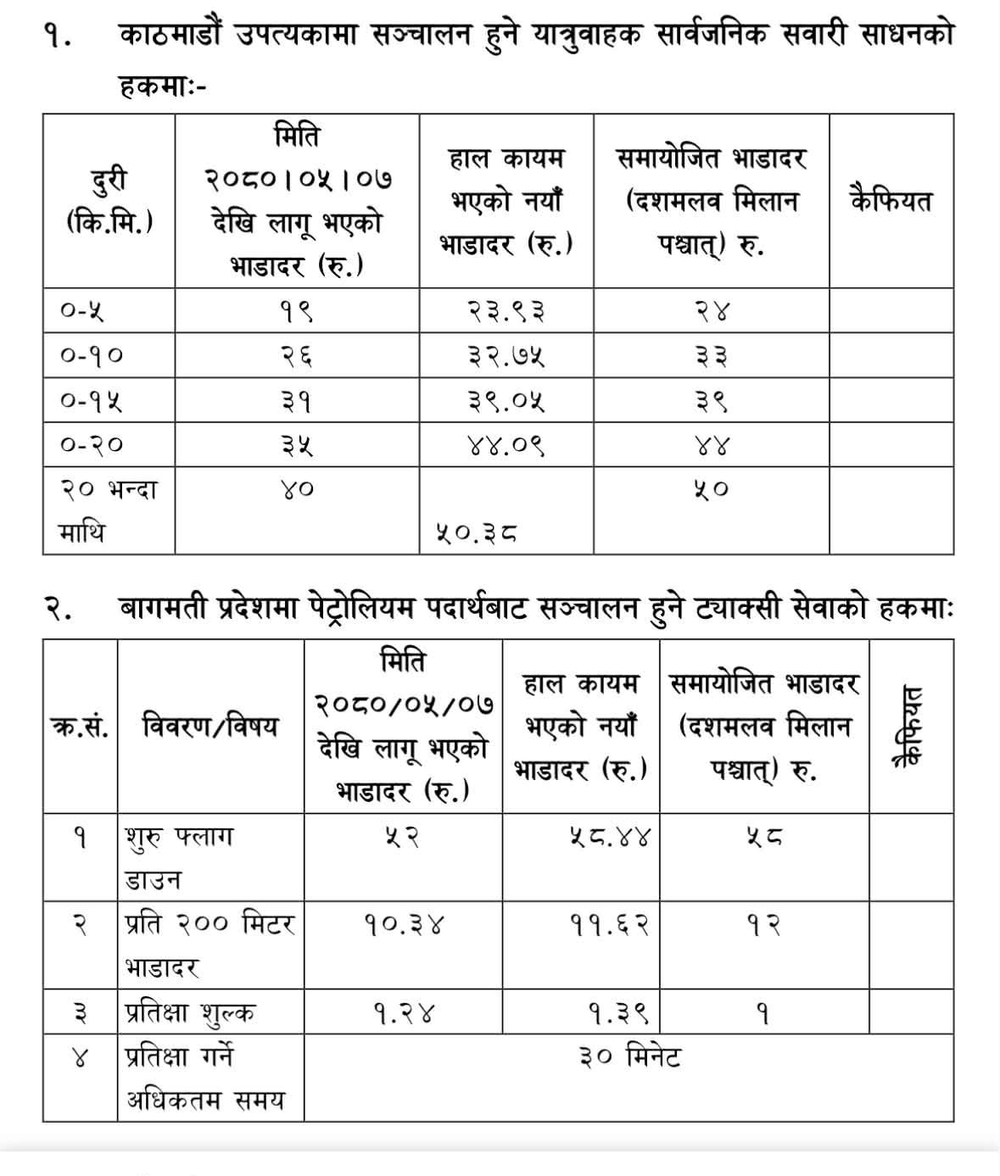
For public transport vehicles operating in the Kathmandu Valley, the fixed fare on Bhadra 7, 2080, was Rs 19 for 5 km. But the fare rate of Rs 24 fixed from Chaitra 27 last year has been effective. Similarly, the fare for a distance of up to 10 kilometers was previously Rs 26, but now it has increased to Rs 33. Similarly, the fare for a distance of up to 15 kilometers is Rs 39, up to 20 kilometers is Rs 44, and the minimum fare for distances above 20 kilometers is Rs 50.
This is the previous and current fare