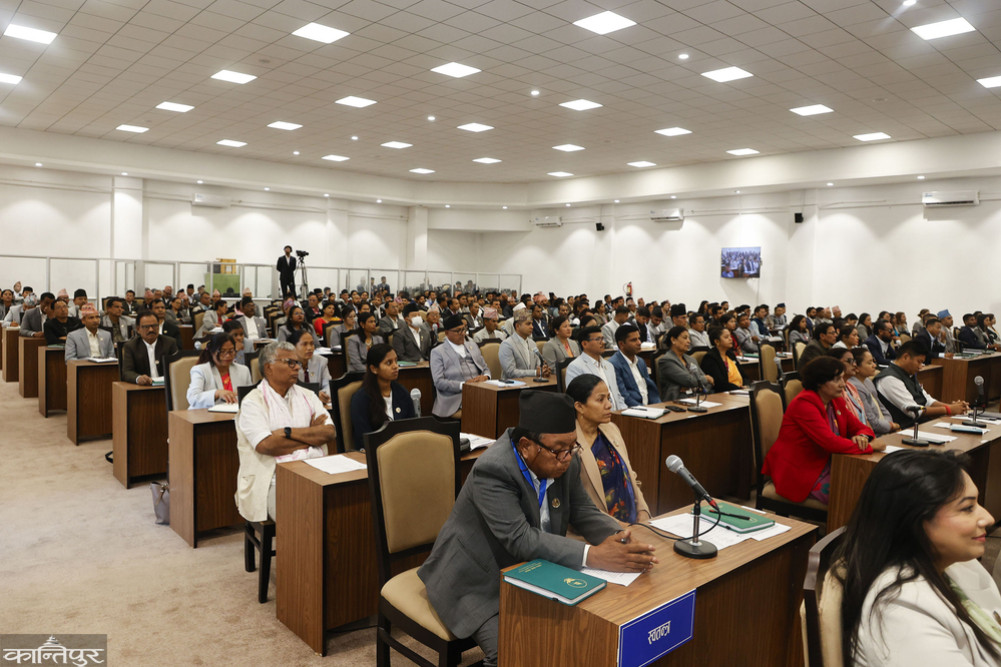
Constitutional experts and political parties object to the government's move, demand to call a parliamentary session to stop the executive's encroachment on the legislative powers of the legislature
We use Google Cloud Translation Services. Google requires we provide the following disclaimer relating to use of this service:
This service may contain translations powered by Google. Google disclaims all warranties related to the translations, expressed or implied, including any warranties of accuracy, reliability, and any implied warranties of merchantability, fitness for a particular purpose, and noninfringement.
The Rashtriya Swayamsevak Sangh (RSS) government, which has a two-thirds majority, is trying to run the government through an ordinance by postponing the session of the House of Representatives. The Council of Ministers' meeting on Monday decided to bring an ordinance to amend the laws related to the Constitutional Council and the return of savings of members of problematic cooperative organizations and sent it to the President's Office. President Ramchandra Poudel's press advisor Kiran Pokharel told Kantipur that the received ordinance is being studied.
The parliament session called for 17 Baisakh was postponed by the government to 10 Baisakh less than 24 hours later. At that time, the government had argued that the postponement was for a few days because the preparations of the parliament secretariat were not complete. But after two ordinances were submitted to the President on Monday, the government's intention to postpone the parliament session that had already been called has become clear.
‘It was seen that the government had even postponed the session that had been called just to bring the ordinance, otherwise the government should have responded to it,’ said constitutional expert Bipin Adhikari, ‘The government is led by such a big party in the parliament, the parliament should not have been bypassed . Good practice of parliamentary procedure should have been started .’
Article 114 of the constitution provides that ‘the President may issue an ordinance on the recommendation of the Council of Ministers if it is necessary to do something urgently in other situations except when the sessions of both houses of the federal parliament are in progress’. This provision of the constitution has set two mandatory criteria for bringing an ordinance . First, the session of parliament should not have been in session . Second, it should have been ‘urgently necessary to do something’ . Even if the session of parliament is not in session, the government cannot bring an ordinance if it is not ‘urgently necessary to do something’ .
Law Minister Sobita Gautam told Kantipur that since it is urgent to appoint a vacant Chief Justice, an ordinance has now been brought to fill the gap in the Constitutional Council Act.
To understand the gap in the act mentioned by Law Minister Gautam, one must look at the initial provisions of the Constitutional Council Act. When the act was enacted in 2066, there was a provision that all members of the council, consisting of the Prime Minister, Chief Justice, Speaker, Speaker of the National Assembly, Leader of the Main Opposition Party and Deputy Speaker, should be present at a meeting and decisions should be made unanimously, and if there was no consensus, four people would make a decision. To amend this, ordinances brought by various previous governments had made a provision that decisions could be made by a majority in the presence of at least four people. However, those ordinances were not passed and became inactive, and after that, it was understood that the initial provisions of the act were also inactive. When that system was inactive, it was considered to be a legal void until another system was introduced or the government brought a bill to revive the existing system. The government had even practiced bringing a bill to remove such a void in some other contexts.
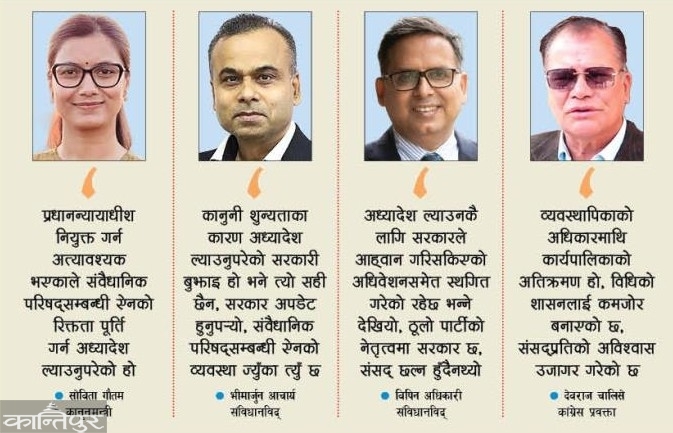
However, constitutional expert Bhimarjun Acharya said that since the full bench of the Supreme Court had already decided that if the system made by the ordinance became inactive, the old system would be automatically implemented, so the system at the time of the enactment of the Constitutional Council Act in 2066 is currently being implemented exactly as it was. ‘If the government’s understanding is that the ordinance had to be brought due to a legal void, that is not correct, the government had to update it,’ he said, ‘The system of the Constitutional Council Act is still in place.’
On Kartik 27 last year, the full bench of the Supreme Court, while hearing the dispute regarding the division of political parties, had decided that the old system of the act would automatically be implemented after the ordinance became inactive. A bench of Justices Sapana Pradhan Malla, Sunil Kumar Pokharel and Meghraj Pokharel had made such an order in the dispute over the division of the Janmat Party led by CK Raut.
Constitutional expert Acharya said that apart from the government's 'incomplete' understanding of legal void, the ordinance should not be brought now for two other reasons. 'Previous governments had misused the ordinance excessively. In particular, the Oli (KP Sharma)-led government dissolved the House of Representatives and brought an ordinance, and brought an ordinance after ending the session. These practices were against the rule of law, and it has been seen that the same practice is being repeated even now,' he said, 'It was a wrong practice to end the session of the parliament that had already been convened. Moreover, a big party has a big responsibility. If it had worked according to the law, it would have been done. It has been seen that it is not accountable.'
Opposition parties in parliament have also opposed the government's move to bring an ordinance after ending the session. Congress spokesperson Devraj Chalise has called such a practice ‘highly objectionable in terms of democratic values, parliamentary dignity and constitutional process’. In a statement issued by him on Tuesday, it was said, ‘This is not just a procedural error but a clear encroachment of the executive on the legislative powers of the legislature.’ It has weakened the basic essence of the rule of law and exposed the government’s distrust of parliament.’
Similarly, the NCP has also opposed the ordinance. The Central Coordination Committee’s meeting on Tuesday has demanded the immediate convening of the budget session of parliament. ‘We oppose the undemocratic act of the government to postpone the parliament session it called and move forward with the ordinance, which is deceiving the parliament, and demand the immediate convening of parliament,’ said a statement issued by NCP spokesperson Prakash Jwala.
Similarly, RPP MP Khushbu Oli said, ‘Proceeding through an ordinance despite the fact that there is a living parliament is a serious attack on parliamentary practice.’ ‘What is the reason for a government with a clear majority to choose the path of an ordinance by bypassing the parliament?’, she said, ‘It is not a proper practice to advance an important body like the Constitutional Council and an issue directly related to people’s lives like the cooperative sector by bypassing the parliament. As the opposition, I strongly oppose such a trend of making the parliament inactive and demand the empowerment of the parliament.’
The Supreme Court had already called the government’s continuous practice of bypassing the parliament and governing through ordinances five years ago as contrary to the principle of separation of powers. The constitutional bench, which sat to examine the validity of the citizenship ordinance issued by the Oli government after dissolving the parliament, had held that ‘bypassing the parliament and issuing an ordinance for government convenience would be an undue interference in the powers and effectiveness of the legislature.’ He had termed ordinances issued with the aim of circumventing Parliament as ‘pseudo-legislation’ and held that they could not obtain constitutional validity.
The constitutional expert Adhikari said that the executive’s right to bring ordinances is an exception in the Constitution. He said that governments have established a wrong tradition of bringing ordinances to circumvent Parliament and sidestep questions within Parliament, and that the current government has also followed the old path by bringing ordinances instead of convening Parliament at the beginning of the budget session.
The Constitution has fixed the deadline for presenting the budget to Parliament on Jestha 15. Before presenting the budget, the President must present the policy and program in a joint meeting of the Parliament, which must be passed by Parliament. In addition, the pre-budget discussion must also be completed in Parliament before that. For that, there is usually a tradition of calling the budget session in the second week of Baisakh. Last year, the budget session was called on Baisakh 13. A parliamentary official said that the time for convening the budget session of the parliament is running out and if the meeting is not called within a week at the most, there will not be enough time for policy and program and pre-budget discussions.