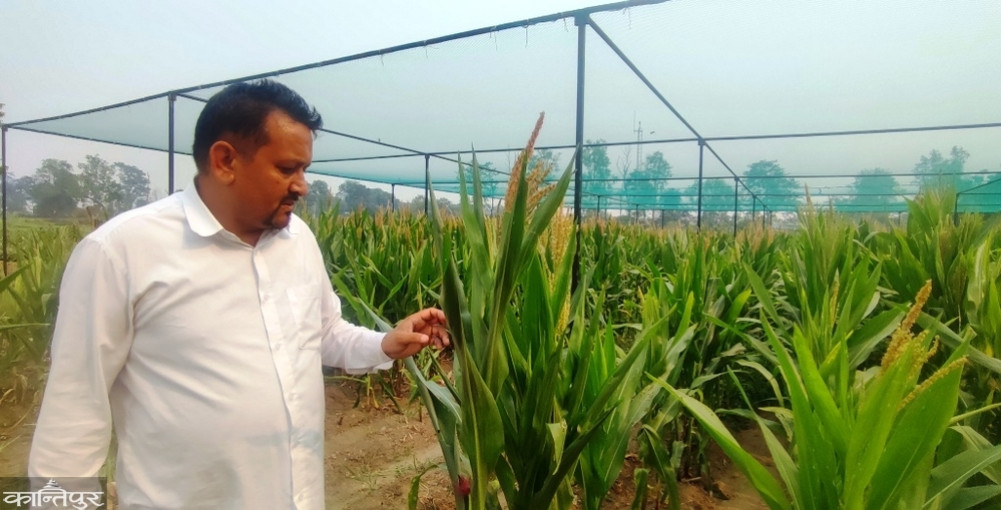
The new maize varieties developed over four years at the National Maize Research Program in Rampur have not yet been released due to a lack of necessary manpower.
We use Google Cloud Translation Services. Google requires we provide the following disclaimer relating to use of this service:
This service may contain translations powered by Google. Google disclaims all warranties related to the translations, expressed or implied, including any warranties of accuracy, reliability, and any implied warranties of merchantability, fitness for a particular purpose, and noninfringement.
The popcorn sold at high prices in restaurants and cinemas in the city is mostly imported from abroad. The Murli maize variety that can grow in Nepali climate and soil is yet to be formally approved. Along with Murli maize, a hybrid and two open-irrigated maize varieties are also ready. These maize varieties, which have been developed after four years of research, are waiting to reach the farmers' fields.
The National Maize Research Program in Rampur, Chitwan develops new and suitable varieties of maize. The Maize Research Program under the Nepal Agricultural Research Council (NARC) once owned 100 hectares of land. Now it has about 77 hectares.
According to Shuk Bahadur Gurung, information officer of the National Maize Research Program in Rampur, 7.5 hectares of this land is for experimental cultivation. The research and production area is 19 hectares and the production area is 39 hectares. The area of habitat, swamp and butyan is 11 hectares. Despite the large amount of land for research and production, there are no skilled manpower available to work.
Information Officer Gurung said that out of the 69 people, there are 35 people. Out of the 35 people, two are on study leave. The research center is staffed with half the manpower due to the vacancy. Although there is a vacancy for one chief scientist in the highest level 'S5' category in the research program, the post has not been filled. Out of the four senior scientists in the 'S4' category, one has not been filled. Out of the six senior scientists in the 'S3' category, there is not one. Other scientists and technicians are also not as per the vacancies. 'We have extracted four castes in four years. But the release is yet to be done. Due to lack of manpower, the work has not been done quickly,' Information Officer Gurung said.
After the new variety prepared by Rampur through research is released, the original seeds are taken and produced by large farmer groups or seed production companies and sold to farmers. 'Study and research should be carried out throughout the year to develop new varieties. Research programs are always run with the aim of developing new and better varieties,' said Gurung.
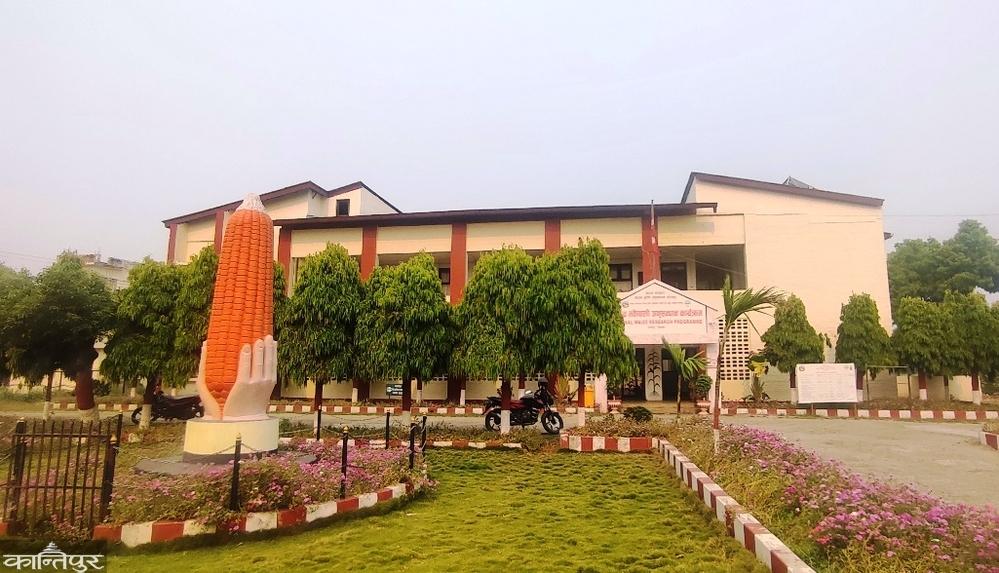
Earlier, this office was named the National Maize Development Program. Information Officer Gurung said that in 2048 BS, the office was renamed the National Maize Research Program to focus more on maize research. From here, in 2032 BS, the 'Rampur Composite', which was developed by mixing the properties of 38/39 maize varieties, is very popular among maize farmers, Gurung said.
He said that the Murali maize that is currently being released is also suitable for the Terai, has low, yellow grains, and is tasty. ‘Murali maize is cultivated in Nepal, but the maize sold in the market is mostly imported from abroad. This variety can stop imports,’ he said. Rampur has developed 31 open irrigated and 10 hybrid varieties of maize. Once the seeds are sown, the same crop can be sown for at least three years. In hybrids, new seeds have to be sown every year.
According to the National Maize Research Program Office, maize is cultivated in an area of 916,000 hectares in Nepal. Maize contributes 7.6 percent to agricultural production. The demand for maize seeds across the country is 24,639 metric tons. Of which, the domestic supply is 3,407 metric tons. ‘We have not been able to meet the target due to lack of manpower,’ said Information Officer Gurung.
Information Officer Gurung said that although research work for breed development has been carried out, research on the soil required for maize has not been carried out. He said that due to the lack of manpower, agricultural engineering and mechanization have not been as expected.