Ministry of Foreign Affairs prepares draft bill to amend Passport Act
We use Google Cloud Translation Services. Google requires we provide the following disclaimer relating to use of this service:
This service may contain translations powered by Google. Google disclaims all warranties related to the translations, expressed or implied, including any warranties of accuracy, reliability, and any implied warranties of merchantability, fitness for a particular purpose, and noninfringement.
Preparations are underway to add crimes related to cooperation, murder and rape to the list of crimes for which passports cannot be issued. The draft bill to amend the Passport Act, 2076 prepared by the Ministry of Foreign Affairs has made more stringent provisions for passports.
Section 12 of the Act provides for the non-issuance or withholding of passports in cases where an investigation is underway, a case is pending in court or a person has been found guilty of 10 different crimes, if the relevant body so requests. According to this, passports are not issued or withheld for a person who is under investigation for a crime related to immigration, corruption, money laundering, human trafficking, kidnapping, narcotics, illegal arms trade, organized crime or terrorism.
The draft bill to amend the Passport Act, 2076 BS states that passports will not be issued even if the investigating officer sends a letter in the course of investigation into charges of cooperative crimes, murder, and rape. There is a new issue in the draft that passports will not be issued even if the investigating officer sends a letter in the course of investigation into charges of any other crime punishable by life imprisonment. The wording of ‘withholding’ has been removed from the provision of ‘issuing or withholding’ of the act in the draft.
Tirtharaj Aryal, Director General of the Passport Department, says that the concept of ‘withholding’ an already issued passport is not practical. He said, ‘The passport that has already been issued belongs to the person concerned. It is practically difficult to withhold it. The work of preventing people from going abroad is done through immigration.’ Director General Aryal informed that an attempt has been made to further clarify the provisions on non-issuance of passports, the use of diplomatic and special passports, and the process of obtaining passports by minors living abroad by amending them.
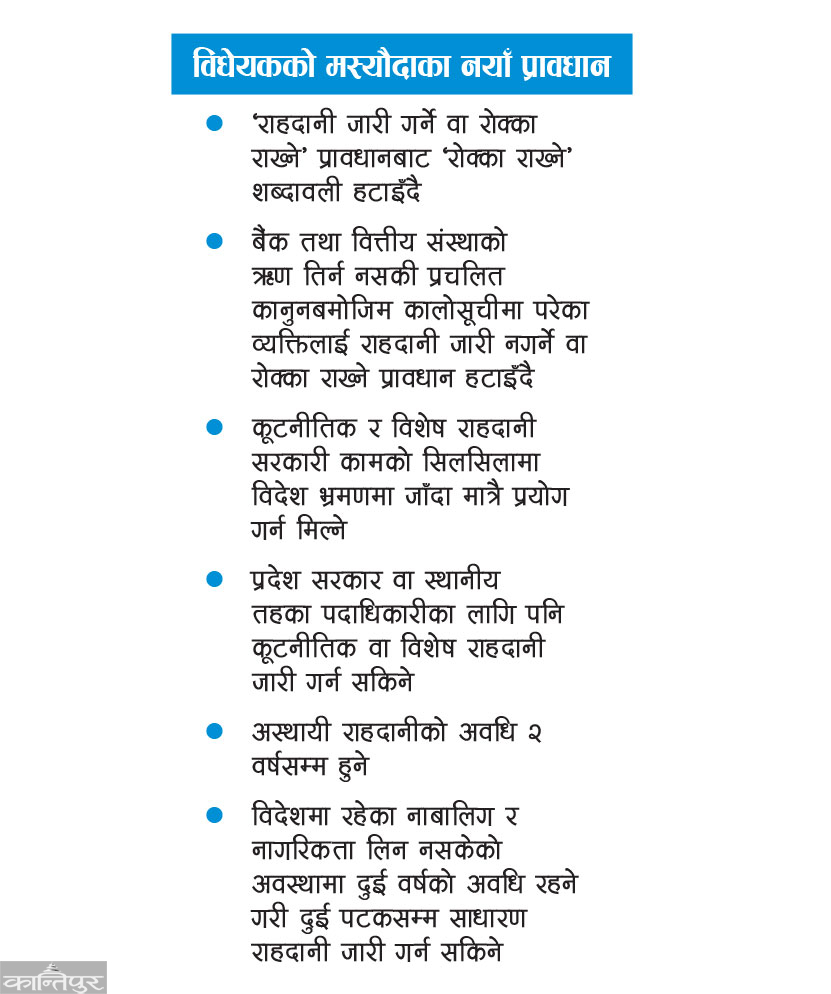 The provision in Section 12 1(d) of the Act that does not issue or withhold passports to people who are blacklisted under the prevailing law due to failure to repay loans from banks and financial institutions has been removed from the amendment. Aryal said that it is not necessary to keep such matters in the Passport Act since they are guided by the relevant law.
A provision has been proposed that even if the Government of Nepal orders to prohibit someone from going abroad or not to issue a passport, a passport will not be issued. The existing Act states that in cases where there is a reasonable reason for a person to be barred from going abroad or an order not to issue a passport or to withhold an issued passport, a passport will not be issued or withheld. It has been amended to remove the word 'reasonable reason' and say that 'passport will not be issued in cases where the Nepal government or a court has issued an order prohibiting travel abroad or not issuing a passport and has sent a written order accordingly from the concerned body. Director General Aryal claims that the Nepal government can issue such an order in accordance with the prevailing law.
The proposed bill makes it clear that diplomatic and special passports can only be used when traveling abroad for government work. It has been said that such passports will be issued to officials or distinguished persons who have been recommended as per the decision of the Federal Parliament, Government of Nepal, Supreme Court or constitutional body.
The proposed bill mentions that diplomatic or special passports can be issued on the basis of nominations to travel abroad for government work as per the decision of the provincial government or local level, as well as on the basis of recommendations from the relevant ministry of the Government of Nepal. There is no such provision in the existing law for the provincial government or local level.
Director General Aryal has said that the bill is being amended to organize diplomatic passports in accordance with federalism. The draft bill also defines foreign travel for government work. It also clearly states the purpose for which a diplomatic passport will be used. There is a new proposal that a diplomatic passport can be used for a maximum of 30 days when traveling abroad for government work in addition to the specified travel program.
It is proposed to amend the provision of the act that allows temporary passports to be issued for up to 9 months and increase the period of temporary passports to 2 years. If the validity period of a Nepali citizen's passport abroad expires, is destroyed or is damaged and cannot be used, there is a legal provision that a temporary passport will be issued for a maximum period of 9 months until a new passport is issued. Similarly, there is a legal provision that ordinary passports will be issued once for a period of two years for minors living abroad and those who have not been able to obtain citizenship. It is being amended to make it possible to issue ordinary passports up to two times for a period of two years.
The draft also proposes to give the Director General of the Passport Department the authority to impose a fine of up to three hundred thousand rupees for passport offenses.