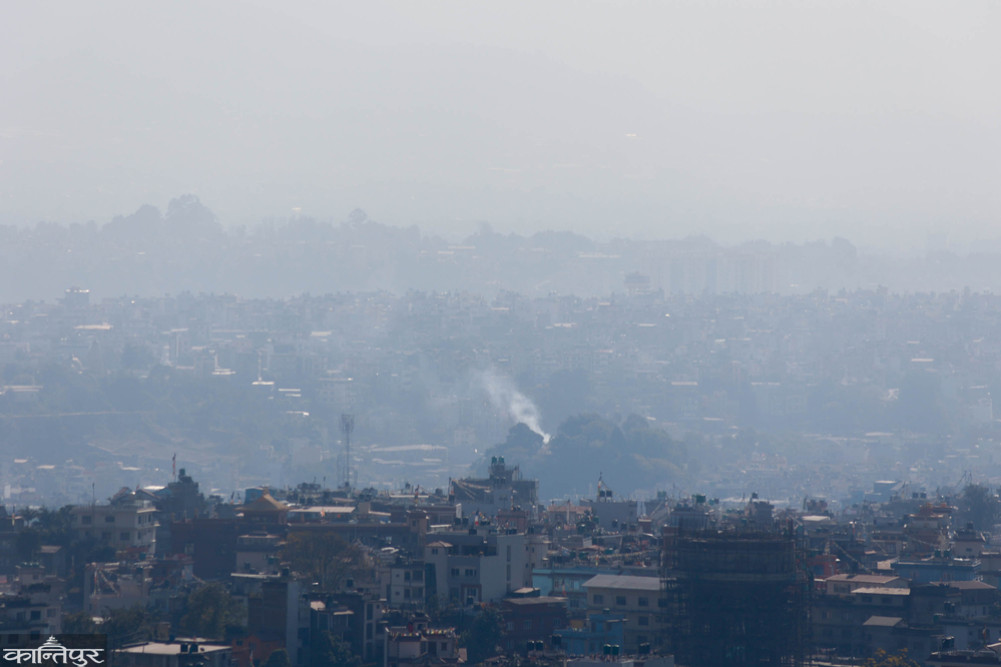
Although there are signs of gradual improvement in the foggy and hot weather seen in various parts of the country, it will take a few more days for it to completely disappear.
We use Google Cloud Translation Services. Google requires we provide the following disclaimer relating to use of this service:
This service may contain translations powered by Google. Google disclaims all warranties related to the translations, expressed or implied, including any warranties of accuracy, reliability, and any implied warranties of merchantability, fitness for a particular purpose, and noninfringement.
With the increase in forest fire incidents, air pollution has also increased in areas including the Kathmandu Valley. The increase in both fires and pollution is due to the lack of rain for the past few days, as temperatures have risen and the dry conditions have increased.
The Department of Forest and Soil Conservation has stated that the risk of even a small spark causing fire has increased due to the dry weather and high temperatures. The smoke from forest fires and dust particles accumulated in the atmosphere have also started to worsen the air quality of the valley.
In the month of Chaitra, which is considered to be the high risk of forest fires, there was a significant decrease in the current year compared to the previous year. The incidence of fires had decreased due to the reduction of dryness due to the above-average rainfall in the pre-monsoon period. However, experts have said that there are signs that the risk of fires is increasing again as the dryness has started to increase again with the lack of rain in recent days.
According to the Department of Forest and Soil Conservation, 466 fire incidents were registered in Chaitra in 2078. Although this number decreased to 267 in 2079, it increased again to 249 in 2080 and 331 in 2081. In the current fiscal year 2082, only 79 incidents were registered, which experts have linked to the weather conditions. Due to good rainfall during the pre-monsoon period, there was a significant decline in fire incidents in Chaitra compared to the same period of the previous year.
According to the department, fire incidents have been increasing again across the country since the first week of Baisakh. The department's statistics, releasing daily details from Baisakh 6 to 9, stated that 102 fire incidents were registered in four days.
The highest number of fire incidents, 17, were registered in Dang. After that, 14 fires have occurred in Kapilvastu and 9 in Nawalpur. A significant number of fires have also been observed in districts including Salyan, Surkhet and Kailali. According to the data, the 'confidence level' of fires (more than 60 percent) is high in some districts. The department has stated that 12 high-confidence incidents have been observed in Kailali, 11 in Doti, seven in Arghakhanchi, six in Gulmi and five in Palpa. Similarly, the risk of fires has persisted within protected areas during this period. The highest number of 23 incidents have been registered in Chitwan National Park, while 10 incidents have been observed in Parsa National Park and nine incidents have been observed in Banke National Park. The details mention that fires have also spread to areas including Bardiya National Park and Shuklaphanta National Park. A total of 57 fire incidents and 33 high-confidence incidents have been recorded in the protected areas. Similarly, only 15 forest fire incidents were reported from Wednesday to Thursday, according to the department's statistics.
Dhirendra Kumar Pradhan, Director General of the Department of Forest and Soil Conservation, said that the fire incidents have started increasing again in recent days. 'The fire incidents have increased since yesterday,' he said. 'The monsoon had supported for some time, but now the situation is dry again. Due to the dryness, the risk of fire even from a small spark is high.'
According to Pradhan, if there is no rain in the near future, the risk of fire may increase further. 'If there is no rain now, the fire may spread further,' he said. Director General Pradhan pointed out the rising temperature, dry weather and human carelessness as the main causes of the fire, and said that there is a need to increase awareness and preparedness.
'Heat' forecast in Terai districts
Forest officer Vijay Dhakal of the department said that coordination between the local level, security agencies and the community is necessary to control the fires. The general public has been urged not to set fire, throw ashes or use fire carelessly in forest areas.
Kathmandu is the first polluted city
The impact of the increasing fires in various parts of the country is starting to be clearly visible in the atmosphere of the Kathmandu Valley. In recent days, with the increase in fire incidents due to lack of rainfall and dry weather, air pollution in the valley has also increased rapidly.
According to the Air Quality Index (AQI), the air quality index, which was around 92 on Tuesday afternoon, has increased to 178 today. With this, Kathmandu has been listed at the first place in the list of the most polluted cities in the world. On Thursday, the AQI had further increased to 247, which is in the 'extremely unhealthy' level.
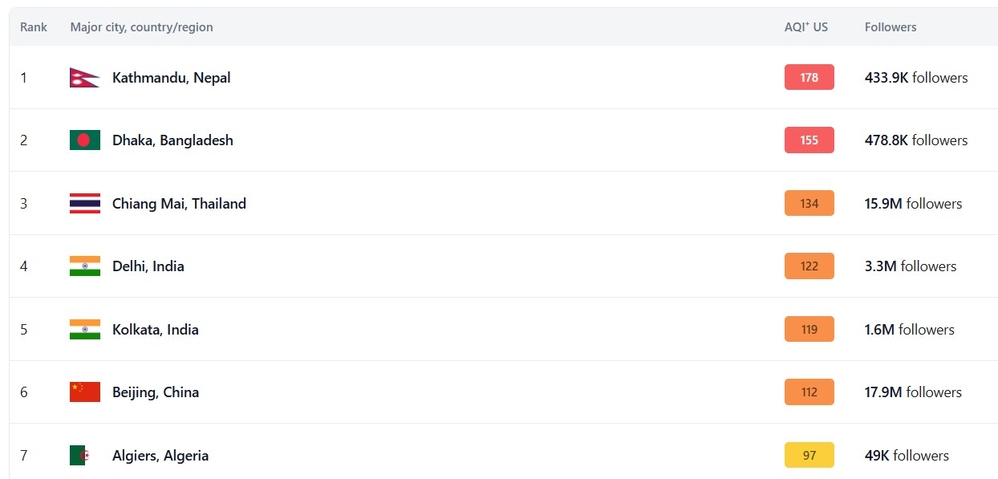 Director General of the Department of Environment Gyanraj Subedi informed that due to weather conditions such as lack of rain, low wind speed and increasing temperature, polluted particles have accumulated in the atmosphere and air pollution has increased in the valley.
Environment youth activist Rajan Thapa said that smoke, dust and fine particles (PM 2.5) emitted from the fires will seriously pollute the atmosphere.
According to the AQI criteria, 0-50 is considered 'good', 51-100 'moderate', 101-150 'unhealthy', 151-200 'unhealthy for all', 201-300 'very unhealthy' and above 300 'extremely dangerous'. Health experts have advised children, senior citizens and people with respiratory problems, especially during times of increased pollution, not to go out unless absolutely necessary, to use masks and to stay safe.
Dry for a few more days
According to Binu Maharjan, a meteorologist at the Department of Hydrology and Meteorology, although there are signs of gradual improvement in the foggy and hot weather seen in various parts of the country, it will take a few more days to completely disappear.
'Although the weather has started to improve since Sunday, we will have to wait until Wednesday for the haze to completely disappear,' she said, 'There is a possibility of good rain only from next week, which can help in controlling forest fires and pollution.'
According to the department, the 'hot day' condition is likely to continue today in the Tarai regions, valleys and gorges of Bagmati, Gandaki, Lumbini, Karnali and Sudurpaschim provinces, including Madhesh Province. There is also a risk of a 'heat wave' (hu) in the Tarai regions of Lumbini and Sudurpaschim provinces in particular. Meteorologists have urged the general public to take necessary precautions to avoid the effects of high temperatures and haze.