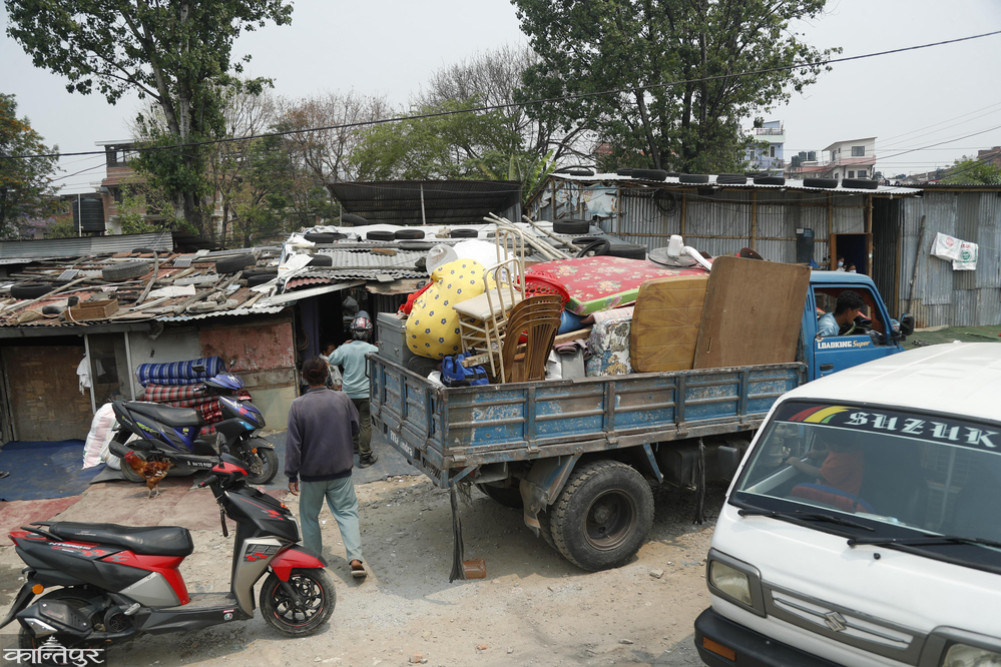
Gen-G activists and victims have filed a writ petition in the Supreme Court.
We use Google Cloud Translation Services. Google requires we provide the following disclaimer relating to use of this service:
This service may contain translations powered by Google. Google disclaims all warranties related to the translations, expressed or implied, including any warranties of accuracy, reliability, and any implied warranties of merchantability, fitness for a particular purpose, and noninfringement.
The Human Rights Commission has directed the government to identify and manage the actual squatters. The commission has also asked not to use force while vacating the houses and huts on encroached land.
The commission has taken interest after the notification was issued to remove the houses and huts of squatters living in places including the Bagmati River in Kathmandu. The commission has stated that the actual squatters should be identified and necessary management should be implemented by implementing the recommendations made by the commission in the past and the orders of the Supreme Court and other courts. The commission had recommended to the government on 1 Jestha 2069 regarding the issue of squatters.
International human rights organization Amnesty International has expressed concern that there is a risk of making hundreds of already marginalized individuals and families homeless. It has also expressed concern over Prime Minister Balendra Shah's attempts to mobilize security forces to clear the unorganized settlements in Kathmandu.
‘The notices issued to evict within two days show a clear disregard for Nepal’s domestic and international human rights obligations and the rule of law,’ said Neerajan Thapaliya, Director of Amnesty International Nepal. ‘Such actions would be contrary to the government’s public commitment to address the problems of landless squatters through a planned, humane and timely process.’ Amnesty said that evicting families without verification, meaningful consultation and assurance of alternative housing undermines the government’s public commitment.
As the government began preparations to immediately evict the squatters, the victims, including Gen-G activists, have approached the Supreme Court. A writ was filed in the Supreme Court on Friday on behalf of Gopal Ranpaheli, who has been living in the squatter settlement. The filing of the writ is scheduled for Monday. The victim had also filed a contempt petition in the Patan High Court. The victims said that the high court has not registered the contempt petition.
In the writ petition filed in the Supreme Court, the petitioners have filed a petition against the Office of the Prime Minister and Council of Ministers, Prime Minister Balendra Shah, the Ministry of Home Affairs, the Police Headquarters, the Inspector General of Police, and the acting mayor of Kathmandu Metropolitan City, Sunita Dangol, among others, demanding an order not to hastily move the squatters.
The petition demands that the squatters should not be removed without arranging for alternative and humane rehabilitation. Similarly, it has been demanded that an order be issued to immediately prepare a record by surveying, identifying, and verifying the families of the squatters living on the banks of the rivers of the valley.
The Supreme Court and the High Court had ruled on the squatters of Kathmandu in 2080 BS. The Supreme Court had said that the squatters should also be moved to a suitable place in the dispute regarding the vacating of a 20-meter area along the river bank. The Supreme Court had ordered the removal of these settlements as they are at risk due to the civilization of the rivers of Kathmandu, including the Bagmati River, as well as floods during the rainy season. The High Court had issued a four-point order, which asked for data to be collected, identified and classified within six months, and a plan to be developed and managed in coordination with the local level.
The Congress, UML and Shram Sanskriti Party have opposed the government's preparations to vacate the squatter settlements. The Congress has emphasized the need to find a long-term solution without using force on the squatters.
The meeting of the Congress Central Working Committee held on Friday urged the government not to use force on the squatters. 'This is not just a problem of any one party or group, but a common problem of the entire nation, the solution of which must be sought by fully adhering to the rule of law,' said a statement issued by Congress spokesperson Devraj Chalise after the meeting.
The Congress has urged the government to move forward considering the court orders and the decisions of past parliamentary committees as a guide. ‘Before using force, rational, just and humane solutions should be adopted,’ the statement said, ‘First of all, it should be clearly identified who are the real squatters and who are not.’ The Congress has also reminded that it is the government’s responsibility to provide land and housing to the squatters.
UML has stated that the sudden removal of squatter settlements would be a direct violation of fundamental rights, basic values of humanity, principles of social justice and basic standards of international human rights. A statement issued by the party’s publicity department chief, Min Bahadur Shahi, states that the squatter problem is linked to the social, economic, cultural and historical background. Shram Sanskriti Party Chairman Harkaraj Rai (Sampang) objected to the government’s intention to make poor people homeless by using dozers in squatter settlements in various parts of the country. Stating that Article 37 (1) of the Constitution guarantees the right to housing, he suggested that the government should move forward only after proper rehabilitation and management with proper compensation. 'Demolishing people's houses, making them homeless, harassing them, abusing them, intimidating them with sticks, boots and guns, and creating state terror have shown the autocratic character of the government,' Sampang said in a statement.