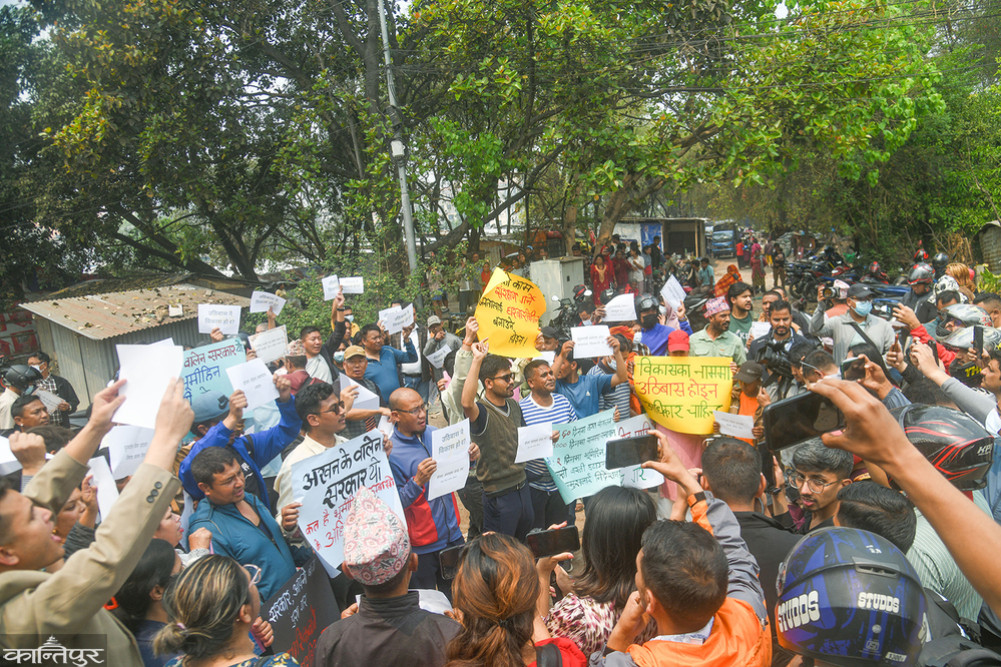
Civic leaders, human rights activists, and political parties have expressed objections to the move to evacuate the settlement.
We use Google Cloud Translation Services. Google requires we provide the following disclaimer relating to use of this service:
This service may contain translations powered by Google. Google disclaims all warranties related to the translations, expressed or implied, including any warranties of accuracy, reliability, and any implied warranties of merchantability, fitness for a particular purpose, and noninfringement.
A protest was held on Friday against the government's move to evict squatters by force. The United National Slum Front has demanded a reconsideration of the decision, saying that the government's removal of squatters through security agencies without alternative arrangements would violate human rights.
As preparations are underway to remove the squatters, Nepal Police has arrested Slum Front acting president and UML leader Narayan Pariyar (Parishrami). Kathmandu Police claims that he was arrested on charges of banking offenses and that it has nothing to do with other government actions.
Senior advocate Raju Chapagain says that the government is following the wrong path of using force by ignoring the rules and procedures in resolving the squatter problem. ‘He (Prime Minister Balendra Shah) had agreed with the Land Commission to get the squatters certified when he was mayor, but he never did that,’ he told Kantipur. ‘He went to the settlement with a dozer at once, and a case was filed against him in the Patan High Court.’
Chapagain, who was also an advocate in this case filed in 2080, recalls that the court had ordered the settlement not to be removed without certification. ‘The court had given six months for certification at that time, two years have passed, but nothing has been done,’ he added. ‘The Right to Housing Act, the Land Act, the Constitution and international legal obligations also say that their management should be done, and the way to do that is through study and certification.’
Senior advocate Chapagain says that the state should decide through a process of study how many squatters are there and how many are not, and then decide whether to provide them with rehabilitation or use proportional force to actually remove them. ‘Now they are saying to first verify by sitting down and doing sit-ups, that is not the legal way,’ said Chapagain.
Even Gen-G leaders have opposed the government’s attempt to clear the squatters. They have reminded the statement made by Rashtriya Swayamsevak Sangh (RSS) President Ravi Lamichhane himself that if the government uses a dozer, he will come first to beat his chest.’ They have also filed a petition in the Supreme Court against that.
Ten people, including Gen-G leaders Tanuja Pandey and Majid Ansari, who are also lawyers, have filed a writ petition against the government’s move. ‘We have filed a petition saying that the decision to remove the squatters without consulting the affected families and providing safe rehabilitation is illegal,’ said Pandey.
Even when he was the mayor of Kathmandu Metropolitan City, Balendra Shah had tried to remove the squatters. However, he did not receive support from the federal government. On 12 Mangsir 2079, there was tension with the locals when Kathmandu Metropolitan City tried to clear the squatter settlements in Thapathali. At that time, 36 people, including the chief of the municipal police force, Raju Pandey, were injured. Balen's plan could not succeed as the Nepal Police did not cooperate. Later, he had requested cooperation in the campaign to remove the squatter settlements when he was the home minister from Narayan Kaji Shrestha to Ravi Lamichhane.
However, when Lamichhane was the home minister, the ministry had said that 'the entire problem should be resolved with sufficient preparations by completing the legal process, holding necessary discussions and coordination with all the stakeholders'. Now, Shah has become the prime minister from the Rashtriya Swayamsevak Sangh (RSS), where Lamichhane was the president, and is trying to take forward the work that could not be completed when he was in the metropolis.
The government's '100 agendas for governance reforms' made public after Shah became Prime Minister, states that the collection and verification of integrated digital data of landless squatters and unorganized settlements across the country will be completed within 60 days. To solve the problem of landless squatters and unorganized settlements within a thousand days, it is said that a household survey will be conducted in coordination with the local level, clear criteria will be implemented for identifying real beneficiaries, and records of public announcements and Guthi lands will be updated. The agenda mentions 'Preparing a GIS-based digital database, providing land to identified real squatters in phases or alternatively making arrangements for rehabilitation through integrated housing in dense urban areas.'
However, within a month of leading the government, Prime Minister Shah had instructed the security chiefs on Wednesday to start preparing to evacuate the squatter settlements. After Sudhan Gurung resigned after being embroiled in a share investment dispute, the Home Ministry is now under the Prime Minister.
Prime Minister Shah claims that the relocation is being carried out safely, taking into account humanity, without using force, in a risky situation on the banks of the Kathmandu river. 'We have not forgotten the promise I made in Jhapa as a candidate, the commitment written in the manifesto of the Rashtriya Swayamsevak Sangh as a senior leader, and the 100 tasks that the government elected as the Prime Minister must do (point 91 of managing squatters and point 92 of preventing encroachment and occupation of government land),' he said on social media Facebook. 'We are preparing internally to fulfill those promises. Apart from the banks of the Kathmandu river, there are thousands of other families who are really suffering. And there are millions of squatters across the country. The problems there and here are completely different. We are in the government, we will separate the encroachers and the squatters.'
While carrying out the work we tried to do as mayor, the government has not coordinated much with the Kathmandu Metropolitan City. Kathmandu Metropolitan City spokesperson Naveen Manandhar says, ‘The government has sent the letter, but we have not been informed about how to do it and where to keep it.’ Stating that the metropolis was trying to do the same thing even when Shah was the mayor, he said that the city police will be mobilized as needed.
According to the report of the empowered Bagmati Civilization Integrated Development Committee, the number of landless squatters and unorganized settlers in Kathmandu Metropolitan City alone is 2,245. Project Director Machakaji Maharjan says that efforts have been made to evict unorganized settlers in the Kathmandu Valley for a long time, but they have not been successful. ‘Since we live in risky places, there was always a fear of floods, so we have always been trying to evict them during the rainy season,’ he told Kantipur. ‘We had even built a house in Ichangu, Nagarjuna Municipality for management.’ Maharjan says that only a space that can accommodate 45 people is available in that house now. "The ashram has also used other structures, and they can be arranged to stay if they want," he said.