A fact-finding study presented by FWLD advocate Dipesh Shrestha states that most housewives are victims of violence, with family members, relatives, neighbors, and husbands being the perpetrators, and a significant number of service providers also committing violence.
We use Google Cloud Translation Services. Google requires we provide the following disclaimer relating to use of this service:
This service may contain translations powered by Google. Google disclaims all warranties related to the translations, expressed or implied, including any warranties of accuracy, reliability, and any implied warranties of merchantability, fitness for a particular purpose, and noninfringement.
Despite the provision of respectful maternity services under the Safe Motherhood and Reproductive Health Rights Act, pregnant women continue to be victims of abuse and violence, a study has shown. A study conducted by the Forum for Women, Law and Development (FWLD) has shown that more than one-third of women experience abuse, violence and rights violations during pregnancy, childbirth and postpartum.
The fact-finding study presented by FWLD advocate Dipesh Shrestha states that most housewives are victims of violence, family members, relatives, neighbors and husbands are the perpetrators, and service providers also commit violence in a significant number of cases. Emotional violence has been found to account for more than one-third of emotional, physical and sexual violence. The fact-finding study has shown that there is more violence against women in urban areas than in rural areas, and that pregnant women in Madhesh and women in the Far West suffer more emotional violence during pregnancy and postpartum.
According to Shrestha, the fact-finding mission was to identify and document in detail the nature of various types of abuse, violence and rights violations faced by women during pregnancy, childbirth and postpartum in Nepal. He said that the study will also help to improve and revise laws, policies, plans and programs to create a situation where women can enjoy this situation with self-respect.
The fact-finding mission was conducted on 1,680 pregnant, 560 postpartum and 560 postpartum women living in metropolitan cities, sub-metropolitan cities, municipalities and rural municipalities. According to Advocate Shrestha, the study was conducted in 28 municipalities in 14 districts of 7 provinces. 60 women (20 pregnant, 20 postpartum within 42 days and 20 postpartum within 3 months) from each municipality were involved in the study. 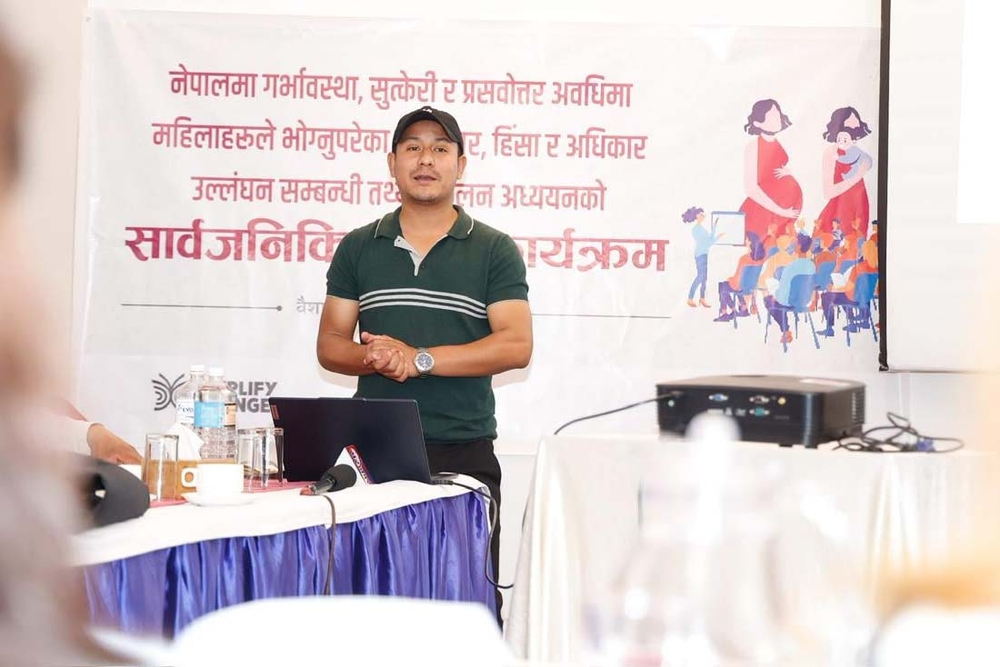
The data shows that 38.4 percent pregnant, 37.9 percent postpartum and 35.9 percent postpartum women have experienced violence. Similarly, 30.7 percent of pregnant, 32.7 percent of postpartum and 30 percent of postpartum women experienced emotional violence. Similarly, 4.5 percent of pregnant, 3.2 percent of postpartum and 4.5 percent of postpartum women experienced physical violence and 16.1 percent of pregnant, 9.5 percent of postpartum and 16.4 percent of postpartum women experienced sexual violence.
Family members and relatives are the most common perpetrators of pregnancy, childbirth and postpartum violence. The study showed that 60 percent of pregnant, 64.4 percent of postpartum and 71 percent of postpartum women experienced violence from family members and relatives.
52.1 percent of pregnant, 44.9 percent of postpartum and 47.47 percent of postpartum women were found to have been subjected to violence by their husbands. Similarly, data shows that 26 percent of pregnant women, 22.7 percent of postpartum women, and 13.4 percent of postpartum women are subjected to violence by service providers.
Sankhuwasabha and Morang in Koshi Province, Siraha and Dhanusha in Madhesh Province, Kathmandu and Makawanpur in Bagmati Province, Lamjung and Kaski in Gandaki Province, Kapilvastu and Dang in Lumbini Province, Mugu and Surkhet in Karnali Province, and Kailali and Dadeldhura districts in Sudurpaschim were selected as the study areas.
Permission was obtained from the Nepal Health Research Council before the study. Then, a questionnaire was prepared focusing on the 7 principles of respectful maternity care in accordance with the White Ribbon Alliance. According to Advocate Shrestha, the study was conducted through trained human resources. The study was conducted from October to December 2025.

