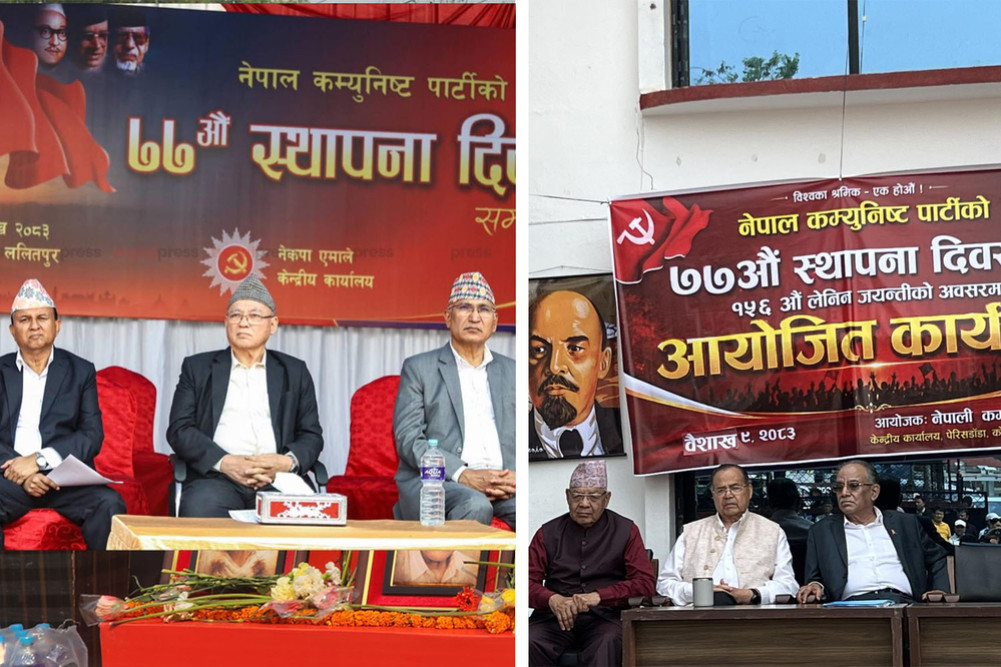
Communist parties, which had forgotten the grassroots class when public opinion was strong in parliament, have started advocating for unity after being removed from power.
We use Google Cloud Translation Services. Google requires we provide the following disclaimer relating to use of this service:
This service may contain translations powered by Google. Google disclaims all warranties related to the translations, expressed or implied, including any warranties of accuracy, reliability, and any implied warranties of merchantability, fitness for a particular purpose, and noninfringement.
The Nepali communist movement has reached its weakest point in the 77th year since its inception. When public opinion is strong, Nepali communists, who do not understand the importance of unity, have started standing in favor of unity.
UML and Nepali Communist Party leaders have started speaking in favor of leftist collaboration or unity. When public opinion is strong in parliament, communist parties that forgot the basic class have started advocating unity after they were out of power. Analysts have said that the consciousness of unity has been awakened after the communists in Nepal lost power. UML and NCP leaders have started speaking publicly about the need for communist unity.
Even though UML and Maoist Prachanda formed a government with a majority in the 2074 elections, they could not last long. The NCP split within about two years after the party unification. After the defeat in the last election, they have started seeing the need for leftist unity.
NCP coordinator Pushpa Kamal Dahal emphasized the need for leftist reorganization on the NCP Foundation Day. ‘The left needs to be reorganized. There is an opportunity to lead the reorganization,’ he said at the NCP central office in Parisdanda.
He said that there is an opportunity for reorganization among the left forces when public opinion has kept them out of power. ‘Unity among all left and communist forces that carry the goal of socialism and communism has become a historical necessity today to advance the Nepali revolution and build an egalitarian society by ending all kinds of discrimination,’ Dahal said. ‘History has proven that only the communist movement can truly protect the rights of neglected and oppressed communities and national independence.’ Therefore, the responsibility of Nepali communists to advance the revolution in favor of the common poor, farmers and working people while protecting the achievements of the past sacrificial struggle has increased.’
While informal talks were being held between the leaders of the UML and the NCP for cooperation, Dahal publicly called for the reorganization of the communist movement. ‘To fulfill this responsibility entrusted to us by history, I sincerely appeal to everyone for the overall reorganization of the Nepali communist movement by synthesizing the first pamphlet and manifesto of the Nepal Communist Party and the ideas developed thereafter,’ he also pointed out the need for unity among the parties to the peace agreement. ‘I would like to emphasize that unity among all forces supporting the peace agreement and the democratic republic is indispensable to protect and develop the achievements gained through the struggle of the Nepali people.’
The UML had scheduled a program for Chairman KP Sharma Oli to address the NCP Foundation Day at the party central office in Chyasal, Lalitpur. He was unable to attend the program due to health reasons as he was undergoing treatment for a stone at his residence in Gundu, Bhaktapur. However, Acting Chairman Ram Bahadur Thapa, while relaying Chairman Oli's message, said that the time has come for the communists to introspect, transform and unite to resolve for a new victory.
'It is time for the communists of Nepal to introspect, transform and unite and resolve for a new victory,' he said. 'The socialist movement has suffered a major setback. The communists of Nepal are seriously reviewing. It is necessary to defeat the right-wing and opportunism externally and internally.'
General Secretary Shankar Pokharel says that it is time for revival and reorganization because the left in Nepal is power-oriented. 'The power-oriented and centrist mentality must be changed. We must turn ourselves towards the people. We must win the hearts of the people,' he said. 'When talking about the party's revival and reorganization, we all must resolve. We are no longer towards the center, but towards the people. We should be people-oriented, not power-oriented.'
Analysts said that the left movement is in extreme crisis due to power interests. CPN United's acting chairman and analyst Ghanshyam Bhusal said that there is disappointment and confusion in Nepal as the Communist Party of Nepal has completed 77 years of its establishment. He said that the resurgence of the consciousness of left unity among the UML and CPN leaders after the defeat is a manifestation of the loss of power.
'When the CPN has completed 77 years of its establishment, there is disappointment and confusion,' he said. 'Talking about left unity after losing power is like announcing the end of the left.'
He said that if the left is to be polarized, there should be a serious discussion about the upcoming movement. 'We cannot say that we should unite the left just because we lost power. Let's discuss the left movement.'
The left parties have reached a very weak state according to the latest election results. Out of the 275 seats in the House of Representatives, UML and Nepali Communist Party have won only 42 seats.
In the proportional representation, UML has won 1,455,885 votes, or a total of 13.44 percent, and the NCP has won 811,057 votes, or 7.49 percent. In this election, the left wing has won only about 21 percent.
In 2074, UML and Maoists had won almost two-thirds (174) seats. In the proportional representation, the two parties had won about 47 percent of the votes. Similarly, in the 2079 election, they had won about 42 percent of the votes.
16 cracks in communism
With the establishment of the Nepal Communist Party in 2006, founder Pushpalal Shrestha had dreamed of class struggle, equality, socialism and a communist system. Ideological differences had begun within a few years of the establishment of the NCP. The NCP split from the general convention held in Banaras, India in 2019. The NCP split for the first time after Kesharjung Rayamajhi, Shambhuram Shrestha and DP Adhikari were prosecuted from the general convention.
After a dispute broke out between the then general secretary Tulsilal Amatya and senior leader Pushpalal Shrestha, Pushpalal organized the 'Third Conference' in Gorakhpur, India in June 2025. Pushpalal's party was influenced by Mao, Chairman of the Communist Party of China. The mainstream NCP adopted the policies of the Russian Communist Party. Communist parties had already started forming into individual groups. Small communist groups such as the Workers' and Peasants' Congress (2030), the Communist Ekta Sampark Samiti Nepal (2030), the Proletarian Revolutionary Organization (2033) and the Mukti Morcha Group (2033) had already started to emerge.
In the 2030s, the communist movement in Nepal had already split into small groups. After the Jhapa rebellion in 2028, the ‘Coordination Center’ (KOK) was formed.
When the Communist Party was in a divided state, efforts for unity were started by forming a central nucleus in 2028 Mangsir with the active participation and participation of leaders including Manmohan Adhikari, Shambhuram Shrestha, Mohan Bikram Singh and others. Despite talks and discussions with Pushpalal for unity, an agreement could not be reached. In 2031 Bhadra, the Fourth General Conference was organized in Varanasi, India under the leadership of Mohan Bikram Singh. Rather than maintaining unity, it created another division in the NCP by forming new groups. Which was named the NCP (Fourth General Conference) under the leadership of Mohan Bikram Singh.
2042 Division in NCP Mashal, NCP Mashal was formed under the leadership of Mohan Vaidya and NCP Masal was formed under the leadership of Mohan Bikram Singh. The CPN (ML) did not recognize the Fourth General Convention, saying that it had divided the CPN. The Fourth National General Convention of the CPN (ML) was organized from Bhadra 9 to 14, 2046 in Bishnupurkatti, Surrey Ambas, Siraha.
On Poush 22, 2047, the CPN (ML) and the CPN (Marxist) united to form the CPN (UML). The communists remained the mainstream in Nepal. After the restoration of democracy, the CPN (ML) and the CPN (Marxist) formed the CPN (UML), and the 'People's Multi-Party Democracy' (JABAZ) put forward by Madan Bhandari established the UML as a major force in the parliament. In 2054 BS, the party split and the CPN (ML) was formed under the leadership of Bamdev Gautam, but after some time, Gautam and he returned to the UML.
2047 The CPN Mashal led by Pushpa Kamal Dahal, the CPN Chaum led by Nirmala Lama, and the proletarian workers' organization of Ruplal Bishwakarma united to form the CPN Ekta Kendra. Which started a 'people's war' under the name of CPN (Maoist) from 1 Falgun 2052 and fought a 10-year war. After the people's movement of 2062/63, the Maoists entered mainstream politics, but after entering the peace process, this force was not immune to division. In Asad 2069, expressing dissatisfaction with the peace process, a large section of them, led by the then Vice President Mohan Vaidya, separated from the Maoists and formed the Revolutionary Maoists.
The biggest success of the communists in the history of Nepal was achieved by the UML and Maoist alliance in the 2074 general election. Which managed to win 174 seats out of 275 seats. In Jestha 2075, the UML and the Maoist Center formed the 'Nepal Communist Party (NCP)'. There was a power struggle between the two chairmen of the NCP, KP Sharma Oli and Pushpa Kamal Dahal.
While the dispute was raging in the NCP, the Supreme Court's decision on a petition filed regarding the NCP on 23 Falgun 2077 nullified this unity. After that, the UML and the Maoists returned to their previous status. Due to disputes within the UML, the NCP (Unified Socialist) was formed in Bhadra 2078 under the leadership of Madhav Kumar Nepal. Although the Unified Socialist participated in the 2079 election and won 10 seats directly, it could not become a national party. In the third week of Kartik 2082, the Maoist Center and the Unified Socialists united. In the election held on Falgun 21, the NCP won only 17 seats. 16 communist parties were registered with the Election Commission for the purpose of the Falgun 21 election.
Communist parties registered with the Election Commission and their key officials
1. Communist Party of Nepal (Unified-Marxist-Leninist) – KP Sharma Oli
2. Communist Party of Nepal – Pushpa Kamal Dahal
3. Communist Party of Nepal – Lok Narayan Subedi
4. Communist Party of Nepal (Marxist-Leninist) – Chandra Prakash Mainali
5. Communist Party of Nepal (Marxist) – Ambika Prasad Baib
6. Communist Party of Nepal (Maoist) – Ram Narayan Prasad Pant
7. Communist Party of Nepal Marxist (Pushpalal) Mandhwaj Gurung
8. Communist Party of Nepal (Democratic) – Sudip Ruwali
9. Communist Party of Nepal (United) – Ghanshyam Bhusal
10. Communist Party of Nepal (Gauravshali) – Bhavishwar Parajuli
11. Communist Party of Nepal Maoist Socialist – Karnajit Budhathoki
12. Nepal Communist Party Parivartan – Jogman Lama
13. Nepal Communist Party Maoist – Nekra Bikram Chand
14. Nepal Workers and Peasants Party – Narayanman Bijukchhe
15. National Janamorcha – Chitra Bahadur KC
16. Janata Janabadi Party – Sandhya Tiwari