The Nepali-speaking community is increasingly displaced from Manipur due to ongoing protests, clashes, and violence following the death of two children on April 7.
We use Google Cloud Translation Services. Google requires we provide the following disclaimer relating to use of this service:
This service may contain translations powered by Google. Google disclaims all warranties related to the translations, expressed or implied, including any warranties of accuracy, reliability, and any implied warranties of merchantability, fitness for a particular purpose, and noninfringement.
Violence has flared up again in the northeastern Indian state of Manipur, which has been in turmoil for nearly three years. The violence in Manipur has resumed after two children were killed. The conflict between the local Meitei and Kuki-Naga communities has also affected thousands of Nepali-speaking communities living there.
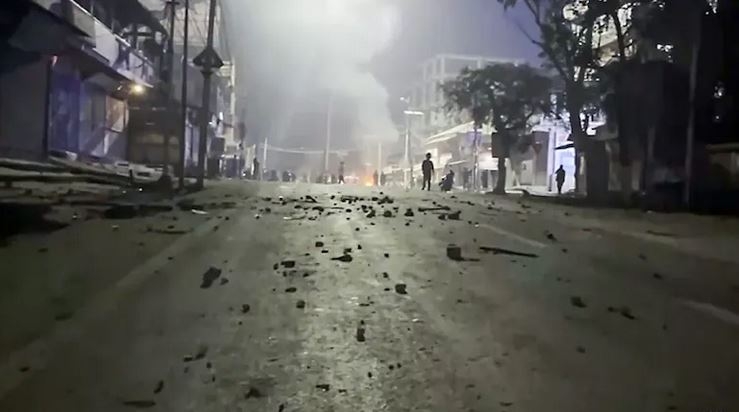
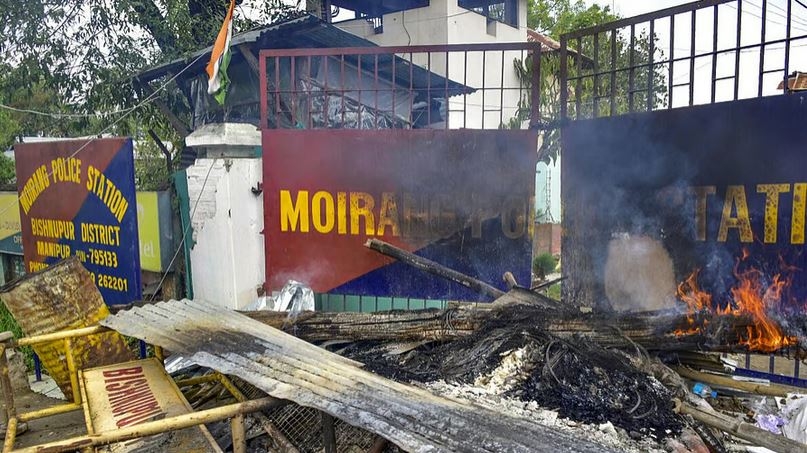
The angry crowd was further incited by unconfirmed rumors on social media that suspicious armed men were roaming around. A week later, on April 14, clashes broke out between protesters and security forces. According to the Bishnupur district administration, a 5-year-old boy and a 6-month-old girl were killed on the spot when a suspected armed group hurled a bomb at a house in the Moirang Tronlaobi area on April 7. Their mother was seriously injured. The area borders the lower reaches of the country, where the indigenous Manipuri (Meitei) community is predominantly located, and Churachandpur district, where another tribal community, the Kuki, is predominantly located.
Locals took to the streets to protest the deaths of the children. According to Reuters, citing Home Minister Govindadas Konthoujam, two civilians were killed in a shootout with security forces during the protest that day. The angry crowd was further agitated after unconfirmed rumors of suspicious armed men roaming around spread on social media. A week later, on April 14, clashes broke out between protesters and security forces.
The administration had to issue a curfew order to control the situation. The locals' protests have not stopped. More than 20 protesters have been injured in clashes with security forces and some have been arrested. The administration has issued curfew orders in Bishnupur, Imphal West, Imphal East, Thoubal and Kakching districts. The government has also extended the ban on mobile internet and data services (including VPNs) for another 48 hours to prevent the spread of rumors on social media. Chief Minister Yumnam Khemchand Singh, in a message on Friday, appealed to the protesters to maintain social harmony.
About 60,000 Nepali-speaking (Gorkha) communities live in Manipur. They are not for or against this violence. But they are not completely safe either.
According to Shiva Kumar Basnet, former Pradhan Panch of Kanglatumbi village, more than 10,000 Nepali-speaking people have been displaced from Manipur in the past 10 years. He says that the rate of displacement has increased further after the latest violent movement. He says, ‘All those who are there are living in fear.’ Basnet says that the Nepali (Gorkha) community has been the target of the wrath of the Maitei, Naga and Kuki communities. According to Shyam Kumar Chhetri, another social activist from Manipur, Nepali settlements in areas such as Kalapahad, Irang, Purau Valley and others are being emptied. ‘Now only about 20 percent of Nepali-speaking people remain in those villages,’ he says. The conflicting groups have been taking away Nepali livestock, demanding unnecessary donations, and obstructing businesses.
Dozens of shops run by Nepali speakers were burnt down in February. ‘No one is safe in Manipur at this time,’ said social activist Arjun Jogi, ‘We never know what will happen.’ According to him, conflict has recently broken out between the Naga and Kuki communities. A Kuki was killed in a Naga village on Saturday. According to Kamala Ghatani, a Nepali speaker from Manipur, the renewed violence has disrupted business and life. ‘We have not been able to do business safely for three years,’ she said. ‘Recently, a video of a Kuki being killed has gone viral on social media. Now there is a possibility of renewed violence.’
The violence was not caused by a single incident but was the result of decades of distrust and division between the Maitei and Kuki-Naga communities. The latest trigger was the High Court's recommendation. Violence has been ongoing in Manipur, considered one of the most sensitive states in India, for a long time. This violence was not caused by a single incident, but is the result of decades of distrust and division between the Meitei and Kuki-Naga communities. The latest factor in this was the recommendation of the High Court. In April 2023, the High Court ordered the government to consider including the Maitei community in the Scheduled Tribes (ST) list. The indigenous Kuki and Naga communities living in the hilly region protested, saying the order would jeopardize their rights and land.
On 3 May 2023, clashes erupted after protests and counter-protests. Communal violence erupted between the majority Maitei community living in the Imphal Valley, the capital of Manipur, and the indigenous Kuki-Naga community living in the hilly region. According to government figures, as of November 2024, about 258 people had died. More than 60,000 were displaced. About 1,000 were injured. 4,786 houses were burnt down. 386 religious structures, including temples and churches, were destroyed.
After the prolonged violence failed to stop, the Indian government imposed President's rule on 13 February 2025 to control the situation. Before that, the then Chief Minister N. Biren Singh had resigned. About a year later, on 4 February 2026, President Draupadi Murmu removed President's rule. After that, a new government was formed under the leadership of Bharatiya Janata Party assembly member Yumnam Khemchand Singh.
However, even after the change of government, peace has not been restored in Manipur. Last time, Union Home Minister Amit Shah visited Manipur and called for talks between the conflicting parties, but both sides completely rejected it. 'The crisis of trust is so deep that the door to dialogue has not even opened,' said a human rights activist from Manipur. The land management law in Manipur has also increased inequality. The Meitei are barred from buying land in the hilly areas. However, there is no such ban on the Kuki and Nagas in the valley. Another root cause of the Manipur conflict is state power. The Meitei community controls about 40 seats in the 60-member assembly. They have political power, but no reservation facilities.
On the other hand, the Kuki and Naga communities have been getting reservations, but they are geographically limited. When the Meitei also demanded tribal status, the Kuki side interpreted it as an ‘attempt to usurp power’, which has led to the current violence. The conflict is not only ethnic but also religious. The Meitei community is mainly Hindu, while the Kuki and Naga are Christians. In a way, it looks like a conflict between Hindus and Christians. Religious polarization has deepened distrust.
The violence has taken another dangerous form, militarization. Thousands of weapons were lost from government stores during the previous violence. The weapons looted at that time are being used openly. Both sides have been accusing each other of external support and collusion with armed groups. There have also been allegations that the Naga/Kukis are being operated by armed groups from Myanmar across the border. India has been fencing its border with Myanmar in Manipur since July last year to prevent foreign infiltration following the violence.
The fencing was carried out in line with the government's policy of controlling cross-border movement after the government scrapped the 'free movement regime'. However, Naga and Kuki community organizations are protesting, saying the move will affect ethnic and family ties across the border.

