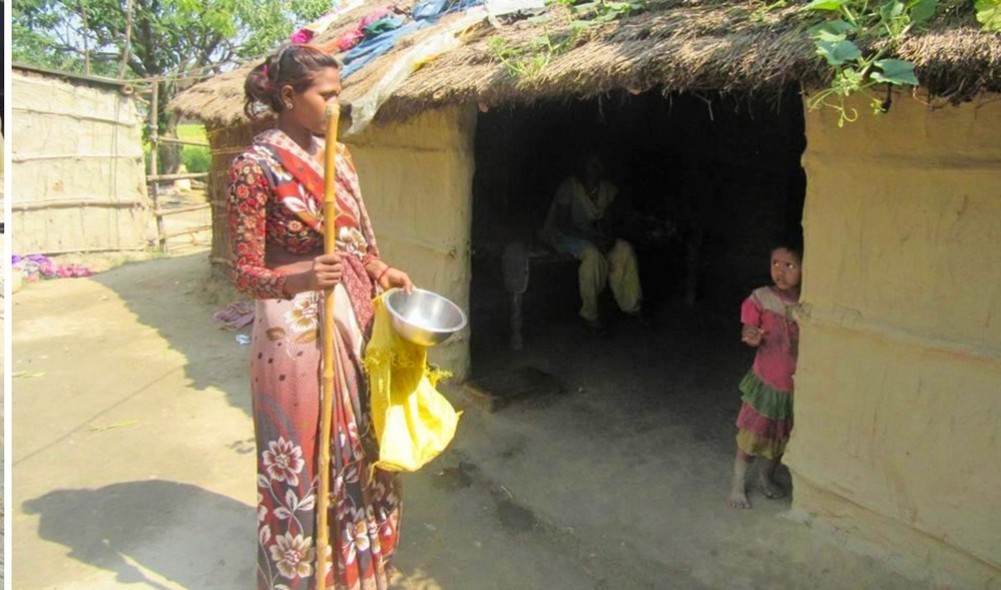
The life of the endangered Netuwa tribe in the district is difficult. They are poor and have not seen the face of school. They do not have ancestral property. Even now, they are making a living by begging every day. Apart from begging, they are catching snakes, extracting honey and living a nomadic life, moving from village to village.
We use Google Cloud Translation Services. Google requires we provide the following disclaimer relating to use of this service:
This service may contain translations powered by Google. Google disclaims all warranties related to the translations, expressed or implied, including any warranties of accuracy, reliability, and any implied warranties of merchantability, fitness for a particular purpose, and noninfringement.
The main job of 50-year-old Shubhawati Netuwa from Dhupahi in Mayadevi Rural Municipality is to collect food and water by visiting the surrounding settlements. She does not have a single plot of land to grow her own food. She cannot live without food. Therefore, she makes a living by collecting food and water from the villages. Her 30-year-old son Hiru works as a laborer. The wages he earns are enough to provide her with food in the morning and evening.
Begging has become their ancestral profession. Shubhawati has been begging and delivering food to a family of 7. She was living in a plastic tent on other people's land in the village. Some time ago, after an Indian citizen left the village, leaving behind a two-room tin hut built on 7 acres of land, the villagers gave the hut to them after consulting them.
Kamalawati Netuwa, 45, of Mayadevi-2, Abhirao, also spends her days begging from house to house. Her husband Vikram works as a laborer. The food Kamalawati begs for and the wages Vikram receives are enough to feed a family of six. They have built a house on the land of the village landlord. The Janata Awas program has built a two-room house. They have not been able to connect electricity due to the lack of land title deeds. They have to go around the village begging to make ends meet and have not been able to send their 4 children to school.
The life of the endangered Netuwa caste in the district is difficult. They are poor and have not seen the face of school. They do not have ancestral property. Even now, they are begging every day. Apart from begging, they are living a nomadic life by catching snakes, extracting honey and migrating from village to village.
Despite being a minority community, they have not been able to get the social security allowance provided by the government. Nayatram Netuwa, chairman of the Netuwa Development Center, said that it is sad that despite many changes in the country's political system and social life, they have not been able to give up their begging profession. 'Those who make state policies and regulations are to blame for this,' he said, 'Even in this era, we cannot even imagine begging. If we get an alternative, we are ready to give up begging.' 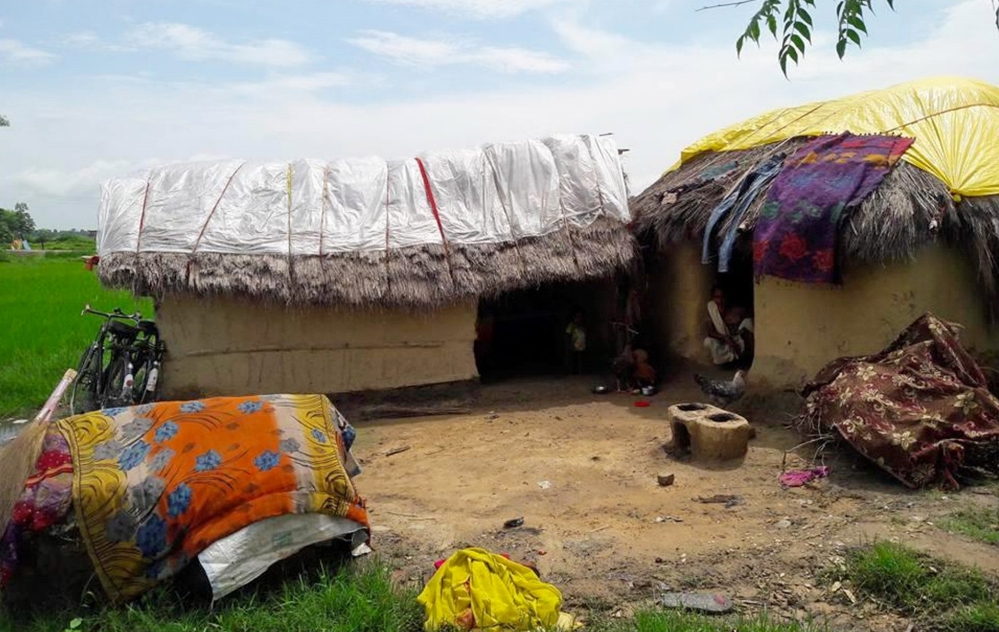 Netuwa settlement in Suddhodhan Rural Municipality-1, Kapilvastu. Photo courtesy: Sanjay Pasi.
He said that the local and federal governments have not brought any plans and programs for them. He urged them to be freed from the situation of begging by providing basic facilities. According to the 2078 census, the population of Netuwa across the country is 2,896. This comes to 0.1 percent based on the total population.
Patharkatta/Kushbadiya, who have a larger population than Netuwa, receive a monthly social security allowance. There are 3,343 Patharkatta/Kushbadiya people across the country. Netuwa leader Padit Netuwa said that the real Netuwa population may be even lower because those who write the Netuwa surname in the eastern Tarai are Muslim. “Real Netuwa are Hindus,” he said, “We have been practicing Hinduism for 5 generations.”
Based on the data from the National Census 2078, the government has included castes that make up less than 0.5 percent of the total population in the minority list. Since the fiscal year 2076/77, Kusunda, Raute, Hayu, Kisan, Meche, Vanakaria, Surel, Raji, Lepcha and Kusbadiya/Patharkatta have received social security allowance. The monthly social security allowance, which started at Rs 3,000, has now reached Rs 3,990.
Apart from senior citizens, Article 43 of the Constitution of Nepal 2072 BS provides that the economically disadvantaged, disabled and helpless, single women, disabled people, children, citizens of endangered castes who cannot take care of themselves and others have the right to social security as per the law. 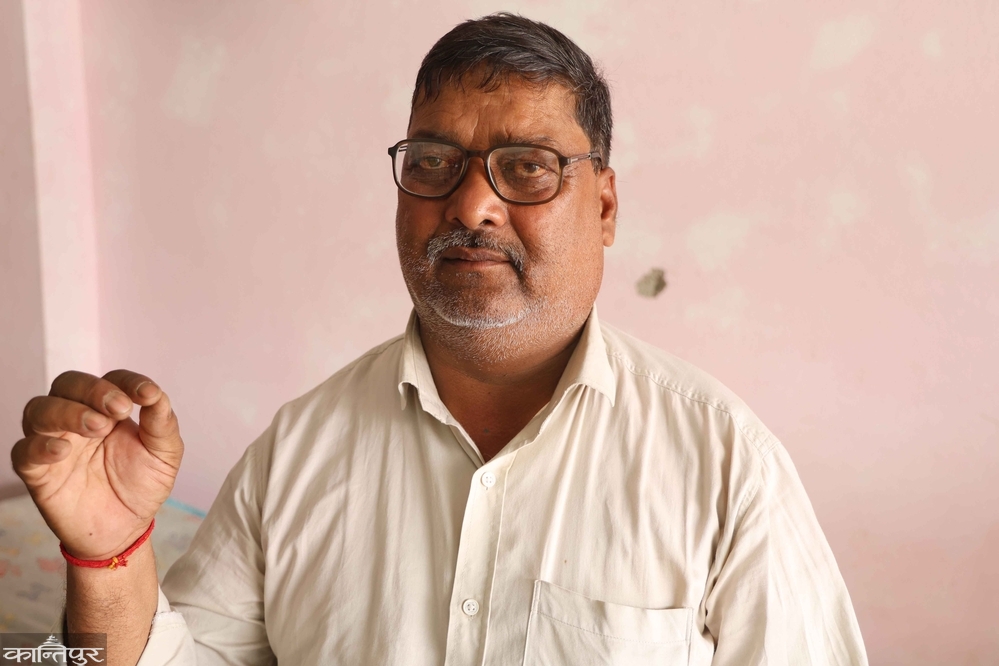 Nayatram Netuwa of Mayadevi Rural Municipality-2, Mankhoriya, Kapilvastu.
Netuwa rights activist Sanjay Pasi said that it is unfortunate that no plan has been brought for the transformation of the caste, which has adopted the ancestral profession of begging for a living. ‘When people of the Netuwa caste beg, everyone looks at them with a bad eye, talks about them and abuses them,’ he said, ‘But, since there is no alternative, we are forced to endure such abuse for our own sake.’
Netuwa have been living in the district for eight generations. They have been living in slums, slums and squatters. There are 113 houses of the Netuwa community in 6 local levels of Kapilvastu. There are 530 people. Similarly, there are 219 in 33 houses in Rupandehi. All of them have thatched houses, mud/brick walls, tin roofs and two have sloping houses. No one has any land for farming. Most of them have citizenship based on their lineage. They can barely afford to eat sweets and wear them. They have no source of income. How much do they earn by begging? They barely have enough to eat. It is difficult to change new clothes and take medicine. Building a good house has become a dream. Even now, they have not been able to give up the profession of begging. Still, about 80 percent of them make a living by begging.
However, when their grown-up daughters and daughters-in-law go to beg, some people tease them, use abusive language and look at them with a bad look, which hurts them, said Prahlad Netuwa of Abirao. However, he said that some people have to endure the same work even if they do not earn a living without begging. The profession of catching snakes is also not risk-free. Snakes are not always found. They are seen more during the rainy season. They say that they can earn two to four hundred rupees by catching a snake.
Chandrika Netuwa of Abirao said that the money earned by catching snakes after taking risks cannot support a family. According to her, 5 Netuwa have lost their lives while catching snakes in the village in the past 50 years. ‘The risk has increased,’ he said, ‘Netuwa are not enthusiastic about catching snakes.’ Another profession, honey extraction, is also not effective. Bee hives are not available everywhere. Even if they are found, the locals do not give them. Even with that, it is not possible to avoid the household expenses. There is no farming. There is no production. There is no education and investment to start a business. 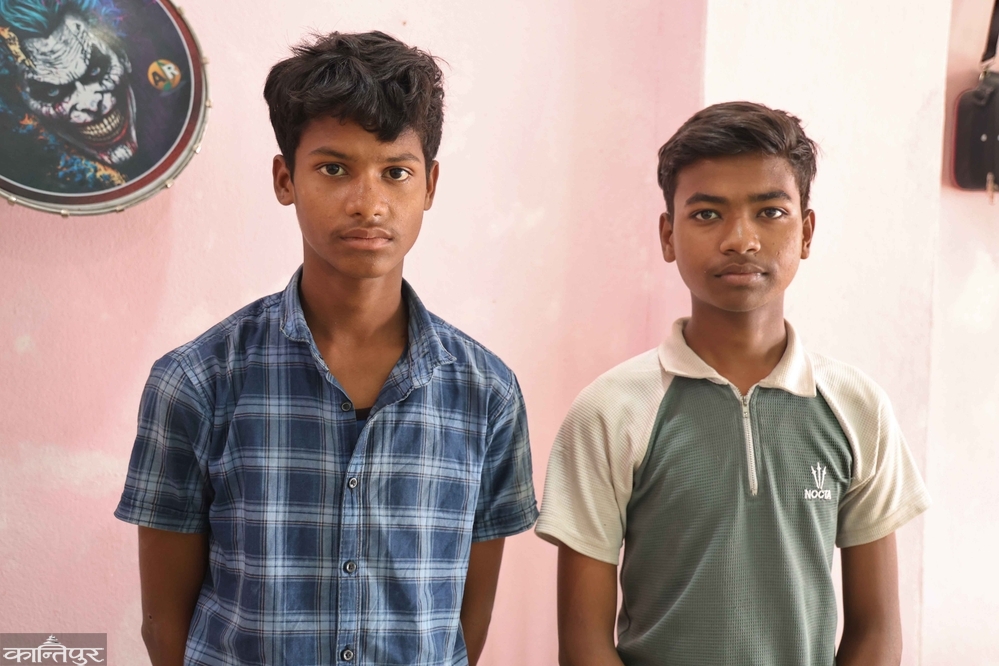 Ravi Netuwa (left) and Ashish Netuwa, who are studying in class 8.
Only one or two people in the Natuwa community have passed class 11. That is why they have to do the same old job, said Chandrika Netuwa. Despite pressure from their parents, 80 percent of the children of Netuwa have enrolled in school. However, barely 30 percent go to school regularly.
Most of the residents lead a nomadic life. They stay in their homes only during Asar/Sawan. At other times, they move around with their families. They migrate by carrying utensils and clothes on bicycles, rickshaws and carts. They find gardens and open land and make temporary huts with plastic tents. They live in them. And they satisfy their hunger by begging for food grains from villages. Their life is difficult. On top of that, sometimes the so-called elders insult them by talking about untouchability. Bhuwar Netuwa said that discrimination by not allowing them to eat and live together adds to the pain. Five Netuwa families living in Mayadevi's Abhirao have not been able to connect electricity to their homes due to lack of land titles. The land they have been living on for three generations is in someone else's name. Five people have built houses on 7/7 Dhur land. But despite their efforts of lakhs, they have not been able to connect electricity to their homes by installing meters.
Ravi Netuwa, 17, a student in class 8 at Chhatrapali Tirthadevi Secondary School in Pakdi, Mayadevi, said that he wanted to study pharmacy. ‘Our ancestral profession is not good,’ he said, ‘Now the youth should move forward with new thinking together.’ He said that even if no one makes fun of him and teases him, the common people’s understanding is wrong. Ashish Netuwa, 17, of Yashodhara-1, Tirtikha, studies in class 8. He said that he is interested in a government job.
‘There are no government employees from our community,’ he said, ‘I will become a government employee after passing class 12.’ Netuwa, deprived of the basic opportunities provided by the state, has been listed among the Madhesi Dalits. Despite having identity and tradition, the Netuwa community is economically, socially, educationally and politically backward. They have been stung by caste discrimination and untouchability. They have established the Netuwa Development Center to raise their voices for this.