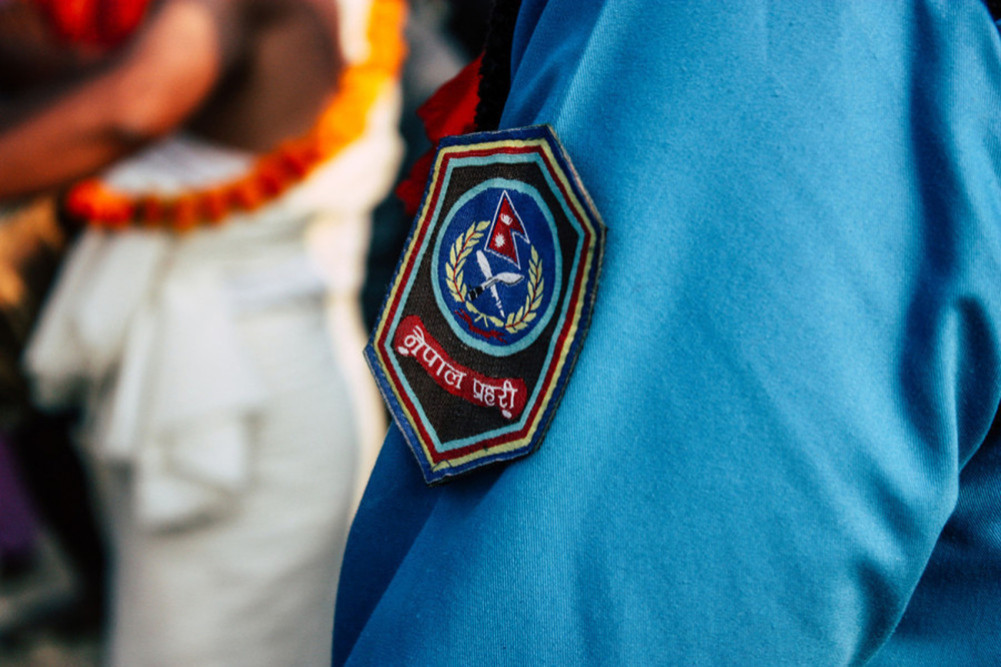
Kathmandu Police has prepared a list of only 179 people involved in hooliganism to control crime.
We use Google Cloud Translation Services. Google requires we provide the following disclaimer relating to use of this service:
This service may contain translations powered by Google. Google disclaims all warranties related to the translations, expressed or implied, including any warranties of accuracy, reliability, and any implied warranties of merchantability, fitness for a particular purpose, and noninfringement.
Kathmandu Police has prepared a 'criminal profile' of 1,097 people repeatedly involved in crime, including their criminal patterns. The list was prepared by the District Police Range, Kathmandu, with the aim of 'proactive policing' to control crime.
According to Kathmandu Police Chief SSP Ramesh Thapa, the list includes people repeatedly involved in heinous crimes and hooliganism to those accused of theft. Of these, only 179 people are involved in hooliganism. 'The names and background details of some are still being added,' Thapa said.
In the past, hooliganism flourished under the protection of political parties. They used to intimidate and threaten citizens by saying that they would settle disputes over contracts, transactions, and other matters. Their influence gradually weakened after the police started taking aggressive action in the 2070s and started looking into cases of digitization of contracts and banking offenses.
In the 2070s, after aggressive action was taken and the police started looking into cases of digitization of contracts and banking offenses, their influence gradually weakened. Some had abandoned their traditional ways and entered politics on their own. A police officer informed that the police have also included some of these old accused in their list. According to him, Chakre Milan has also been included in the list. He was a candidate from Gorkha-2 from UML in the 21 Falgun House of Representatives elections. However, he was defeated. The police had also arrested him on 15 Shrawan 082 on charges of posting videos spreading terror through TikTok. He was later released on bail.
According to an officer of the Kathmandu Police, although the tendency to spread terror by showing weapons like in the past has decreased, some are spreading terror among the citizens in a different way. The list has been prepared after identifying those people. The police officer informed that the list also includes details collected from all the police circles and divisions subordinate to the Kathmandu Police.
‘We have now made a list not only of gangsters but also of those involved in other crimes. We expect that this will help in the investigation if any crime is committed tomorrow,’ said SP Pawan Kumar Bhattarai of Kathmandu Police. ‘This list has also been prepared to keep in institutional ‘memory’ as it will be easier to investigate some incidents based on the style of crime.’
Kathmandu Police Chief Thapa says that there is a separate list of those involved in drug dealing/smuggling, theft, robbery, gambling, fraud, arms smuggling, working as middlemen in public services and criminal nuisance. ‘There is a separate list of those who steal motorcycles, scooters and other goods, we have also kept a description of their style of committing crimes,’ he said. ‘This means that if a vehicle or any other item is stolen one day, we can get an indication of their involvement in crime by looking at their style.’
The police have also prepared a list of those who oppose government policies. It also includes a list of those arrested for protesting during elections and those protesting on issues related to foreign affairs. ‘For example, when there is a high-level visit from China, there is always a group protesting, and when there is a visit from India or America, there is another group protesting, their list has been kept,’ said another officer of the Kathmandu Police, ‘This will help the police in security at any time tomorrow.’
The police in Kathmandu have been repeatedly making lists of those involved in gangsterism since 2070. In a list made by the police in 2074 BS, it was pointed out that 132 gangsters were active in Kathmandu and divided them into three categories. At that time, the police had placed 14 in category ‘A’, 32 in ‘B’ and 47 in ‘C’. It was said that the categories of 15 more people could not be revealed. At that time, Dawa Lama of Kavre, Ganesh Lama, Raju Gorkhali to Deepak Manange (Rajiv Gurung) were in category ‘A’. The Lama duo and Manange are currently active in politics.
According to police officers, complaints about hooliganism are rare. But in informal conversations, complaints of harassment from them are widespread. ‘Hooliganism has also been committed to protect some illegal activities, and even those who repeatedly engage in such activities have not been able to come under the purview of action due to lack of complaints,’ said SP Bhattarai of Kathmandu Police. ‘A list of names that appear repeatedly in such cases has also been prepared. This will help the police in crime prevention and investigation in the long term.’
Senior Superintendent of Police (SSP) Uttam Subedi, who is also the former chief of Kathmandu Police, recalls that a list of those involved in hooliganism was prepared in the past and says that it also causes psychological distress to those involved in the crime. ‘In my opinion, it would be better if such people could be directly monitored and sent to jail on the basis of the crime,’ he says, ‘otherwise, those involved in hooliganism have also changed these days, the old style may not work.’ He believes that we need to think differently, saying that those involved in hooliganism who used to walk around with weapons, long hair and a muscular body in the past have now started walking around in tight suits.
Even some current police officers say that if ‘profiles’ are prepared for crime control, they should be kept secret. ‘Such actions have been done many times before to intimidate those involved in crime, if we really want to control them, the police should take action,’ said an SSP of the Nepal Police, ‘that action should also be based on a strong legal basis, so that they do not escape the court immediately.’
Former Deputy Inspector General (DIG) of the Nepal Police Hemanta Malla Thakuri shares the same opinion. "It may be fine for a scare tactic, but if the aim is to take action, it is better to take action directly rather than making a fuss," he said. "Otherwise, when the name is made public, the common accused will be branded even more." For example, he said, Kimjong Boss, who was arrested by the police for being involved in hooliganism, could be taken. "Many people did not know him, he must have been doing petty activities," Malla said. "However, after the police arrested him and made him public, everyone recognized him." Although the police arrested him on 21 Chaitra, he was released a few days later.