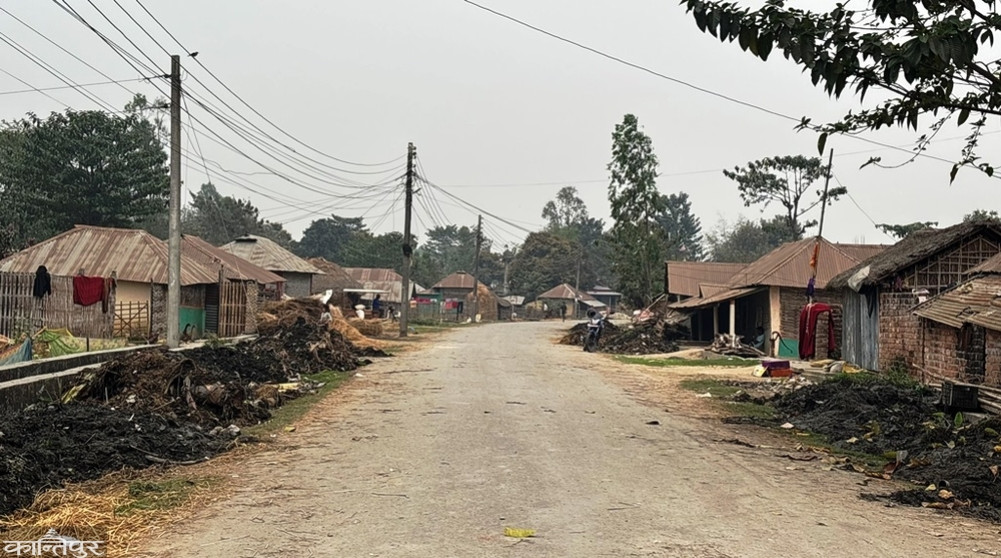
Dozens of families in the seemingly peaceful Sardar Basti of Morang Gramthan-2 are affected by high blood pressure and paralysis. More than 50 people are bedridden and crawling with the help of sticks in the settlement. The settlement itself is now in the grip of 'paralysis'.
We use Google Cloud Translation Services. Google requires we provide the following disclaimer relating to use of this service:
This service may contain translations powered by Google. Google disclaims all warranties related to the translations, expressed or implied, including any warranties of accuracy, reliability, and any implied warranties of merchantability, fitness for a particular purpose, and noninfringement.
Morang Gramthan-2 Jhorahat Bazaar is located near the capital of Koshi Province, Biratnagar. After crossing the paved road of the ward, you reach the Tharu-dominated Sardar Basti. The residents of the attractive-looking settlement are in pain.
58-year-old Jurilal Sardar here needs a cane to get around. He wants to walk, but he can't. Until a few years ago, he was a carpenter. He was skilled in making wooden items. He would play with tools all day and return home in the evening. Life was going on peacefully. There was laughter in the family.
Five years ago, he had to endure something he had never imagined in his life. While he was working, he suddenly felt as if a heavy load of wheat was pressing on the left side of his chest. Suddenly, he collapsed on the ground. His colleagues immediately took him to a nearby drugstore. From there, he was referred to the hospital. ‘Thankfully, his life was saved by reaching the hospital early,’ said Jurilal, ‘the right side of his body became paralyzed.’
Living a normal lifestyle, he did not pay attention to the increase in blood pressure. At that time, his life changed after he had an ‘attack’ of high blood pressure. Despite his skills and willpower, his body did not support him to work. The pain of not being able to work is reflected on his face.
Local 64-year-old Nepanlal Sardar has been battling paralysis for 18 years. He also cannot move the left side of his body. Due to this, he is also forced to live with the support of others. Until last year, he used to walk a little. Since this time, he has been bedridden. ‘I get Rs 8,000 as social allowance every three months,’ he said, ‘I am using that money for treatment and food.’
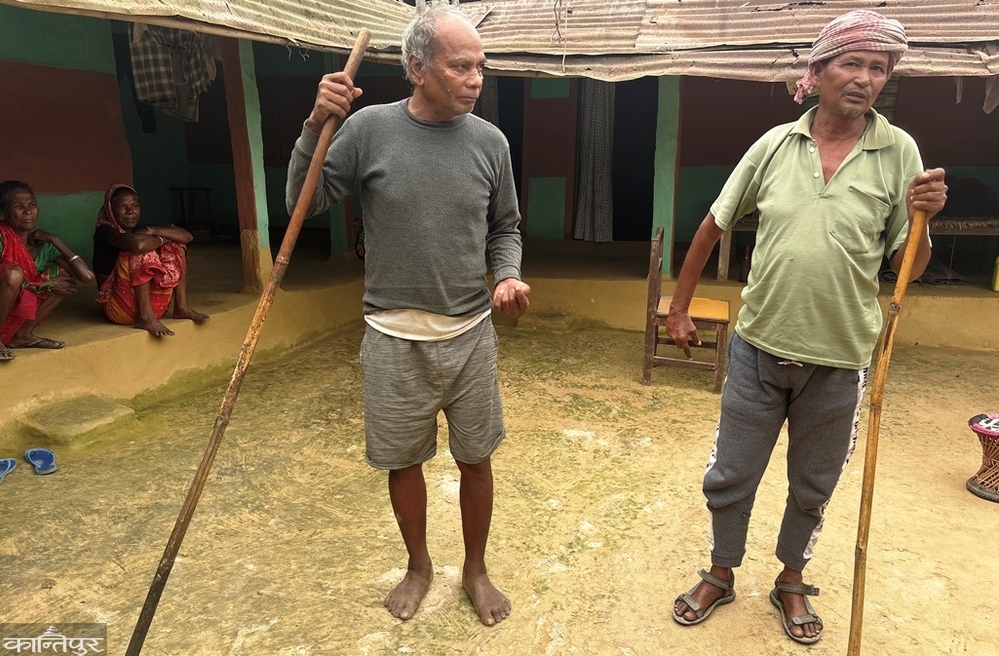
Jurilal Sardar, 58 (right) and Nepanlal Sardar, 64.’ Photo: Parbat Portal/Kantipur
According to him, three months ago, local Rasilal Sardar lost his life due to high blood pressure. Until the previous day, Nepanlal had joked with Rasilal. ‘But, the next day, I couldn’t believe the news of his death,’ he said, ‘Rasilal collapsed without even seeing him at the hospital and never got up.’ Locals say that high blood pressure was also the reason for the death of former village president Narendra Sardar.
Five years after Narendra passed away, his son Umesh also suffered in the same place. ‘Thankfully, his life was spared,’ said Nepanlal, ‘Initially, he went to Kharaiya, India, for treatment, but when he did not recover there, he went to a hospital in Biratnagar. After receiving treatment in Biratnagar, he is now much better.’
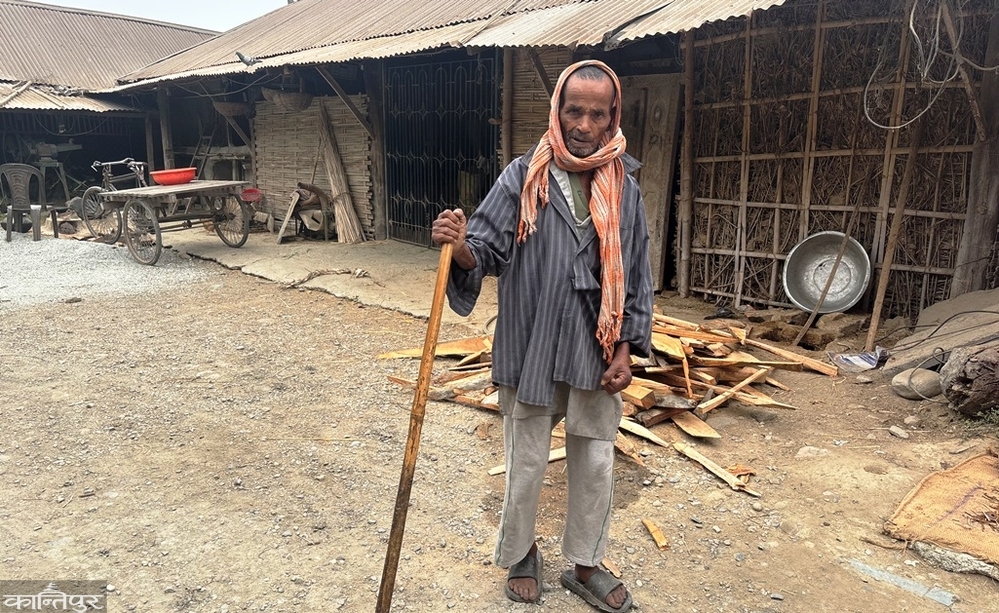
Digna Sardar, 70. Photo: Parbat Portal/Kantipur
70-year-old Digna Sardar here is also living with the help of a cane. Earlier, the Digna couple were running a tea and snack shop in the settlement. One day, Digna collapsed while serving tea to customers. ‘After that, a dark cloud began to loom over his life,’ said Mrs. Rekha Devi, ‘We used to make a living from the tea shop, we closed the shop after getting sick, now we are unemployed.’
His neighbor, 82-year-old Dukhai Sardar, has been relying on a cane for 4 years. He was earning his living by farming. Now he is not even able to farm. 'I walk around with a stick in the morning and evening,' says Dukhai, 'My son and daughter-in-law cook and feed me.'
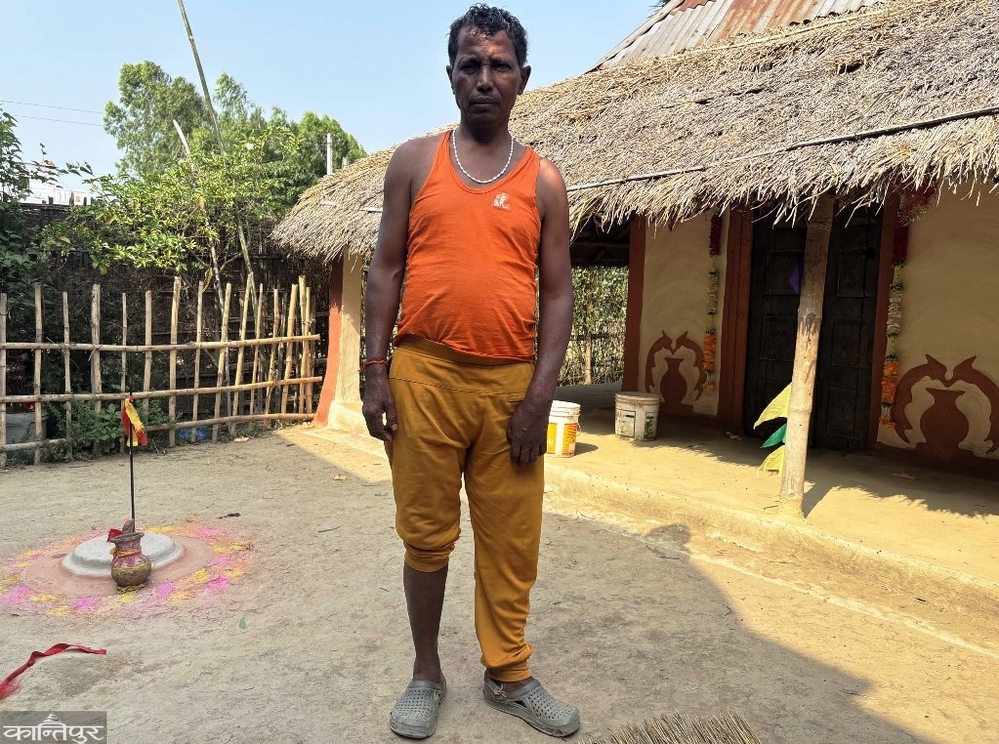
Menulal Sardar, a 53-year-old local, was a skilled tile/marble mason here. Now he is spending his days at home, remembering his old days. Three years ago, he collapsed while laying marble in a house in Kathmandu. His life was saved because the homeowner rushed him to the hospital quickly. After that, the left side of his body is not moving. 'About 1.2 million rupees were spent on my husband's treatment,' said Paro Devi, a Dalit woman member of Gramthan-2. 'At that time, he could not repay the loan taken for treatment.'
According to Paro, her husband had also lost his voice until a year ago. However, after taking Ayurvedic medicine, her speech became impaired. ‘Now she can speak with ease, but she needs support to walk,’ she said. Menulal said that she was an alcoholic before the problem arose. ‘She used to drink four to five bottles of beer a day,’ she said, ‘she would also eat meat with pleasure.’
Menulal’s aunt, 70-year-old Pudani Devi, is also facing a similar problem. She has been bedridden for 10 years. Even though there are patients with paralysis in the village, there is no health facility here for treatment. If you need to seek specialist medical care, you have to go to Biratnagar for treatment. Due to the lack of testing and control, pesticides, inedible items and adulterated substances are being used in food. Gunawati Devi Tharu, vice-chairwoman of Gramthan Rural Municipality, said that this may be the reason for such health problems in human health.
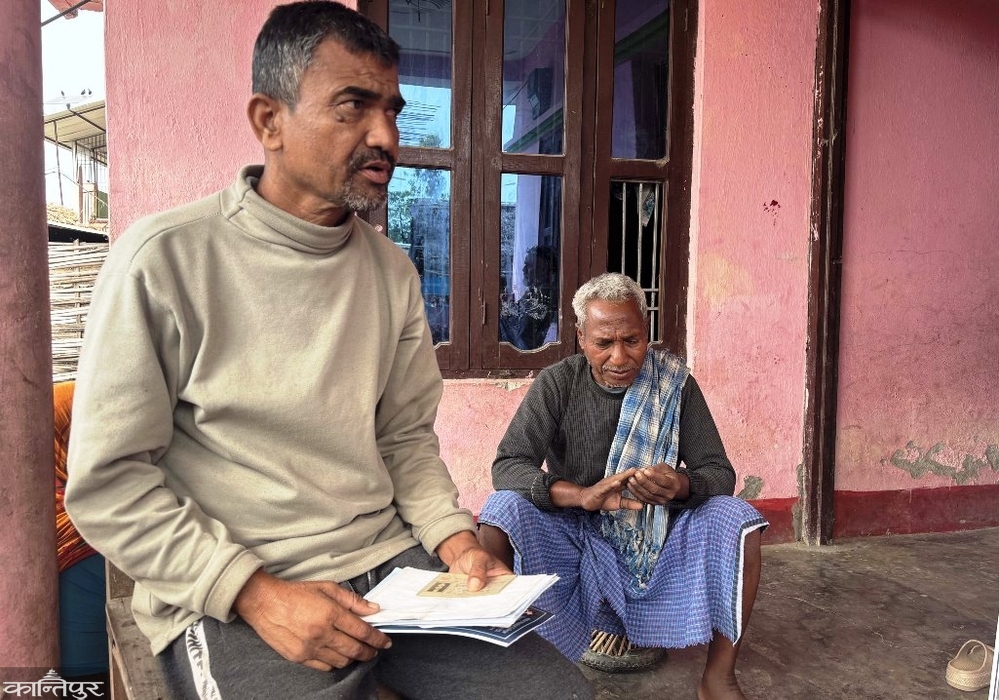
Paralysis patients Umesh Kumar Sardar and Mangal Sardar (sitting). Photo: Parbat Portal/Kantipur
The Sardar settlement is called ‘Vatarai Tole’ by locals. The settlement, which has about 300 households and a population of 1,100, looks peaceful from the outside, but the residents here are desperate for treatment. The blacktop road and the concrete temple make the village seem developed. However, if you enter the thatched huts lined up on the right and left of the road, a horrifying scene is seen.
People lying in bed and the elderly crawling with the help of sticks are found. The settlement itself is currently in the grip of ‘paralysis’. About 5 percent of the total population of the settlement, i.e. more than 50 people, are paralyzed due to paralysis. The ward office and the municipality's health department do not have accurate data on the number of patients.
Youth also suffer
This problem is not limited to the elderly in the settlement. High blood pressure and the risk of stroke due to it is increasing even among young people around 40 years old. Youths like Mailu, Suresh, Jaguwa and Ram Prasad Sardar here have been suffering for the past few months. According to local Tika Prasad Khatiwada, the risk of stroke due to high blood pressure is increasing even among young people due to unhealthy eating habits.
Ram Kumar Sardar, 46, was affected by high blood pressure at the age of 28. He was earning a living by repairing bicycles. He fell while repairing a broken bicycle 18 years ago. 'My life was saved but my whole body became disabled,' he said. 'I move around on the tricycle given to me by the donor.' He sits on it and repairs the bicycle. He said that he is earning 2-3 hundred rupees a day to feed his family.
Former Pradhan Panch Mohanlal Sardar does not look like he is 80 years old at first glance. He is the oldest person in the village. He said that he is healthy due to his healthy diet and lifestyle. ‘Like other people in the village, I do not eat anything that is harmful to my health,’ says Mohanlal, ‘I am conscious about my health.’ The lifestyle of most of those affected by the disease is chaotic. They work as wage laborers all day long. They have the habit of consuming alcohol and cigarettes in the evening. They eat chicken and pig intestines. ‘Such things are not considered healthy for the body,’ said Mohanlal. ‘People who are addicted to alcohol and cigarettes are very sick.’
Badri Chaudhary, a health worker who runs a clinic in Jhorahat, also points out the same thing. He said that the problem has also increased among the youth due to unhealthy eating habits, especially excessive meat consumption, and irregular lifestyle. ‘Lack of awareness is the main reason,’ he says, ‘There is a tendency to seek treatment only after the disease has worsened, by then it is too late.’
Most of the Sardar community are poor and illiterate. They do not have access to regular health check-ups and medication. According to Ahab Bimal Sardar, who works at Koshi Provincial Hospital, Biratnagar, most patients do not take medication regularly even after the disease is diagnosed. Instead, they are negligent. ‘The problem has become complicated by not treating it on time,’ he says, ‘They are negligent in treating it after the disease starts, and problems arise when it is hidden.’
According to the Nepal Sardar/Batar Welfare Committee, the population of this community in the 2078 census is around 250,000. They are listed in the Madhesi Dalit list and are scattered from Jhapa to Makwanpur. Most of them are dependent on wages and the standard of living is very poor.
India for ‘cheap treatment’
The residents here do not know what medicines are available free of charge at the health post in the municipality. However, the name of the ‘Rajendra Prasad Yadav Free Treatment Center’ in Manikpur Kharaiya, Bihar, India, is on their lips. Kharaiya has become the treatment destination for patients here.
Locals say that they reach Kharaiya Hospital in search of cheap treatment. However, treatment is done through injections without any scientific tests. ‘There is neither proper examination nor lab test,’ said Rajkumar Jha, the health branch coordinator of the village, ‘but people are going with faith.’
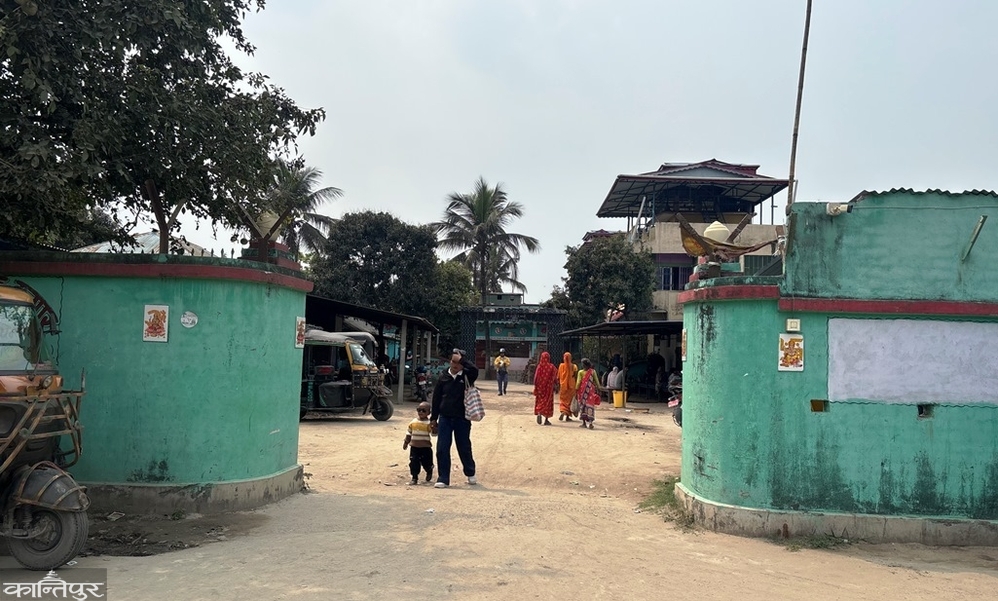
‘Rajendra Prasad Yadav Free Treatment Center’ in Manikpur Kharaiya, Bihar, India. Photo: Parbat Portal/Kantipur
According to doctors, the treatment there risks complicating the patient. ‘Many people are dying due to drug overdose,’ said coordinator Jha, ‘except for the exception, everyone dies after returning from there.’ According to him, giving strong antibiotics through a needle gives relief to the patient for a while. However, it is also fatal in the long term. According to Parul Chhetri of Biratnagar, the problem becomes serious when the medicine stops working. According to him, two neighbors who returned from treatment in Kharaiya died some time ago.
After a journey of about two hours from Biratnagar, Kharaiya Hospital is reached. The treatment center located on the border of Dewanganj Rural Municipality in Sunsari is crowded with Nepalis. Not only ordinary people from Jhapa, Morang and the southern parts of Sunsari but also from Madhesh Province reach there for treatment.
In 1995, Rajendra Prasad Yadav started free treatment services in Kharaiya. Locals say that Yadav did not study medical subjects. Residents of Kharaiya said that treatment will be based on experience without identifying the disease. Sunita Devi Singh, who came here from Mirchaiya in Siraha for treatment of her paralyzed husband, said, ‘I came here after hearing that the treatment here is cheap and good.’
A woman from Urlabari in Morang, who was found in the premises of Kharaiya ‘hospital’, had come to buy medicine for her paralyzed mother-in-law. ‘After taking the medicine here, the patient has started talking,’ she said.
For years, ordinary people from the border areas have been victimized by this health center in the name of free treatment. ‘In Nepal, treatment is done by identifying the disease, but there, treatment is done without testing,’ says Ahab Bimal Sardar, ‘This risks making it more complicated than it is cured.’
The treatment center started by Rajendra Prasad about 35 years ago is now being run by his nephew Ashok and grandson Nitish. Founder Yadav died four years ago. After him, his son and grandson are continuing the legacy, said local Birendra Mandal. 'They give medicine by looking at the face,' said Jha, the health department coordinator of the rural municipality, 'They give injections through the clothes.'
'Risks if you don't take precautions'
The rural municipality has been running camps on non-communicable diseases such as high blood pressure, diabetes, and kidney disease for the past three years. However, the camps have not been able to solve the problems here. Most of the settlements visited in last year's camp had high blood pressure problems.
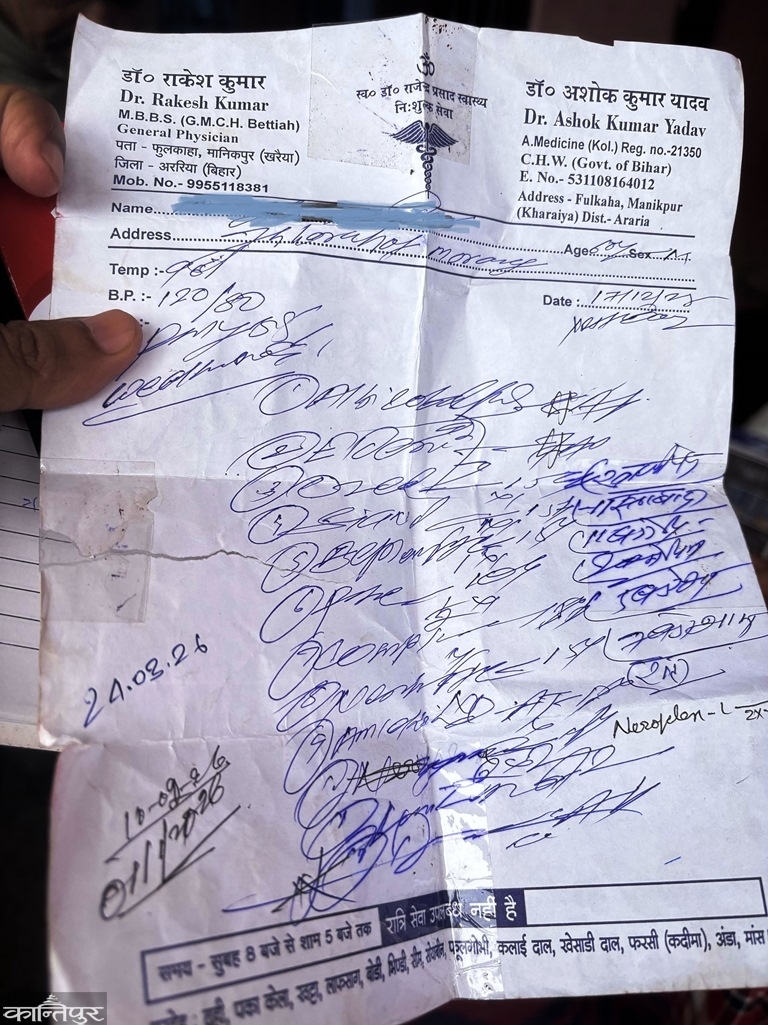
Prescription from 'Rajendra Prasad Yadav Free Treatment Center' in Kharaiya. Photo: Parbat Portal/Kantipur Neurologist Dr. Sunanda Poudel said that the biggest mistake is to consider high blood pressure normal. ‘Unhealthy diet, stress and physical inactivity increase blood pressure,’ says Poudel. ‘If this is not controlled, blood clots in the brain or a blood vessel bursts, causing paralysis.’
According to Dr. Poudel, a balanced diet, regular exercise and taking medicine as per the doctor’s advice can reduce the risk by 90 percent. Poudel says that this risk can be reduced by eating a balanced diet, quitting alcohol and smoking, getting timely treatment and taking medicine. ‘Only by adopting these simple measures can the risk be greatly reduced,’ he said.
According to Jha, the health department coordinator of the rural municipality, last year, 502 people were examined across the municipality and those with complex diseases were sent to the hospital in Biratnagar for further treatment. The municipality has 5 health posts, 2 basic health centers, 1 primary health center and 5 health centers.
Paralysis victim Menulal Sardar. Photo: Parbat Portal/Kantipur
ग्रामथान–२ मा स्वास्थ्य केन्द्र भए पनि बिरामी पुग्दैनन् । केही समयअघि गरिएको शिविरमा अधिकांशलाई उच्च रक्तचाप र मधुमेह देखिएको थियो । तर, त्यसपछि उनीहरुले नियमित औषधि सेवन नगरेका कारण जोखिम बढेको हो । वडाका धेरैलाई निःशुल्क औषधि पाइन्छ भन्ने पनि थाहा छैन । जब गम्भीर समस्या हुन्छ तव मात्रै अस्पताल जाने गरिन्छ ।
स्वास्थ्य चौकीबाट ४०, प्राथमिक स्वास्थ्य केन्द्रबाट ५५ बिमाबाट ९७ प्रकारका औषधि निःशुल्क वितरण हुन्छ । खासगरी मधुमेह, उच्च रक्तचाप, क्षयरोगलगायतका औषधि निःशुल्क पाइन्छ । ‘हामीलाई त त्यसबारे थाहै छैन’, स्थानीय बुदुनी सरदारले भनिन्,‘थाहा पाए पो लिन जानु ।’
स्वास्थ्य संयोजक झाका अनुसार गत वर्ष भएको स्वास्थ्य शिविरमा सरदार बस्तीका अधिकांशमा उच्च रक्तचाप, मधुमेह, मृर्गौला सम्बन्धी रोग देखिएको थियो । चिकित्सकले धेरैलाई औषधि पनि दिएको थियो । केही गम्भीर विरामीलाई विराटनगर रेफर पनि गरियो । ‘नियमित औषधि नखाने, दवाई र दारुसँगै खाने प्रवृत्तिले समस्या थपिएको देखिन्छ’, झाले भने,‘नियमित औषधि खाने हो भने समस्या कम हुने थियो ।’ उनका अनुसार मूलतः खानपिन र सरसफाइको कमीले पनि समस्या थपिएको देखिन्छ । सँगै शारिरीक व्यायाम पनि छैन ।
प्रदेशमा १५ देखि ४९ वर्ष उमेर समूहमा नसर्ने रोगबाट हुने मृत्यु दर उल्लेखनीय रहेको काेशी प्रदेश स्वास्थ्य मन्त्रालयले जनाएको छ । मन्त्रालयका अनुसार मुटुरोग, कलेजोसम्बन्धी रोग र दीर्घ श्वासप्रश्वास रोगका कारण मृत्यु बढ्दो क्रममा छ । १५ देखि ४९ उमेर समूहमा मृत्युको दर ९ दशमलव ३ प्रतिशत छ । १५ देखि ४९ सम्म मस्तिष्कघातबाट २ दशमलव ५ प्रतिशत छ । सोही उमेर समूहमा दीर्घकालीन मृर्गौला रोगबाट हुने मृत्युको दर २ दशमलव ३, सोही समूहमा मधुमेहबाट हुने मृत्युको दर १ दशमलव ६, दीर्घ स्वासप्रश्वासबाट हुने मृत्युको दर १ दशमलव ९ प्रतिशत छ । उच्च रक्तचाप २४ दशमलव ५ प्रतिशत बयस्कमा देखिनु चिन्ताजनक रहेको स्वास्थ्य मन्त्रालयले जनाएको छ ।