After China stopped importing livestock following the COVID-19 pandemic, the income, business, and future of about 180 yak farmers in Taplejung are in doubt.
We use Google Cloud Translation Services. Google requires we provide the following disclaimer relating to use of this service:
This service may contain translations powered by Google. Google disclaims all warranties related to the translations, expressed or implied, including any warranties of accuracy, reliability, and any implied warranties of merchantability, fitness for a particular purpose, and noninfringement.
Yak-chauri farmers are busy in the Himalayan pastures of Taplejung. However, after China banned animal imports, cross-border trade that has been going on for decades has come to a standstill, and Himalayan livestock farmers are in crisis.
As the demand for opening up trade is intensifying, farmers are under pressure to resume exports to China rather than the festival.
Participants in the municipal meeting suggested that Cheten Sherpa Lama, ward chairman of Olangchunggola, Phaktanglung Rural Municipality-7, hold a yak-chauri festival. As suggested by the participants in the municipality, he also consulted livestock farmers in his and neighboring wards.
Farmers, however, had a different opinion. They urged them to take the initiative to open up trade with China rather than the festival. They said that export-import was important to them. The farmers also suggested that the expenses incurred in the festival should be spent on a consultation program to open up trade.
Mikwakhola Rural Municipality-5 Ward Chairman Gyanje Sherpa is also under similar pressure from farmers. Under the cattle breeding program, cattle and yak calves were brought from outside the district for breed improvement and distributed. Farmers are not interested in it now. Their only demand is that trade with China should be opened.
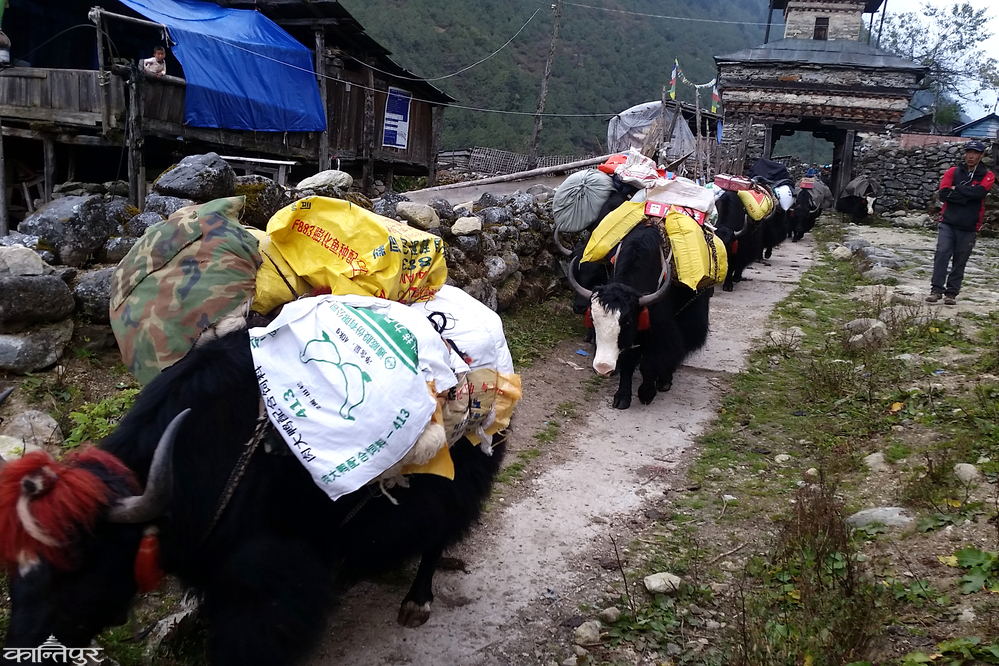
‘Our Himalayan pastures are like a festival day, night, month and year round,’ said Nupu Sherpa of Mikwakhola-5 Tokpegola, ‘Whenever I come, the pastures are full of cattle, I have not been able to sell them.’ He complains that the practice of raising calves, selling them when they grow old and meeting household expenses has become disorganized. After the Corona infection, the livestock farmers in the Himalayan region are in trouble as China does not buy Nepalese yaks and yaks.
Nupu had taken 20 yaks to the market in Dingze County, Tibet, China in 2077 BS and sold them. At that time, he charged between 90,000 and 110,000 for each yak. Five farmers including him had taken the yak carcasses to China through the Omdola checkpoint in Sankhuwasabha Thudam. Nupu says that Nepali earned 5 million rupees from the sale. After that, exports to China stopped.
At that time, 1 Chinese yuan was worth 16 Nepali rupees. Now it is 19 rupees. According to Nupu, once he opened the sale, he could immediately sell 95 yaks. Yaks, which usually live for 15 to 20 years, had been sold for 12 years. Earlier, it was customary to carry heavy loads. Now, due to road expansion and mules, the practice of carrying heavy loads has decreased.
This problem is faced by more than 180 farmers like Nupu. They are affiliated with the Yak-Chauri Farmers Federation. According to the data of the Yak-Chauri Breeders Association, these families raise at least 10 to a maximum of 300. Olangchungola ward chairman Cheten Sherpa Lama said that there are three to four hundred animals from one family in the pasture. ‘They say that they have held a festival for the Chauri here, and they have held a festival there, but there are only Yaks and Yaks in our pasture,’ said Cheten.
In Nepal, Churpi and ghee are made from the milk of the Chauri. But farmers say that this alone cannot be used to raise livestock. Nupu Sherpa of Olangchungola says that since generations, it has been a practice to sell and raise calves after they grow old.
The livestock farmers of Lelep, Olangchungola, Yangma, Tokpegola, Papung, and Sanwa, which border China, have been raising this issue with their people's representatives. The then Chief District Officer Netra Prasad Sharma, who went to the bilateral border meeting, was also urged by a group of farmers to raise this issue.
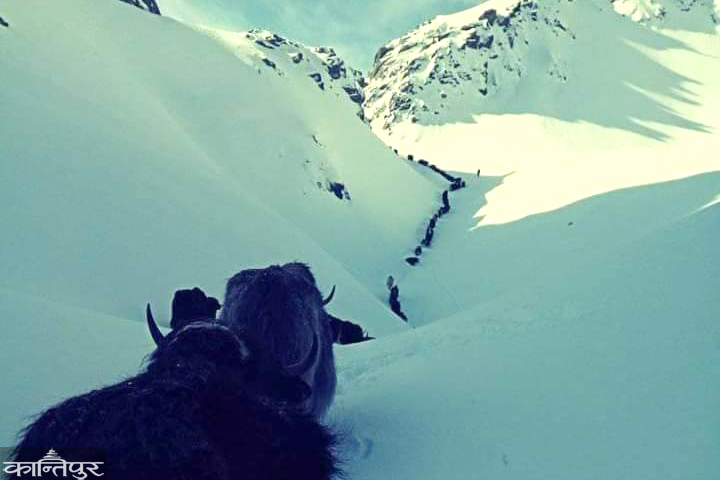
Pemwaphuti Sherpa of Papung says that the candidates who became candidates in this election were also urged to raise their votes while seeking votes. The delegation led by Sharma also raised this issue in the meeting of the chiefs of Taplejung and Dingje counties held on Mangsir 29, 2081. But China replied that 'the decision on livestock should be taken by the center, we request it from the higher authorities', Sharma recalls. He informed that this issue was also included in the Home Ministry while reporting on the border meeting. After that, no border meeting was held.
Nepali farmers, who had lost a good market for selling livestock due to the corona infection, had expected that everything would open up with the opening of the border with Nepal on 2081 Jestha 11. Ward Chairman Cheten, who acted as an interpreter with the Taplejung administration and Dingze County of China, could not understand why China did not import livestock. ‘Earlier they said it was because of lumpy skin, now some say it is because of cholera. But it is not clear,’ he said.
According to the data of the District Animal Service Office, there are more than 12,000 yaks in the district. Residents of the Himalayan region have been rearing it as an ancestral profession. The altitude of 3,000 to 5,000 meters is considered the grazing area of yaks. The district's upper reaches of Sirijanga, Phaktanglung, Mikwakhola, Meringden and Phungling municipalities are home to the Chauriyak. The statistics of the Taplejung Animal Services Office mention that the lumpy skin of these animals, which can cause damage to tigers, bears and wolves, has caused damage worth more than three thousand rupees.

