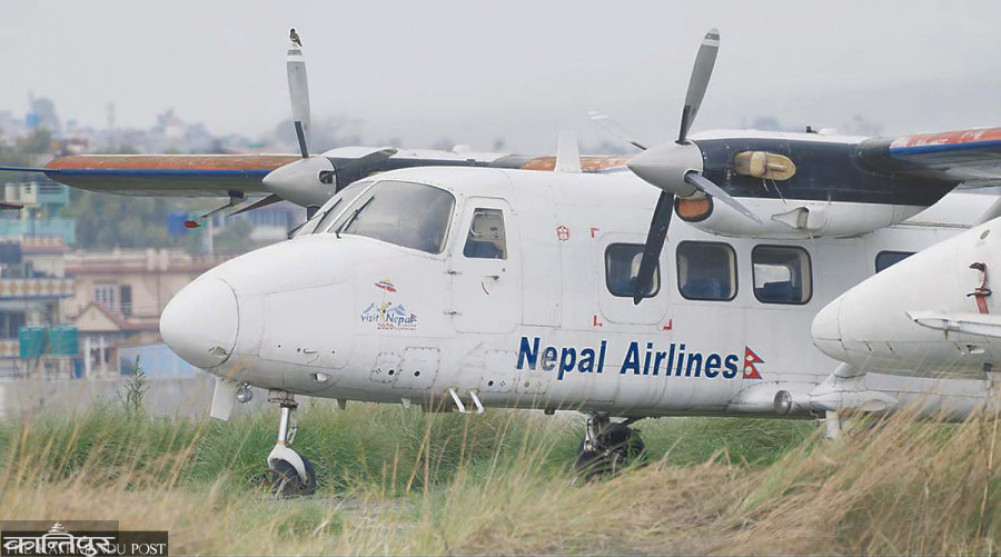
The income from aircraft that have been idle for years is zero, but interest, maintenance, and insurance costs are constantly increasing.
We use Google Cloud Translation Services. Google requires we provide the following disclaimer relating to use of this service:
This service may contain translations powered by Google. Google disclaims all warranties related to the translations, expressed or implied, including any warranties of accuracy, reliability, and any implied warranties of merchantability, fitness for a particular purpose, and noninfringement.
Eastern corner of Tribhuvan International Airport. Near Buddha Air's hangar. 5 planes are seen in a hurry. From afar, they look like they are preparing to take off somewhere. However, these Chinese-made planes have been sitting here for 5 years. These planes, which were once brought to strengthen Nepal Airlines Corporation's domestic flights, are now becoming a burden due to non-operation.
Nepal Airlines has neither been able to sell them nor lease them. These parked planes are not generating any revenue. On the contrary, they are causing further losses to the financially weak airline corporation. Because the airline corporation is still in debt of 50 billion. The interest on the loan taken by the corporation from the government to purchase the Chinese planes is continuously increasing. Last year, interest alone added 681 million rupees due to the Chinese-made Modern Ark 60 (MA 60) and Yun-12 (Y-12E) aircraft. The financial burden is not limited to this. Even when grounded, the aircraft must be maintained. Insurance, parking, engine repair and maintenance cost about 200 million rupees annually. According to a report by the Auditor General's Office, about 115 million rupees of this is spent on the MA-60 and 85 million on the small (Y-12E) aircraft. The corporation is very disappointed with the Chinese aircraft. 'We have been trying to sell or lease it since 2022. However, no one has shown interest nationally or internationally,' said a senior official of the airline on condition of anonymity. The unwillingness of anyone to lease or purchase the aircraft has also raised serious concerns about the practical operation of the aircraft.
The story of these aircraft is more than a decade and a half long. The Nepal Airlines Corporation brought these aircraft with the aim of flying in the remote mountainous areas of Nepal and competing with private companies. At that time, the mainstay of flights in remote areas was the Canadian-made Twin Otter aircraft. From 1972 to 1979, the Canadian International Development Agency provided the Corporation with 7 Twin Otter aircraft as a grant. Of these, only two are currently in operation. After the aggressive entry of the private sector, the Corporation's share in the domestic aviation market decreased significantly. On August 7, 2011, the Corporation wrote a letter to the Ministry of Finance to explore the possibility of providing aircraft under grants through development partners to expand services in remote areas. The Corporation understood that Canadian support might come again. The letter first reached the Ministry of Tourism. The ministry reviewed the request and directed it to resend the letter, requesting some as grants and some as loans. In response, the Chinese side stated that it was ready to provide some aircraft as grants and some as concessional loans. According to sources at the time, Beijing was preparing to send these aircraft to Nepal for testing in the high Himalayan region. This was seen as a marketing strategy to push for commercial sales after the success in Nepalese skies, considered one of the most difficult geographical conditions in the world.
Then the then Tourism Minister Lokendra Bista Magar signed a memorandum of understanding (MoU) with China's AVIC International behind closed doors, which was promoted as part of a political commitment made earlier to justify it.
Magar's decision to sign the MoU to purchase eight aircraft was criticized by senior government officials. They called the move a "violation of the system".
A few weeks later, a technical team from Nepal Airlines visited AVIC International, which supplied the Y-12E and MA-60 aircraft, to assess whether the aircraft were suitable for Nepal. The team reported that the aircraft were suitable for Nepali skies.
Then, in December 2011, the Chinese government formally wrote a letter to the Ministry of Finance stating that it would provide three aircraft to Nepal Airlines as a grant and the rest as a concessional loan. However, the process was drawn into controversy after it came under the scrutiny of the Commission for the Investigation of Abuse of Authority due to complaints of irregularities.
The government resumed the plan on 17 October 2012 under the then Good Governance and Economic Reforms Action Plan of 2012 introduced by former Prime Minister Baburam Bhattarai. The Prime Minister's Office directed the Civil Aviation and Finance Ministry to complete the aircraft procurement process within six months. It also warned that the concerned officials would be removed from their posts if they failed to conclude the process.
Accordingly, the Corporation signed a formal agreement with AVIC to purchase 6 aircraft. Out of which, 2 aircraft were on grant and 4 on loan.
Accordingly, the Corporation received the MA-60 aircraft on 27 April 2014. The Y-12E arrived on 14 November 2014. Both these aircraft came from China as a grant. In January 2017, Nepal purchased another MA-60 from China. And, in February 2017, it purchased the Y-12E aircraft. Similarly, in February 2018, it purchased two more aircraft.
These aircraft came from China's grant and concessional loan. The total cost of which was 408 million yuan (equivalent to 6.67 billion Nepali rupees). Of which 180 million yuan was a grant. 228 million yuan was a concessional loan. As per the terms of this loan, the Ministry of Finance has been paying an annual interest rate of 1.5 percent and a service fee. For this, the Ministry borrows 1.75 percent from the Nepal Airlines Corporation.
Initially, the goal was to reduce the financial pressure by providing a grace period of 7 years. Which meant that the corporation did not have to pay the installment for 7 years. This grace period ended in March 2021. However, by this time, these aircraft had been withdrawn from active service.
In the beginning, there were many challenges in operation. There was a shortage of trained pilots in Nepal to operate these aircraft. Spare parts were not easily available. Even if they were, they were expensive.
Insurance premiums were high. Given Nepal's challenging geography and competitive aviation sector, the market demand for these aircraft did not seem to be sufficient. Additional investment was required to train pilots and engineers. After facing many challenges, the board of directors of the airline decided to completely ground the aircraft on June 29, 2020. Since then, the aircraft have been stored. The spare parts are gradually deteriorating.
Despite repeated attempts to change this situation, they were not successful. In September 2022, the corporation issued a public notice with the aim of leasing the aircraft. However, after the notice period expired, there was no response. Not a single bidder came forward.
Attempts were also made to sell the aircraft. The corporation sought a diplomatic solution. In December 2024, Yuvraj Adhikari, the then executive chairman of the corporation, raised the issue with the aircraft supplier company AVIC. He had urged the company to take back the aircraft as a goodwill gesture, keeping in mind the close bilateral relations between the two countries. However, the old agreement did not allow for a new solution. According to AVIC, the aircraft, which were brought in with grants and loans from the Chinese government, were first handed over to the Chinese government under an intergovernmental agreement. Only then were they given to Nepal Airlines Corporation. Therefore, Beijing's approval is necessary for any decision to sell these aircraft.
AVIC refused to immediately agree to the sale, but offered limited assistance. The company said it could help identify potential operators. It also said that some Y-12E aircraft are still in use within China. In addition, it has also pointed out the possibility that domestic organizations such as the Nepal Army or the Civil Aviation Authority of Nepal could use the aircraft. According to officials, the process of selling aircraft given in an intergovernmental agreement is not easy.
With no clear solution, the issue has reached the top government level. Recently, Nepal's Finance Secretary has directed the corporation to explore the possibility of bringing the planes back into service. The directive has led to a situation where the aircraft will have to start from scratch. The authorities have been instructed to try to get the aircraft back in the sky despite the obstacles, without finding solutions to the reasons for which the aircraft was grounded in the past. However, operating these damaged aircraft is extremely complex.
According to airline officials, this will require more than 2 billion rupees. The company will have to hire instructor pilots, of which there is a shortage not only domestically but also internationally. New captains will have to be trained, a process that could take years. Ensuring a continuous supply of spare parts is another major challenge. "The problem is complex," admitted an official.
The planes, unused for years, have become dilapidated. Their value has plummeted. An independent valuation conducted by an American company in 2023 had pegged the total value of all the planes at just Rs. 220 million.
A private Pakistani company has sent a formal offer to Nepal through diplomatic channels, expressing its desire to purchase the small planes.
Fearing public outrage and possible scrutiny by anti-corruption agencies, Nepal Airlines itself conducted its own valuation. The sale price of the planes was set at a high price. The airline had set a total of about US$19.6 million (approximately 2.85 billion Nepalese rupees today) for the remaining five planes. This large gap between the external and internal valuations has further complicated efforts to sell the planes.
Recently, a private Pakistani company sent a formal proposal to Nepal through diplomatic channels, expressing its interest in purchasing the small aircraft. Officials said there could be other potential buyers. However, any such deal would require the approval of the Chinese government.
Earlier, in 2024, Thailand-based Alphabet Aviation and Engineering had shown interest in purchasing three Y-12E aircraft. The company had proposed to purchase these aircraft at Nepal Airlines' book value, but there was a condition that they would be grounded for four years, so they would be depreciated by 10 percent each year.
"If the government reaches an agreement with Beijing, the sale can go ahead," said a tourism ministry official. "We have asked the Nepal Airlines Corporation to look into the matter."
At the same time, Bangladesh had also looked at these aircraft. However, it did not proceed with the procurement process as it did not see it as suitable. Nepal, on the other hand, proceeded with the procurement based on the recommendation of its technical team. The procurement process for these aircraft is also controversial. In 2011, a technical team from Nepal Airlines visited China and inspected the aircraft. Then the Chinese government indicated that it could provide some aircraft as a subsidy. However, for that, Nepal had to purchase additional aircraft.
Critics have long questioned this decision. Former Nepal Airlines board member Achyut Pahari has called it one of the worst decisions the airline has ever made. He has accused the evaluation process of being flawed and influenced by vested interests. ‘The Y-12E was compared to the Twin Otter and the MA-60 to the ATR-72 SAG,’ Pahari had said in an interview some time ago, ‘Now flying these aircraft is just a waste of money.’
Why did the airline buy these aircraft from AVIC? Questions remain about why it failed so quickly and why no accountability has been established. However, former officials say that since the deal was made at an intergovernmental level, even the country's anti-corruption agencies have not initiated a formal investigation.
The Chinese planes have been parked in the same place for years. Unused and slowly deteriorating, Nepal Airlines is struggling to survive. Along with the burden of debt, it is also suffering the consequences of past decisions.