Even the general rules of child rights are not followed in the juvenile correctional home, children are kept up to the capacity. They have to queue to cook food, eat, and even go to the toilet. Even those over the age of 18 are kept. Most of the correctional homes do not have reading facilities.
We use Google Cloud Translation Services. Google requires we provide the following disclaimer relating to use of this service:
This service may contain translations powered by Google. Google disclaims all warranties related to the translations, expressed or implied, including any warranties of accuracy, reliability, and any implied warranties of merchantability, fitness for a particular purpose, and noninfringement.
Disorganized and cramped rooms. Crowded children. Lines to go to the toilet. Infrastructure that is not even suitable for normal sports practice.
This is a common picture of children's reform homes across the country, which are operated to reform children who have committed child abuse or are in legal disputes. Not only are the necessary general rules not followed in the children's reform homes, the government is violating children's rights by inhumanely detaining children for up to four hours beyond their capacity. According to the Ministry of Women, Children and Senior Citizens, there are about a thousand children in children's reform homes across the country.
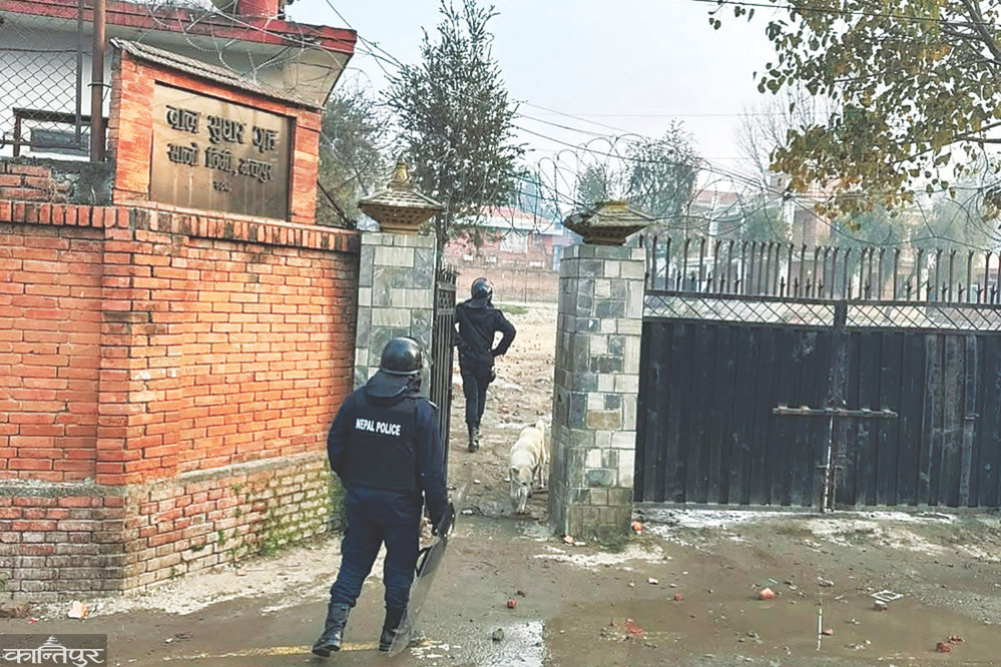
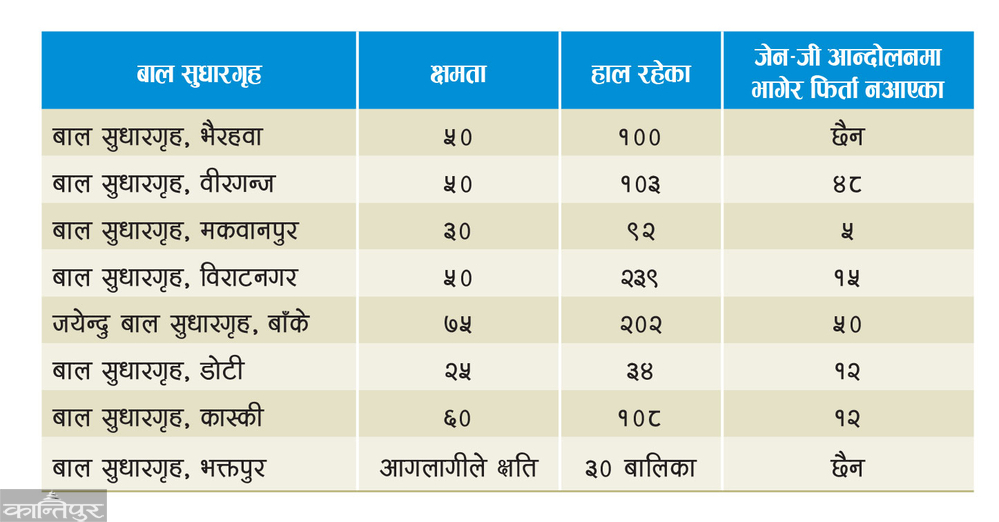
The children's reform home in Bhairahawa is spread over an area of 2 katta 6 dhur. There are 100 children in this home with a capacity of 50. They have to wait their turn to go to the toilet. Two to three people have to sleep in a single bed.
A child named '20-20 A', who has been in the children's reform home for 6 years, described the hardships there. 'They have to sit on one side. On top of that, it is cramped, so there is a need to suffocate,” he said. “When there are many people, there is a queue for everything including cooking, eating, going to the toilet, sleeping.”
Bodhraj Acharya, head of the juvenile correctional home, said that it is difficult to manage the children because the building is cramped. “There is a problem in the summer when more than the capacity is kept. The place to eat is cramped.”
 According to Acharya, three or four people have to sleep in a single bed. Eight plainclothes police officers are guarding the place without weapons. The Children’s Regulations, 2078 BS, stipulate that in addition to clean drinking water, a juvenile correctional home must have a toilet and sanitation facility, as well as psychosocial counseling.
The situation at the juvenile correctional home in Birgunj is no different. This home, spread over an area of 1 katta and 18 dhur, has 22 rooms. The capacity is 50, but there are 103. Of these, only 21 cases have been decided and all the others are under trial. Home Chief Tika Krishna Kafle said that due to lack of sufficient budget, there are problems in managing maintenance, fans, and lights.
The Kaski-based Juvenile Correctional Home should accommodate 50 to 60 people, but there are 108. Up to 15 people have to live in one room. ‘Currently, we have managed it in 7 rooms,’ said Office Chief Durgaraj Subedi. ‘The government has said that it will expand, but when is not decided.’
The Makawanpur-based Juvenile Correctional Home has three times more juveniles than its capacity. The home, which is spread over an area of 5 acres and has a capacity of 30, has 92 people. The head of the correctional home, Pradeep Gautam, said, ‘Due to lack of space, children are having to sleep on the floor.’
Section 24 of the Children’s Regulations, 2078 BS, states that children in Juvenile Correctional Homes must attend school compulsorily according to their age and educational level. But this is not followed in the children's home in Makawanpur. The children here are deprived of education. The library has also not been able to operate due to lack of space. 'There is also a challenge of what level of teacher to bring to the children of different age groups and how to arrange the education according to age and class,' said Chief Gautam, 'but the main problem is the lack of space.'
The children of the children's home in Biratnagar have been able to study despite facing the cramped space, lack of cleanliness and playground. There are 239 children here, and the capacity of the home is 50. 130 children are studying in the school. There are also 8 teachers and 2 assistants for them.
There is a Deepjyoti School inside the children's home in Biratnagar, where education is provided from grades 4 to 10. Those studying up to grade 12 are enrolled in the local Janata Mavi and those studying for graduation are enrolled in the Gograh Campus in Biratnagar. According to Sanat Koirala, principal of Deepjyoti School, 14 students, including 12 regular students and 2 part-time students, had given the SEE this time. Children living in a children's reform home in Birgunj had started shouting slogans on 19 Chaitra. They had started the protest after officials from the State Attorney General's Office and the District Attorney's Office returned after questioning them. They complained that some officials came and understood their problems, but even their basic needs were not met.
They said that they were being kept in a cramped environment, that it was difficult to pass the time due to the lack of facilities like reading, music and language training, and that they had submitted a 22-point demand letter to the home administration, but it had not been heard. They said that solar lights, fans, toilet doors, emergency lights, mesh doors, paper, pens, dustbins, coolers, taps, sand filters, and pots were not provided. A child said that even now, these demands have not been heard.
Children under the age of 18 are kept in the same place in the juvenile correctional home, which has been overcrowded. On July 28, a police officer and staff were injured in a clash at the juvenile correctional home in Biratnagar Metropolitan City-3. The dispute escalated when the staff questioned the children in the correctional home about eating khaini. The children pelted police constables and staff with bricks and stones when they were asked who brought the khaini and where it came from, according to the correctional home.
Only children under the age of 18 should be kept in the juvenile correctional home, but children older than that are also being kept. 28 people over the age of 18 from the Biratnagar-based juvenile correctional home have been transferred to Morang Prison. Sandeep Neupane, head of the correctional home, said, "Keeping everyone in the same place increases the possibility of quarrels. That is why it was transferred. There is a high possibility that the older ones will look down on the younger ones." This increases the possibility of accidents.’
Arson and vandalism occurred during a clash between two groups at the Sano Thimi Children’s Correctional Home in Bhaktapur on 24th Magh. Bhaktapur Chief District Officer Umesh Kumar Dhakal said that after the incident, out of the 167 juvenile offenders at the juvenile correctional home, only 30 girls have been kept, while 137 have been shifted outside the valley. 30 have been shifted from Bhaktapur to Birgunj, 76 to Nuwakot and 31 to Hetauda. 84 of those shifted were above the age of 18. Dhakal said, ‘Only girls have been kept here as the damage was too much to keep them.’
 On the night of 24th Bhadra, police opened fire on juvenile offenders at the Jayendu Children’s Correctional Home in Naubasta, Banke, when they tried to escape, five people died. Two were injured. Umesh Bista, 21, of Achham, Binesh Gharti Magar, 20, of Dang, Sameer Thapa, 20, of Banke Khajura, Jagat Deuba, 19, of Kailali, and Bhupendra Khatri, 21, of Dailekh, lost their lives at that time. 115 people escaped from the correctional home that day, 50 of whom have not returned.
Jayendu Juvenile Correctional Home Chief Kishore Sharma informed that nine people above the age of 18 have been transferred to Naubasta Prison due to the risk of another fight. They have been kept in a separate block in the prison. ‘Those nine people used to participate in every fight that took place in the correctional home, that is why they have been kept in a separate block inside the prison,’ Sharma said, ‘There is no tension now.’
According to Bhola Mahat, a human rights activist from Banke, keeping those under the age of 18 with those above the age of 18 has a psychological impact on them. He said that some of them have been found to be staying in correctional homes even after they turn 18 due to the lack of speedy decision on the cases of juvenile delinquents. “There are also clashes when those above 18 years of age are kept with young children,” he said. Fifteen people who escaped from the Biratnagar-based juvenile delinquents during the Gen-G movement have not yet returned. The whereabouts of 12-12 people who escaped from the Doti and Pokhara-based juvenile delinquents are also unknown. The Doti-based juvenile delinquents, which has a capacity of 25, currently have 34 juvenile delinquents.
Bhairahawa advocate Shiva Prasad Gaudel commented that juvenile delinquents are becoming like schools for teaching crime instead of being correctional centers. “There is a law, but since there is no one to speak up for children, they are being tortured,” he said. “They have not been able to go out, study, play and have fun.”
The government and the relevant ministries are not unaware of the poor condition of the juvenile delinquents. The Law, Justice and Human Rights Committee of the Federal Parliament had prepared a report in August 2002 after conducting on-site monitoring of juvenile correctional homes in Koshi, Madhesh and Lumbini provinces. The report concluded that the conditions of juvenile correctional homes are very deplorable. The report states that up to four times more children are forced to live in correctional homes than their capacity, and due to this, the report states that even the minimum sanitation, health and food facilities are not being provided. The report states, ‘Keeping children above the age of 18 and younger children in the same place is increasing security challenges and internal conflicts.’
Keeping children above the age of 18 and younger children in the same place is increasing security challenges and internal conflicts. - Report of the parliamentary committee The committee had suggested to the government to classify children separately according to age and nature of the offense and to immediately improve the physical infrastructure. The report emphasized the need to provide quality education, sports and regular psychosocial counseling within the correctional homes. The committee had also directed to develop the reform homes as 'reform centers' in the true sense by effectively implementing the Children's Act, 2075 BS and to improve the behavior of the employees. However, none of the suggestions suggested by the report have been followed by the children's reform homes.
Spokesperson of the Ministry of Women, Children and Senior Citizens, Chakra Bahadur Budha, claimed that the ministry is emphasizing on the management of each child reform home. 'The ministry is taking the process forward on the issue of transferring child offenders from child reform homes that are over capacity,' he said. 'Apart from serious crimes, the process of amending the act to reduce the prison sentence has also been taken forward.'
Madhav Dhungana (Bhairahawa), Pratap Bista (Hetauda), Shankar Acharya (Parsa), Parbat Portel (Biratnagar), Rupa Gahatraj (Nepalgunj), Deepak Pariyar (Pokhara), Mohan Paneru (Doti), Sundar Shilpakar (Bhaktapur) and Prakriti Dahal (Kathmandu)