Dr. Mahendra Shrestha, Vice President of ICF's Asia Program, said that he launched the campaign because Bajah Sagar will be a new and first transboundary Ramsar site for South Asia. ”There is no end to the Ramsar sites in South Asia that are the same for two countries,” he said.
We use Google Cloud Translation Services. Google requires we provide the following disclaimer relating to use of this service:
This service may contain translations powered by Google. Google disclaims all warranties related to the translations, expressed or implied, including any warranties of accuracy, reliability, and any implied warranties of merchantability, fitness for a particular purpose, and noninfringement.
A study has been started to make Bajaha Sagar, located on the Nepal-India border, a transboundary Ramsar site.
The border area is being listed in such a site to give international recognition. There is a border between Tulsidihawa in Mayadevi on the Nepal side and Bajaha in Siddharthanagar district on the Indian side in the Dashgaja area. This area is a habitat for rare birds, storks. A large number of storks can be seen around it. That is why both countries are studying to make it a Ramsar site.
A team from WWF Nepal, Nepal Zoological Society and Tribhuvan University, Central Department of Zoology are studying on the Nepal side and a team from Wildlife Trust of India (WTI) on the Indian side. The team led by Dr. Hari Prasad Sharma, Professor of the Central Department of Zoology, Tribhuvan University, has 10 participants, including flora, amphibian and fish experts. On the Indian side, WTI's Uttar Pradesh Conservation Director Arshad Hussain and International Crane Foundation (ICF), Southeast Asia Program Director of the US Dr. Tran Tritt and other experts are participating.
Due to the geography of the two countries, the work is being done in cooperation and coordination with the ICF headquartered in the US. Both the study teams have conducted on-site observations, research, and discussions with locals. Professor Sharma said that the team returned after studying for a week under the first phase.
'We have studied the basic things found in this area,' he said, 'A lot of things necessary for Ramsar have been discovered through the study.' Details have been collected about aquatic plants, birds, reptiles, amphibians, fish and mammals in the border area. 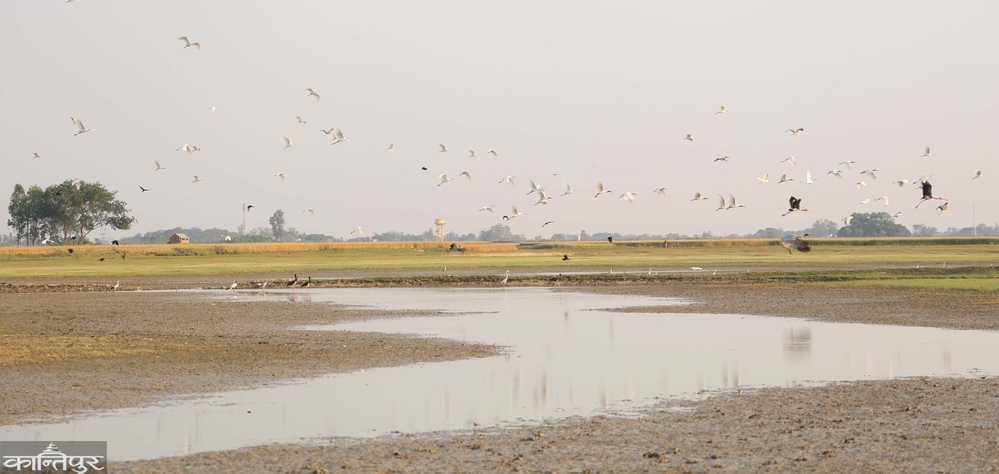 Bajaha Sagar area
Currently, the work of studying the details received is underway, said Dr. Bishnu Prasad Bhattarai, a frog expert from the Central Department of Zoology under Tribhuvan University. ‘The report will be submitted to WWF Nepal,’ he said, ‘WWF and ICF will discuss with the governments and stakeholders of both countries and move forward the process of the Ramsar site.’
The activity of storks around Bajaha Sagar has been enticing. Around 100-150 storks are seen around the border every year. The number increases during the breeding season. Rajendra Suwal, Head of Partnership Program at WWF Nepal, said that the interest of stakeholders has increased after it was made public that storks are found in abundance in the Bajaha area. Earlier, in 2080, when the stork census was conducted across the country, a census was also conducted in Bajaha.
‘We found a significant number of storks,’ he said, ‘After seeing the storks’ habitat there, I felt that one country alone could not do it for their conservation.’ He then said that WWF took the lead and started the initiative for cross-border conservation. For that, a three-day Indo-Nepal cross-border discussion was held in Lumbini in 2081 Magh.
Government/non-government conservationists from both countries participated in the discussion. Conservationists said that the current work was possible after they agreed to run an awareness campaign for stork conservation in the border area and work by exchanging good practices and learnings in stork conservation. 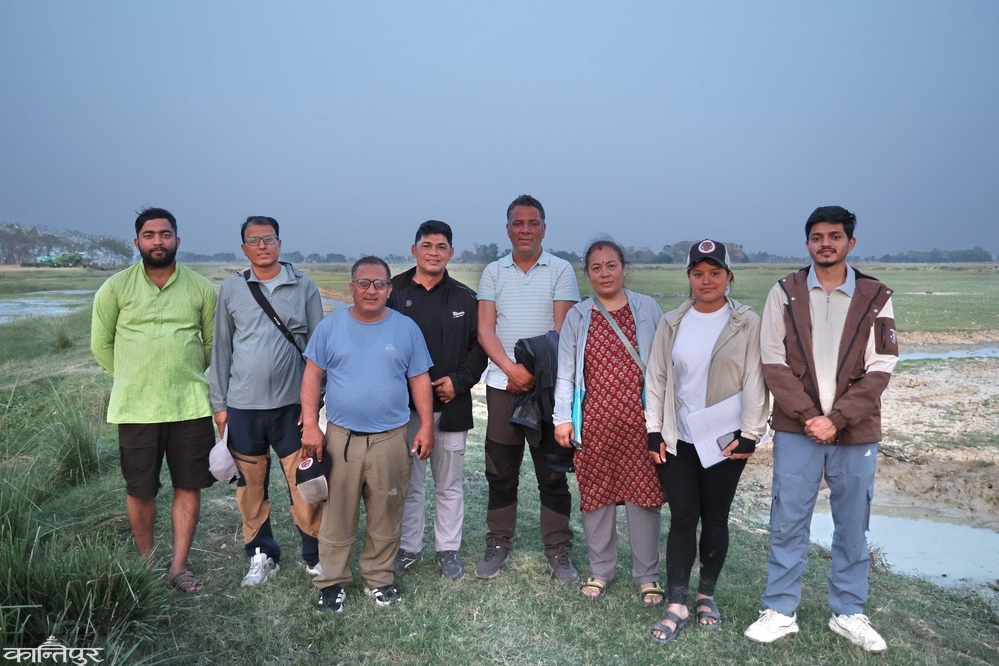 A team led by Professor Dr. Hari Prasad Sharma of the Central Department of Zoology, Tribhuvan University, came to study biodiversity in Tulsidihawa and Bajaha Sagar of Mayadevi Rural Municipality in Kapilvastu.
‘The landscaping of this place is good,’ said Dr. Ghanshyam Gurung, Country Representative of WWF Nepal, ‘There are lakes, borders, wetlands, farmlands and food here for birds including storks.’ Storks always appear confident when they feel good about their food and security. Gurung said that Tinna Tinni rice, produced from wild rice, is also abundant here. ‘There is a huge potential for ecotourism.’ He said that only one country cannot do it on its own, ‘both countries must agree.’
Dr. Mahendra Shrestha, Vice President of ICF’s Asia Program, said that he had launched the campaign because Bajah Sagar would be a new and first transboundary Ramsar site for South Asia. ‘The same Ramsar site of two countries is not the end of South Asia,’ he said, ‘If the campaign is successful, it will add a new dimension to the conservation sector.’ He said that he was working for that. According to him, Hungary and Slovakia and Bulgaria and Romania have 3/3 transborder Ramsar sites.’
170 hectares of Bajah Sagar are in Siddharthanagar, India. There are 80 hectares in Mayadevi Rural Municipality on the Nepal side. Tulsidihawa is on the Nepal side and Bajaha village is on the Indian side. There is a border pillar numbered 552/47 in the middle of the sea. The pillar is submerged in the monsoon season. India has built a dam in the sea for irrigation. ‘It is good to see storks in a large flock in one place,’ said ornithologist Hathan Chaudhary, ‘this is considered to be a conservation of biodiversity there.’ He also said that the ecosystem here is good.
Professor Dr. Amrita Kanojia, Director of the Department of Wildlife Sciences at the University of Lucknow, said that she was excited by the cooperation between the officials of the two countries on stork conservation. She said that the new work in the transborder area by exchanging the experiences of the two countries in the Terai Archlandscape would be exemplary for others.
Buddhists view storks as a form of faith. The beginning of the Ramayana also begins with the description of a courting pair of storks. It also has equal cultural and religious importance. Bajaha Sagar has become an excellent destination to enjoy watching the charming movements of the tall and attractive birds with their chicks.
So far, cross-border discussions and conservation programs have been taking place between Nepal and India on the issues of tigers, elephants and rhinos. For the first time, ecologist Haribhadra Acharya of the Department of Parks and Wildlife Conservation said that bilateral interest in birds has increased.
‘Bajah Sagar has become an important area for birds,’ he said, ‘now we need to work for its identification.’ The stork is one of the nine bird species protected by the Wildlife Conservation Act, 2029. It is estimated that there are more than 600 storks in Kapilvastu, Rupandehi and Nawalparasi. The stork was listed as one of the world's rarest birds in 2000 after its numbers began to decline.

