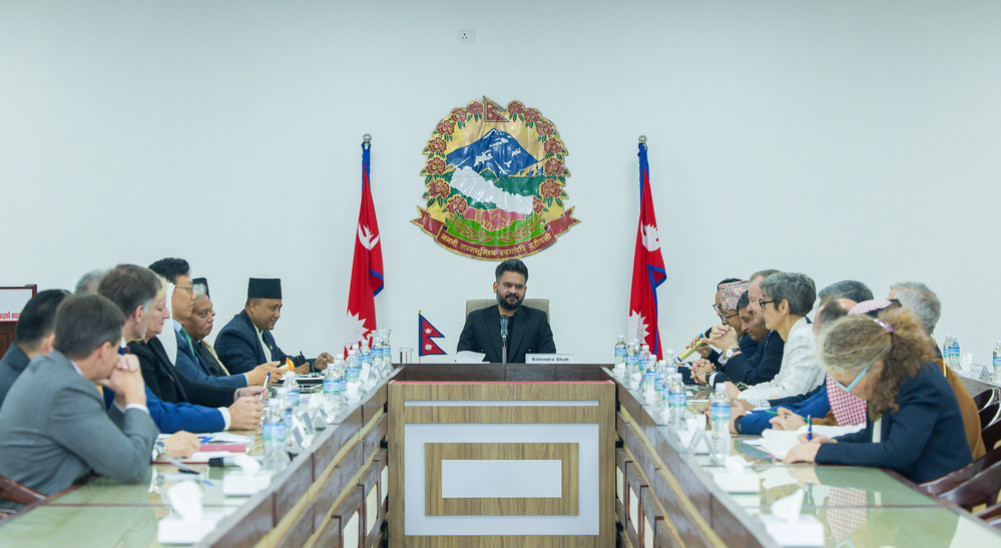
Foreign affairs experts have also raised questions about the fact that the draft of the national commitment letter made public by the government on Monday mentions that a policy of 'equal distance and equal proximity with all' will be adopted.
We use Google Cloud Translation Services. Google requires we provide the following disclaimer relating to use of this service:
This service may contain translations powered by Google. Google disclaims all warranties related to the translations, expressed or implied, including any warranties of accuracy, reliability, and any implied warranties of merchantability, fitness for a particular purpose, and noninfringement.
Foreign policy analysts have questioned the government's draft national commitment letter, which refers to Nepal as a 'buffer state' between India and China. They said the term 'buffer state' is irrelevant and does not represent the current geopolitical reality.
The draft national commitment letter, released by the Office of the Prime Minister and Council of Ministers on Monday, incorporating the election promises of the six parties in the House of Representatives, states that Nepal will be transformed from a buffer state between India and China into a 'vibrant bridge', keeping national interests paramount. The commitment letter states that this goal will be achieved through trilateral economic partnership and 'connectivity', which will ensure national security and stability.
The draft also states that 'a policy of equidistance and proximity will be adopted with all, recognizing that military alliances, arms races and war are obstacles to peace.' Foreign affairs experts have also objected to the term ‘equidistance’ used in it.
‘Buffer state’ refers to a small, usually independent nation located between two larger, competing or potentially hostile powers, which plays a neutral role to prevent direct conflict: Georgetown Journal of International Affairs Former Foreign Minister Pradeep Gyawali has objected to the terminology used in the draft commitment letter. ‘Every word used in international politics and diplomacy has a special meaning, Nepal has never called its geopolitical location a buffer state and neighboring friendly countries have not used such a term,’ he wrote on Facebook, ‘There is no eternal enmity or conflict between our neighbors, in which such a term would be relevant.’
When Gyawali was the foreign minister, in 2022, the National Planning Commission and the ‘Institute of Foreign Affairs’ under the Ministry of Foreign Affairs published a research report titled ‘From Buffer to Bridge: Nepal’s New Foreign Policy’.
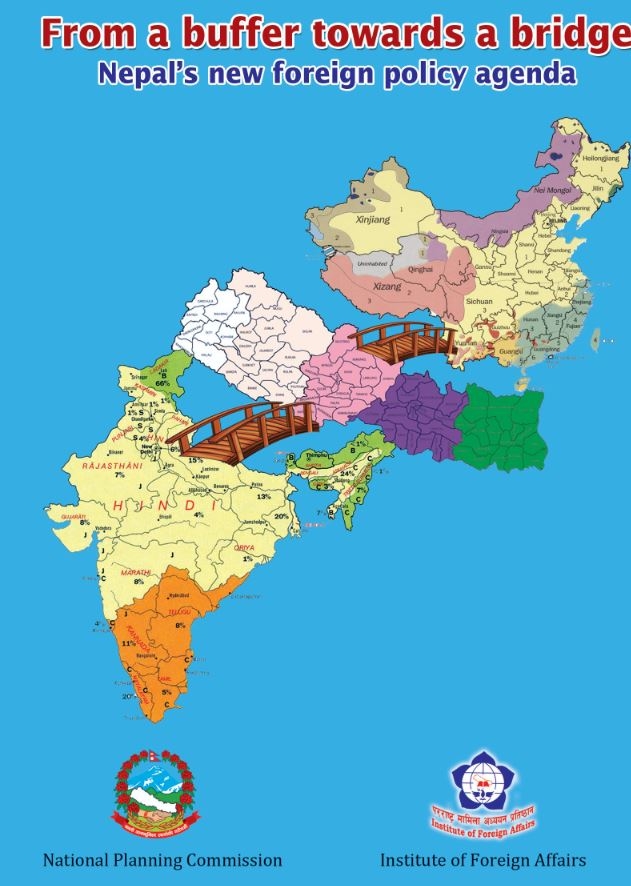 According to the ‘Georgetown Journal of International Affairs’, ‘buffer state’ refers to a small, usually independent country located between two large, competing or potentially hostile powers, which plays the role of a neutral country to prevent direct conflict.
Political analyst Devraj Dahal says, ‘Nepal needs to redefine its traditional identity as a buffer zone to adapt to the economic, security and political changes taking place in the neighborhood.’
Foreign policy analyst Chandradev Bhatta said that Nepal cannot call itself a ‘buffer state’ just because it is located between two large countries. ‘Identifying ourselves as a buffer state does not help us build our confidence,’ he told Kantipur. ‘In principle, this terminology may be correct, but its wider implications and connotations are problematic.’
According to Bhatta, this terminology comes from the competitive geopolitics of the colonial era, is negative, and weakens Nepal’s sovereign position. ‘Perhaps this is why King Birendra rejected the buffer state concept and described Nepal as a country connecting two great civilizations like India and China,’ he said. ‘Nepal is neither a small country nor a buffer. Rather, it is a strong and vibrant sovereign nation with thousands of years of political and cultural history.’
Former Prime Minister Baburam Bhattarai also believed that Nepal should be transformed from a ‘buffer state’ to a ‘dynamic bridge’. In this context, China had put forward the concept of ‘trilateral cooperation’ between Nepal, India and China. Later, a proposal of ‘China, India Plus One’ was also made. A retired Nepali diplomat said, ‘But India showed no interest in trilateral cooperation, nor in the Plus One concept.’
Most foreign policy experts who spoke to Kantipur also disagreed with the terms ‘equidistance’ and ‘equi-proximity’ mentioned in the draft of the commitment letter. ‘The dimensions of our relations may differ according to the issue, partnership and context. In that sense, our relations may not always be at the same scale or level,’ said former Foreign Minister Gyawali.
After the political changes of 2006, when KP Sharma Oli was the Deputy Prime Minister and Foreign Minister, the government had formed a high-level committee to determine the direction of the new foreign policy. The committee had recommended adopting the policy of ‘equidistance and equi-proximity’ for the first time.