The Biska Jatra, which has been going on since the Malla period, is not only preserving historical and cultural traditions in Bhaktapur, but also spreading the message of unity.
We use Google Cloud Translation Services. Google requires we provide the following disclaimer relating to use of this service:
This service may contain translations powered by Google. Google disclaims all warranties related to the translations, expressed or implied, including any warranties of accuracy, reliability, and any implied warranties of merchantability, fitness for a particular purpose, and noninfringement.
The traditional Biska Jatra festival is in full swing in Bhaktapur, a city rich in culture and heritage. Bhaktapur, famous for its dance and music festivals, is currently buzzing with the Biska Jatra, which is celebrated for eight nights and nine days.
The Biska Jatra festival begins 4 days before the start of the new year according to the Vikram Sambat era. The streets of Bhaktapur are now buzzing with the sound of the Biska Jatra, including the Dhime. The atmosphere here is different with the Biska Jatra raga sung by every member of the Dafa Bhajan. The raga of the Bajagaja also gives the impression that this festival has begun. In Bhaktapur, this festival is celebrated only according to the date. There is a tradition of celebrating other festivals according to the date.
In the Ta Mari (Taumadhi) tole in the central part of Bhaktapur city, the artisan community is active from the second week of Chaitra to make Bhairav Nath's chariot (Bhaila Kha) and Bhadrakali's chariot (Nakinju Khacha). The three-story Bhairav Nath's chariot (Bhaila Kha) and Bhadrakali's chariot (Nakinju Khacha) made of wood in the pagoda style are completed and painted and polished. Four days before the start of the new year, Bhadrakali's chariot is pulled. Then, the first day of the festival is started by pulling Bhairav Nath's chariot.
Before pulling the chariot, it is customary for the Bhairav Naikes to have a feast after performing a ritual sacrifice to Bhairav at the Bhairav Nath temple. After that, the Betaal deity is seated at the front of the Bhail Kha and the main deity Bhairavnath is placed in the Bhail Kha. After placing the sword and Taleju Bhavani's prasad brought to Hanuman Dhoka, the procession is started by placing Bhairavnath and the Betaal deity at the front of the chariot.
The first day of the procession is called Dya Khwa Bijaigu, which means the deity rides down. In the procession, 15 people, including one Jusiju, 6 Bhail Naike, 4 carpenters and 4 chaguthis, pull the chariot.
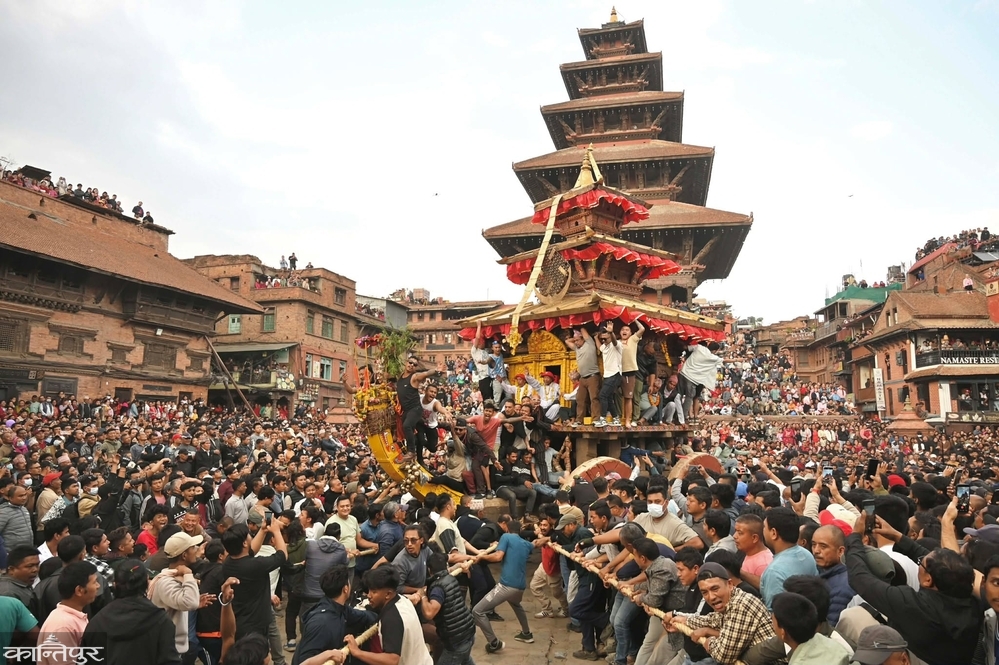
While pulling the chariot, there are 6 ropes at the front of the chariot and 4 ropes at the back of the chariot. On the first day of the procession, thousands of pilgrims participate in pulling/watching the Bhail Kha. On the first day, the youths pull the chariot from both sides in the same rhythm and voice, saying Hoste and Haise Ha... Ha... Ha.... .
The chariot-pulling procession that starts from Mari Tol, the youths of the lower tol and the upper tol try to pull the chariot to their tol. .
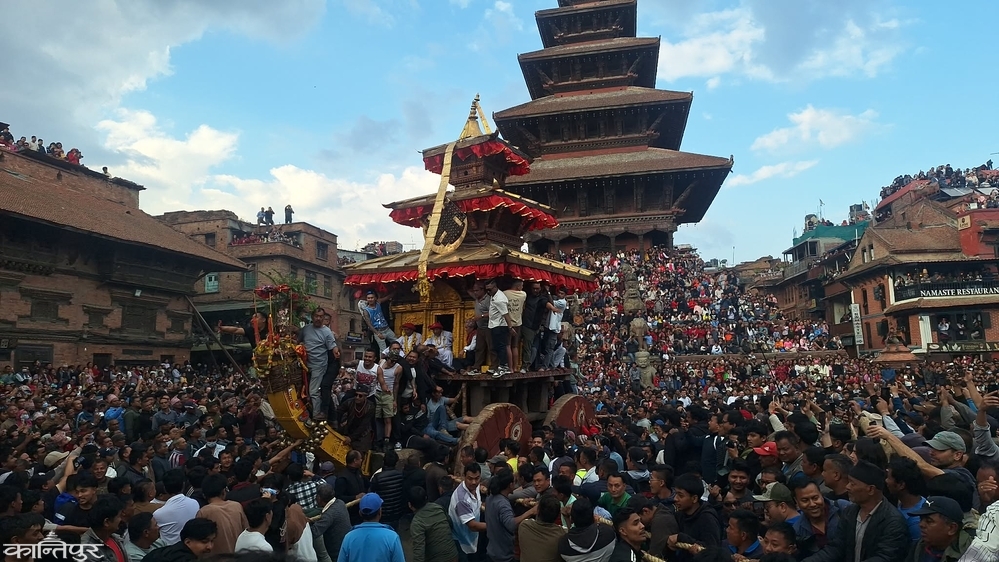
The chariot is taken from Mari tol via Gahiti, Nasamana, Banshagopal to Tekhapukhu Tol in the lower tol, and then it is taken to Dattatray via Sakotha, Sukuldhoka, Golamadhi in the upper tol. The youth of the lower or upper tol who can take the chariot to the tol is considered the winner . Then, to conclude the first day's procession, the Bhail Kha is taken to Gahiti Tol and the first day's procession is completed . On that day, in the evening, all the gods including the Ashtamatrikas are taken down from the seats of the Devgriha . It is called Dyakkahaan Bijayakegu in the local language.
On the second day, it is customary to take the Bhadrakali chariot to Ajima Dyochhen (Bhadrakali Devghar) in Khalatol in Gahitti. On the third day, a sacrifice is offered to Bhairavnath in Gahitti and the government worship is performed by the Guthi Sansthan. The meat of the sacrifice is distributed to the people of Lakulache as prasad. This is called Syaako Tyaako in the local language.
On the fourth day of Bisket, on the last day of the year, in the morning, a hand-less Yosin Dyah (Lhamaru Mha) is erected in the potter's toll in Talakwa. In the evening, on the eve of the New Year, the locals prepare to erect a 55-hand long Yosindyo in the evening in Yoshikhel toll.
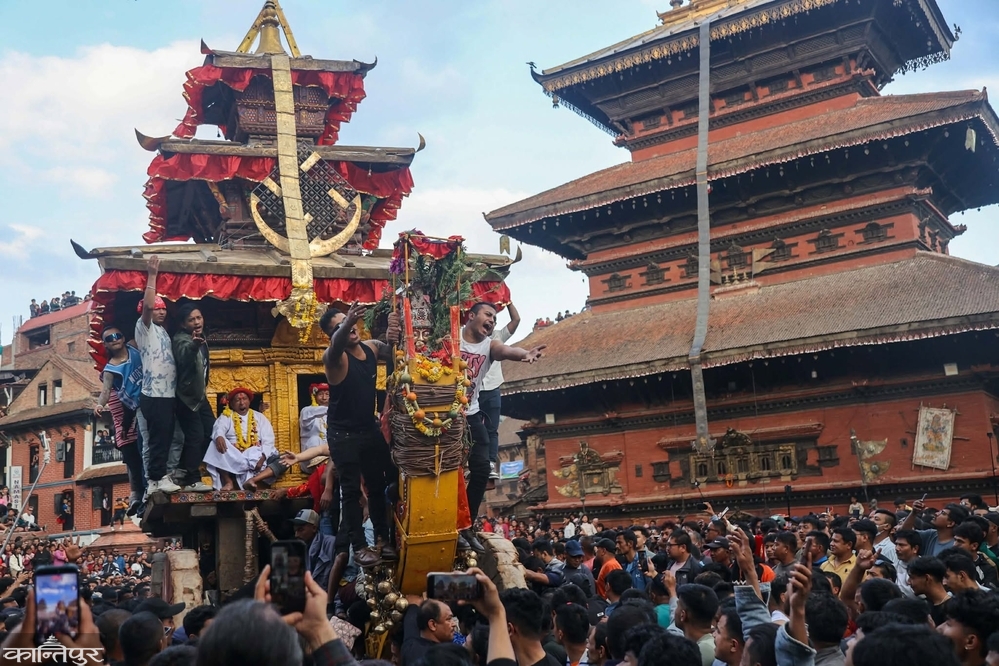
After the chariot in Gahitti is duly worshipped, the chariot is taken to Yoshikhel. Before erecting the Lingo, or Yosin Dya, it is customary for Bhairav Naikes to sacrifice a sheep. Before erecting the Yosin Dya, a ritualistic worship is performed. The pilgrims erect the 55-foot-long Yosin Dya with the help of 8 ropes, which are symbols of the Astamatrika. The Lingo is erected on the eve of the farewell of the old year and the arrival of the new year. The top and arms of the Yosin Dya, which is considered a symbol of Bhairavnath, are wrapped in new cloth. The two flags hanging on the chest of the Yosin Dya are also called the Veerdhwaja and the Vishwadhwaja of Akash Bhairav.
It is believed that the Navadurga Devgan will be present here during the erection of the Yosin Dya. After the procession of erecting the Yosin Dya, there is a special procession and worship of Dumaju in Taleju.
It is also called Shatruhanta Jatra as there is a religious belief that watching Bisket Jatra destroys enemies. On this day, the chariots of Bhairavnath and Bhadrakali are also taken to this place. As soon as the Yosin Dya is raised, the Timpwa Jatra of Barahi Devi is celebrated in Banshagopal Tole.
On the fifth day of Biska Jatra, on the day of the new year, Baisakh 1, the Lingo or Yosin Dya is lowered. Immediately after that, there is a tradition of tying the chariots of Bhairavnath and Bhadrakali to each other in the open tole. Which is called Dya Lwakigu in the local language. In the evening, the Dumaju Devi Jatra is also held. The Jatra of raising and lowering the Yosin Dya is the main activity of Biska.
On the sixth day of the Jatra, there is a Khat-Jundha Jatra of Mahakali and Mahalakshmi in the central part of the city, and on the seventh day, there is a Khat-Jundha Jatra with the Tipva Jatra of Brahayani and Maheshwori. On the seventh day, there is a Sagun Puja Jatra of all the gods and goddesses in Bhaktapur city. This is called Dya Swang Biigu in the local language.
On the last day of the Bisket Jatra, on the 5th of Baisakh, the Jatra concludes with the pulling of the chariots of Bhairav Nath and Bhadrakali. This day is called Dya (God) Thaha Bijaigu in the local language, meaning riding on the gods. On this day, like the first day, the Bisket Jatra concludes with the pulling of the chariots of Bhairav Nath and Bhadrakali. On the same day, in the morning, the handless Yosin Dya, which was erected in the local Talakwa tol, is also demolished. During the Jatra, the city is adorned with the procession of all the eight goddesses, Ganesh, Bhairav, Kumari and other gods and goddesses within the city of Bhaktapur.
Historians and cultural experts say that the Malla kings started the tradition of celebrating the Jatra for eight nights and nine days, including the chariot procession of Bhairav Nath and Bhadrakali, along with Tantric worship rituals. Ananta Dhaubhadel, a local of Mari Tole, a culture lover, says that initially the Biska Jatra was only a Jatra for Bhairav's wife Nakiju Azima. According to him, when Kashi Bishwanath Bhairav came to see the Biska Jatra in Bhaktapur, the Tantrics cut off Kashi Bishwanath Bhairav's head with a saw and kept it in Bhaktapur. Later, to enshrine Kashi Bishwanath Bhairav here, a temple of Bhairav was built in Mari Tole and the Biska Jatra was celebrated by making Bhail Kha and Nakiju Ajima's Khat, that is, the chariot of Bhairavnath and the chariot of Bhadrakali.
According to culture expert and historian Prof. Dr. Purushottamlochan Shrestha, the word Bishik has been found mentioned as a synonym for Vishwa Ketu in the Tamsukpatra of Biska Jatra Nepal Sambat 500. Prof. Shrestha says that the Jatra was first mentioned as Vishwa Jatra in the inscription of Yaksha Malla of Nepal Sambat 561 at Taumadhi in Bhaktapur (now Mari). Similarly, the word Biskyat is mentioned in the inscription written in the royal palace of Bhaktapur during the reigns of Kings Jitamitra and Bhupatindra Malla of Nepal Sambat 808 and 818. According to him, the Biska Jatra that is still going on in Taleju is called Vishwa Jatra Mahaparva.
He said that in the later period of the Sanskrit word Vishwa Ketu, it became Bisik, Biska and became Biska according to the Newari nomenclature. He said that it became Bisket due to corruption. He said that Biska Jatra is still called in Nepali language. Prof. Shrestha claims that the popular legend of Biska Jatra is wrong. He claims that Biska Jatra is only related to Bhairavnath and Bhadrakali and that the popular legend of killing snakes and connecting it with Naganagini is just a delusion. 'This festival is not only of Vishwanath Bhairav but also of his power Bhadrakali.' The symbol of Vishwa Bhairav Nath, the pair of flags (flags) hoisted by Yosin Dya is actually of Bhairav and Bhadrakali. This is a misconception that Bisca, Biska, Bisket is being used to mean that Vi means snake and Syat means killed,’ he said.
In ancient times, this festival was celebrated for only two days. In ancient times, the original festival of Bisca Jatra was to raise Yosin Dya (lingo) with Vishwaketu on the day of Chaitra Masant, hoist a pair of flags on it and lower the Yosin on the day of Baisakh Sankranti.
There is a history of the Lichchhavi celebrating this festival after they succeeded in defeating the Kiratis. In the long history of the Lichchhavi dynasty, after the fall of the ancient city of Bhaktapur, Bhaktapur, established by the Lichchhavi king Ananda Dev in the Middle Ages, remained the capital of the vast Nepal Mandal until Yaksha Malla. During this period, Bhaktapur was the capital of the Nepal Mandal for about 367 years.
Biska: Jatra is not only a unique cultural identity of Bhaktapur, but also a symbol of prosperity and civilization for all mankind, says Prof. Shrestha. At that time, since there were extensive forests around Bhaktapur city, a large and tall wooden linga was raised so that the procession could be seen from all sides, and later a pair of flags were added, he said. It is said that the practice of also holding the procession of Kashi Vishwanath and Bhadrakali in the procession, which lasts only two days, began in the middle of the Malla period.
History mentions the contribution of Bhaktapur's Vishwa Malla, Gangarani, Jagjyoti Malla, Jagat Prakash Malla, Jitamitra Malla, and Bhupatindra Malla to the tradition of organizing the Biska Jatra in Bhaktapur, from making chariots of Bhairav and Bhadrakali to the Jatra Puja festival of other gods and goddesses.
Overall, the Bhaktapur branch of the Guthi Sansthan has been taking the responsibility of celebrating the Biska Jatra in Bhaktapur. The Guthi Sansthan has been managing the necessary budget for making the chariots and bringing the Yosi Dhya. Similarly, the main responsibility of the Guthi Sansthan is to arrange animals and birds for sacrifice at various monasteries and temples for the Jatra, which lasts for eight nights and nine days, and to arrange materials according to the rituals for the worship.
Even after the Jatra is over, the Bhaktapur branch of the Guthi Sansthan will carry out the necessary inspections, perform pujas, dismantle the chariots, and arrange for the safe storage of the materials, said Ananda Karmacharya, the head of the institute. According to him, an annual budget of Rs 4 lakh is allocated to run the Biska Jatra in Bhaktapur. But she said that Rs 28 lakh 64 thousand 265 was spent on this year's Jatra. The institute's head Karmacharya said that this Jatra is being run under the trust of the Guthi.

