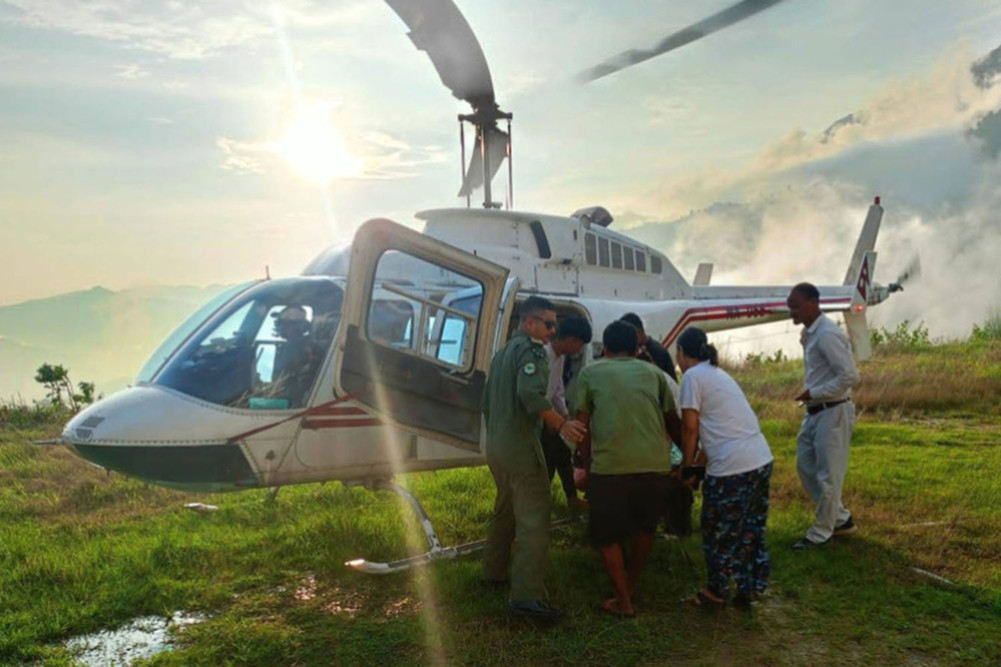
The Ministry of Home Affairs has decided to give priority to rescue operations by revising the 'Helicopter Flight Procedures in Prohibited Areas 2075'.
We use Google Cloud Translation Services. Google requires we provide the following disclaimer relating to use of this service:
This service may contain translations powered by Google. Google disclaims all warranties related to the translations, expressed or implied, including any warranties of accuracy, reliability, and any implied warranties of merchantability, fitness for a particular purpose, and noninfringement.
The government has made helicopter rescue flights in restricted areas of 13 districts of Nepal easier and faster. The Ministry of Home Affairs has decided to give priority to rescue operations by amending the 'Helicopter Flight Procedure in Restricted Areas 2075'.
On Chaitra 10, 2005, Home Minister Sudhan Gurung decided to ease the process of rescue flights keeping in mind human sensitivity, said Pratap Jung Pandey, President of the Airline Operators Association.
According to the new arrangement, flights can now be made immediately to rescue any sick or injured person in restricted areas and the necessary documents will be submitted to the Home Office within 24 hours of the completion of the flight.
The Airline Operators Association had submitted a memorandum to the Home Minister on Chaitra 17, complaining that the process of obtaining flight permission in restricted areas was extremely impractical and cumbersome.
The businessmen argued that the citizens' fundamental right to health was also hampered due to the existing system of obtaining permission from four bodies - the Ministry of Home Affairs, Local Administration, Ministry of Tourism and Civil Aviation Authority - due to which rescue operations could not be carried out on time.
Association President Pandey had demanded that these processes be brought under a 'single-door system'. Addressing that demand, the Home Ministry has made the current relaxed arrangement.
According to an official of Air Dynasty, after the new directive, rescue flights can now be operated immediately in coordination with the Chief District Officer of the concerned district. After the flight, detailed details of the patient, information from the trekking company or, if a local citizen, details related to it will have to be submitted to the Ministry of Home Affairs within 24 hours.
It is believed that this will be of great help in saving the lives of foreign tourists and domestic citizens, especially in remote and restricted areas.
Some tourist and border areas of Nepal have been declared 'prohibited or controlled areas' from a security and strategic point of view.
Various parts of 13 districts of Nepal are considered controlled areas in the restricted areas. These include Upper Mustang, Upper Dolpa, Gorkha's Manaslu and Chum Valley, Nar-Phu in Manang, Humla, Mugu and some parts of Taplejung, Darchula, etc.
These areas are mostly border areas connected to Tibet. Due to the unique culture, biodiversity and national security sensitivity here, foreign tourists are prohibited from entering freely. To visit these areas, tourists must obtain a special permit from the Immigration Department. You cannot go alone (at least two people should be there), you must be accompanied by a licensed guide and pay a high fee (for example, $500 for 10 days in Mustang and Dolpa).
Due to these strict rules, you were previously forced to wait for a long process even for emergency rescue, which has now been ended by the new decision of the Home Minister.
Two helicopters to be kept on standby for use in disasters