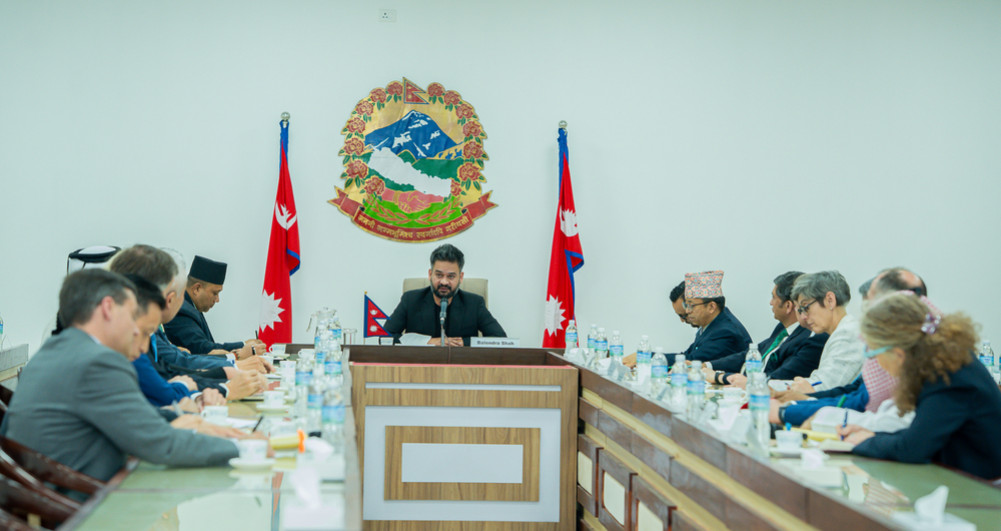
Breaking with the tradition of haphazard courtesy meetings with ambassadors in the past, Prime Minister Balendra held a group meeting with 17 ambassadors at once on Wednesday.
We use Google Cloud Translation Services. Google requires we provide the following disclaimer relating to use of this service:
This service may contain translations powered by Google. Google disclaims all warranties related to the translations, expressed or implied, including any warranties of accuracy, reliability, and any implied warranties of merchantability, fitness for a particular purpose, and noninfringement.
Breaking the tradition of meeting ambassadors one by one in a haphazard manner in the past, Prime Minister Balendra Shah held a group courtesy call on ambassadors and heads of missions from 17 different countries at Singha Durbar on Wednesday. Earlier on Wednesday, the Ministry of Foreign Affairs had also separately briefed all ministers on Nepal's diplomatic code of conduct for the first time.
These two separate steps by the government are being seen as an initiative to restructure Nepal's diplomacy. Diplomatic experts have analyzed that this has led the government to strengthen its policy in diplomacy, reduce mixed messages, and adopt an institutional and integrated approach rather than one based on personal influence. The group meeting between the Prime Minister and ambassadors was not just a simple courtesy but also a diplomatic restructuring, says retired Nepali Army Lieutenant Colonel Binoj Basnyat, an expert in geopolitical affairs. "This clearly shows that Nepal is trying to move from reactive, individual-centric, party-based diplomacy to integrated, state-centric diplomacy," he said.
Since 2063, prime ministers have often held courtesy meetings with ambassadors individually. Neither officials from the Ministry of Foreign Affairs were present at such meetings, nor was the Ministry of Foreign Affairs formally informed or recorded. Such a practice has been criticized as a clear deviation from the diplomatic approach. It has been criticized as being limited to the influence of the person in power.
There have been clear signs of a change in that practice since Wednesday. In the joint meeting, Foreign Secretary Amrit Bahadur Rai welcomed the ambassadors and presented the government's priorities, which has restored the institutional role of the Ministry of Foreign Affairs. In a five-minute address at the meeting, Prime Minister Shah clarified his priorities on the security of Nepalis employed abroad, good governance, economic development, and balanced relations with neighboring and partner countries. 'Peace should be our common priority,' Prime Minister Shah said in the meeting.
Prime Minister Shah also emphasized strengthening relations with neighbors, friendly countries, and development partners based on trust, mutual respect, and shared prosperity. He said that strengthening relations with friendly countries is the government's priority. Prime Minister Shah also said that the government is committed to creating a conducive environment for investment, encouraging entrepreneurship and supporting sustainable development. Representatives from India, China, the US, the UK, Japan, France, Germany, Saudi Arabia, Qatar, Israel, Pakistan, Bangladesh, Sri Lanka, South Korea, Switzerland, Egypt and the United Nations participated in the meeting.
The group meeting with the ambassadors makes it clear that Nepal is trying to move from reactive, individual-centered, party-based diplomacy to integrated and state-centered diplomacy. - Binoj Basnyat, expert on geopolitical affairs According to the Ministry of Foreign Affairs, the ambassadors congratulated the Prime Minister and extended best wishes on behalf of their heads of state and government. They have also expressed their commitment to continue cooperation and cooperation to work for the benefit of the new government and the Nepali people. Expressing support for the new government, some ambassadors informed that their countries are making new plans for cooperation.
However, details of such cooperation have not been made public. ‘The meeting witnessed a positive atmosphere,’ said a foreign ministry official who attended the meeting on condition of anonymity. ‘The international community is on our side, but the challenge is how to utilize this goodwill.’
Foreign Minister Shishir Khanal, the Prime Minister’s Political Advisor Asim Shah, and Chief Secretary Suman Raj Aryal were also present at the PM-ambassadors meeting. According to an official from the Ministry of Foreign Affairs, another meeting has been prepared with 11 more ambassadors.
Before the meeting between the Prime Minister and the ambassadors, Foreign Secretary Rai had briefed the members of the Council of Ministers on Wednesday about Nepal’s foreign policy and diplomatic code of conduct. The code of conduct, issued in 2077, has been rarely implemented in practice. The code of conduct covers diplomatic etiquette, the limits of the role of ministers, and the standards to be followed when meeting foreign representatives.
The Ministry of Foreign Affairs has urged ministers to meet, invite and consider their own level only after arranging the level as much as possible. Secretary Rai, on behalf of the Ministry of Foreign Affairs, has urged the ministers to take decisions on participation in the program only after getting information about the level and scope of work of other people invited to the program, understanding whether the nature of such program/function and the purpose of the invitation are in line with the national interest. It has been said that if there is a high-level representation from the government in such a program, many other high-ranking officials should not be present.
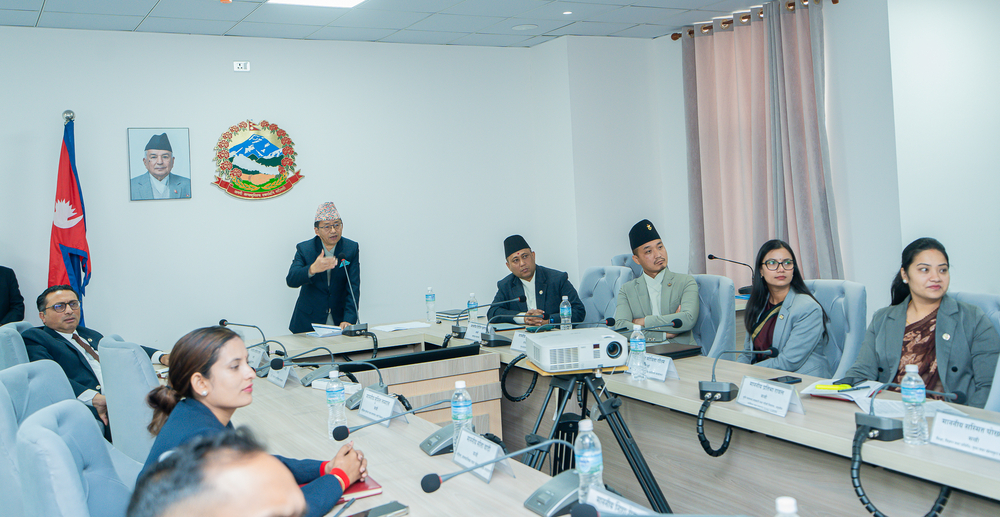 The code of diplomatic conduct states that a record of important parts of the conversation in a courtesy meeting, formal talks or meetings with foreign officials should be kept and such notes should be sent to the Ministry of Foreign Affairs. Former Ambassador Shambhuram Sinkhara says that these steps by the government are positive and welcome. He says that in the past, the tendency of leaders to meet informally with ambassadors while ignoring the Ministry of Foreign Affairs has weakened Nepal's international image. 'Such meetings were in a way careless and irresponsible,' he said.
But Singhada believes that the new government should clarify what changes it intends to make in diplomacy. The Rashtriya Swayamsevak Sangh (RSS) has committed to a ‘balanced and dynamic’ foreign policy in its manifesto. Although the meaning of balance is clear, he said that what constitutes dynamics should be clearer. ‘Both continuity and change are necessary for a dynamic policy,’ he said. ‘A government that has come through major changes should clarify what changes it wants to bring in foreign policy.’
Basnyat, an expert on geopolitical affairs, also says that the format of the joint meeting has sent an important message. Especially at a time when regional power competition is increasing, meeting all the ambassadors at once will not show unilateral preferences or bias in Nepal’s relations with other countries, he said.
‘It is not normal to call everyone at once, this is a message in the context of the growing competition between India, China and the US and Western powers,’ he said. ‘When everyone is put on the same platform, there is no one-sided bias towards anyone.’ He said that the real test of the government will be whether this symbolic step can be transformed into a long-term policy.