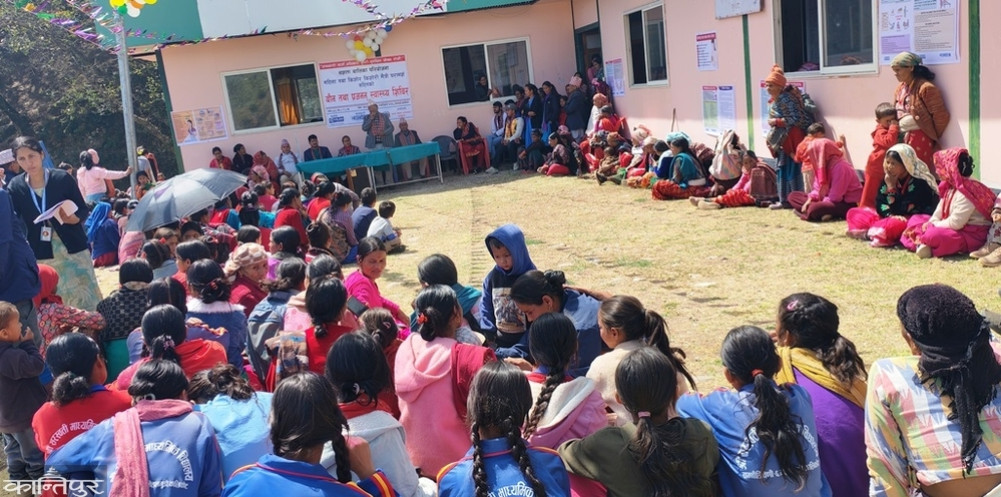
Due to child marriage, having many children, and the burden of household chores, the problem of uterine prolapse has become widespread among women in Kalikot.
We use Google Cloud Translation Services. Google requires we provide the following disclaimer relating to use of this service:
This service may contain translations powered by Google. Google disclaims all warranties related to the translations, expressed or implied, including any warranties of accuracy, reliability, and any implied warranties of merchantability, fitness for a particular purpose, and noninfringement.
A 62-year-old woman from Sannitriveni Rural Municipality-6, Budgaun, fell from a tree on 10 Poush, 2078 and her uterus fell off. She sold her land and spent 350,000 rupees for treatment at a teaching hospital in Kohalpur, but it did not fully heal. She has changed the ring she had inserted into her uterus four times during this period. She is suffering from the problems of ring insertion, pain and bleeding. ‘When it hurts so much, I feel like I could die now,’ she said, ‘I can’t even sit or stand up, the blood keeps flowing.’
Raku Serijula, a relative of hers, got married at the age of 12. She gave birth to her first child, a daughter, at the age of 15. After three daughters were born in a row, the fourth child, a son, was born. The fifth child, a daughter, was born in the hope of another son.
Three daughters are married. The youngest daughter is in class 9. After falling from a tree, she had to sell her land to pay for her treatment, and her 38-year-old son is currently working as a watchman in Mumbai, India. The woman, who is suffering from uterine problems, said that she was forced to hide her illness by cursing fate for having to stay at home sick. ‘The disease was not cured. Neither the land remained, only the son left home,’ she said, ‘There is no visible illness. It would have been better to die than to live like this.’ The woman said that she came to a camp organized at a health post for treatment because the bleeding did not stop even after putting a ring on her.
A 49-year-old woman from Ujel village in Sannitriveni is a mother of 9 children. After giving birth to 7 daughters in anticipation of a son, she finally gave birth to two sons. Her youngest son is 9 years old. She has been experiencing problems with her uterus since the birth of her fifth daughter. She recalled that she had gone to the distant Jit Bazaar to buy rice within 9 days of her daughter's birth and had a problem with her uterus when she returned carrying a 50-kilogram sack of rice. 'My father (husband) had gone to India. There was no grain in the house, there were many people to eat, so we had to go to Jit Bazaar to bring rice,' she said. 'From that time on, the problem with her uterus started. Even though she was always leaking urine and blood, she had to fall ill because she did not tell her husband about it.'
After hiding the problem from her husband and suffering from pain, she gave birth to four more children. ‘I have had uterine problems for 13 years,’ she said, ‘I have had the ring inserted eight times, and the bleeding will not stop. It is very difficult to bear the pain inside the body with household chores and festivals.’ She said that although the uterine pain was not painful when she was young, it is more painful now.’
A 70-year-old woman from the same place has been trying to have the ring inserted in her uterus for 3 years. Despite having the ring inserted 8 times since 2080, her pain is the same. She has given birth to 9 children, 3 daughters and one son are alive. She says that her uterus has fallen out due to having many children and household chores. Another local woman, who has been suffering from uterine problems for seven years, has had the ring inserted in her uterus 15 times and the pain is the same. She said, ‘The bleeding is just a leak.’ It is shameful and disgusting to even go out in society.' She said that only four of her 12 children survived. She said that even though she goes to health camps organized in the village and the local health post to get the ring inserted, the situation remains the same due to household chores.
It has been found that most women here have been suffering from the problem of prolapsed uterus for years due to giving birth to many children at a young age, doing heavy work, and lack of health awareness. Last week, 13 women here who were suffering from uterine problems took the facility of inserting a ring in their uterus through the Mehlakudi health post at the two-day sexual and reproductive health camp organized in Sannitriveni rural municipality.
Durga Shahi, a health worker working at the district hospital, said that although the women who came to the camp avoided them out of shame, saying that they were other patients, as she is also a psychologist, when she investigated the problem, half of those who came to the camp found uterine problems. ‘Many women here suffer from uterine prolapse,’ said Shahi, ‘The health condition of women in the village is very complex.’
Dr. Prakash Poudel, who was deployed at the camp, said that uterine problems were seen in most of the mothers who had given birth to many children after child marriage. ‘The health condition of women in rural areas is poor. Most of them were found to have uterine problems due to child marriage, early pregnancy (pregnant at a young age) and having many children,’ he said, ‘I found that they had been suffering from uterine problems for years due to lack of proper diet, birth spacing, rest and family care.’
Health worker Neelam Sanjyal said that most of the women in villages including Raku, Mehelmudi and Mumra in Sannitriveni have uterine prolapse. According to him, the number of women who come to the Mehelmudi health post every month to have the ring inserted into the uterus is 12 to 15.
Village council chair Mohan Bahadur KC said that it was easy to identify the disease in the camp organized targeting women and adolescents of Sannitriveni. He said that general patients were treated at the village camp and 9 people with complex conditions were referred.
In a survey conducted earlier by the sports organization with the support of Plan International Nepal, women and adolescents here had more stomach pain problems, so there was a demand to conduct a sexual and reproductive health camp through the Empowered Girls Project, said Parbati Singh Sanjyal, vice-chairwoman of Sannitriveni rural council.
In the camp, doctors from the One-Stop Crisis Management Center at the District Hospital Manma, Dr. Prakash Poudel, Dr. Kamalraj Baral of Raskot Municipal Hospital, health workers Durga Shahi, Deep Bahadur Rawat, Babita Shahi and others provided examination and treatment services. Prem Chaulagain, Monitoring and Evaluation Officer of the Empowered Girls Project, said that 519 people have availed services at the camp. According to him, 153 adolescents and 366 women and men have availed services. Chaulagain said that free medicines were provided to the adolescents who came to the camp along with counseling on safe menstruation, birth spacing, hygiene and nutrition. He said that most of the 450 people who availed services at the camp organized in Narharinath two months ago were women. Dr. Darshan Raj Pandey, who is involved in the camp in Narharinath, said that most of the women who came to the camp had problems with vaginal discharge and back pain. He said that the state should be active against child marriage in Kalikot and also said that a teenager who had not yet turned 18 was found to be a mother of two children.
Information Officer and Public Health Officer of the Health Service Office, Katak Bahadur Mahat, said that the number of women suffering from uterine prolapse in Kalikot is very high.
Last year, the highest number of patients with uterine prolapse was 217 from Narharinath, while the lowest number was only four from Palata. Since last Shrawan, the district hospital has seen a higher number of patients from Narharinath. This year, out of the 41 patients with uterine prolapse, 29 have had their rings placed.
Kalikot District Hospital MDGP Dr. Shubh Narayan Thakur said that rubber rings should be placed on the first and second stages of uterine prolapse and cleaned every three months. He said that those who have reached the third and fourth stages need surgery, so they are being referred to Karnali Provincial Hospital, Surkhet or Karnali Institute of Health Sciences, Jumla.