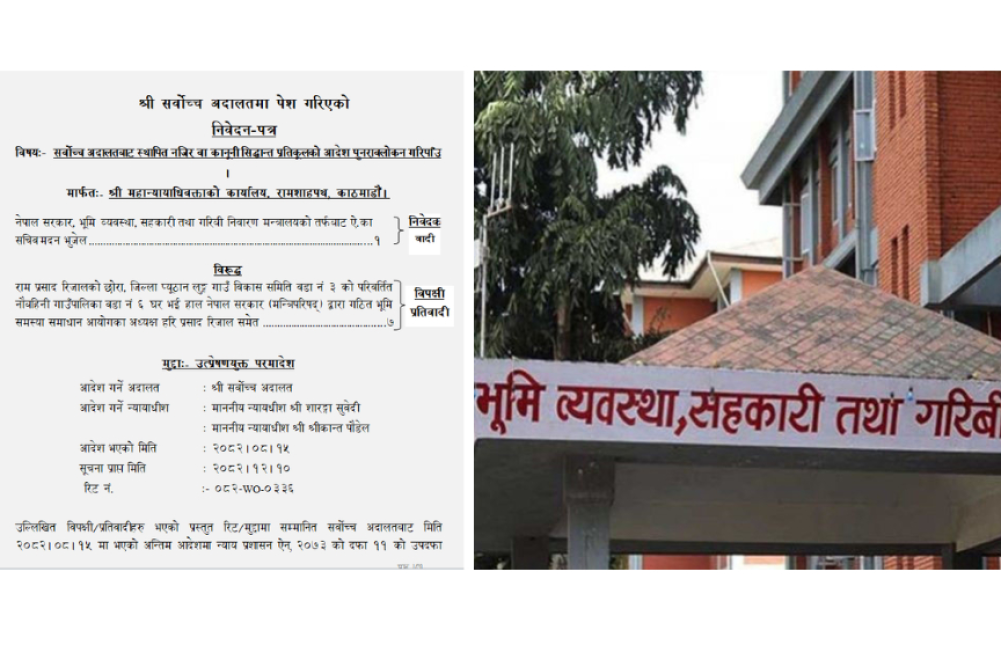
The Ministry of Land Management, Cooperatives and Poverty Alleviation filed a review petition with the Supreme Court on Wednesday, claiming that the Supreme Court's verdict on 15 Mangsir 2082 has hindered the resolution of the land and squatter problem.
We use Google Cloud Translation Services. Google requires we provide the following disclaimer relating to use of this service:
This service may contain translations powered by Google. Google disclaims all warranties related to the translations, expressed or implied, including any warranties of accuracy, reliability, and any implied warranties of merchantability, fitness for a particular purpose, and noninfringement.
The Balendra Shah-led government has filed a review petition in the Supreme Court, claiming that the Supreme Court's decision on 15 Mangsir 2082 has hindered the resolution of the squatter problem, including land.
Secretary Madan Bhujel filed a review petition in the Supreme Court on Wednesday on behalf of the Ministry of Land Management, Cooperatives and Poverty Alleviation.
On 23 Asoj 2082, the Sushila Karki-led government had decided to abolish the then Squatter Problem Resolution Commission and the district structure. After the ministry received a complaint that the commission had become a recruitment center for cadres and was involved in financial irregularities, the then Land Reforms Minister Anil Kumar Sinha had taken the proposal to abolish it to the Council of Ministers. Seven people, including the then chairman of the commission, Hari Prasad Rijal, had filed a writ petition in the Supreme Court against the government's decision.
The Supreme Court had initially issued an interim order in the writ petition. On November 15, a bench of Justices Sharanga Subedi and Shrikant Poudel had issued a mandate to 'allow the Land Problem Resolution Commission and its district committees, office bearers and employees to continue to function transparently and effectively within the framework of the Constitution of Nepal, prevailing laws and the mandate of its formation'.
After the Supreme Court's decision required the commission to be restored and function, Pratibha Rawal had instructed Secretary Bhujel to conduct a review as soon as she took office as the new minister. She had formed a team from the Land, Law and Attorney General's Office to prepare for the review as the new government after the mandate could not work in the old form and by giving responsibilities to the office bearers as per the Rashtriya Swayamsevak Sangh (RSS) pledge, the government's 100-point agenda and the good governance roadmap.
In the review petition prepared by the team, it is claimed that the previous decision of the Supreme Court should be nullified and the matter should be resolved. The Ministry of Land Reforms has informed that if the Supreme Court grants the go-ahead, the new government will form a powerful commission or authority to resolve this problem.
‘The Land Problem Resolution Commission is moving towards a sustainable solution with a broad goal of providing land to landless Dalits and landless squatters through the restructuring of the Commission, and to systematize other issues ensured by the constitution, including unorganized settlements,’ the petition states. ‘A powerful commission/authority must be formed to formulate laws related to the implementation of fundamental rights, to sustainably resolve the problems related to land measurement, mapping, recording and distribution, to control and discourage unauthorized use and encroachment of public, community and government land, structures, heritage, forest areas, parks, etc., and to protect, promote and manage the said areas, so the decision must be reviewed.’
The Land Problem Resolution Commission Formation Order, 2081, has been revoked in the petition, which has argued that the previous decision should be nullified to create a legal and structural mechanism in accordance with the changed context, to adopt and implement the prevailing legal system, and to solve the land problem in a long-term sustainable manner.’
The government has also submitted points 91 and 92 of the 100-point agenda on governance reforms along with the application.
The agenda, which was passed by the Council of Ministers on Chaitra 13, mentions that the collection and verification of integrated digital data of landless squatters and unorganized settlements across the country will be completed within 60 days.
Similarly, to solve the problem within 100 days, it has been mentioned that a household survey will be conducted in coordination with the local level, clear criteria will be implemented for identifying real beneficiaries, records of public, public and Guthi land will be updated, mapped and a database based on Geographic Information System will be prepared.