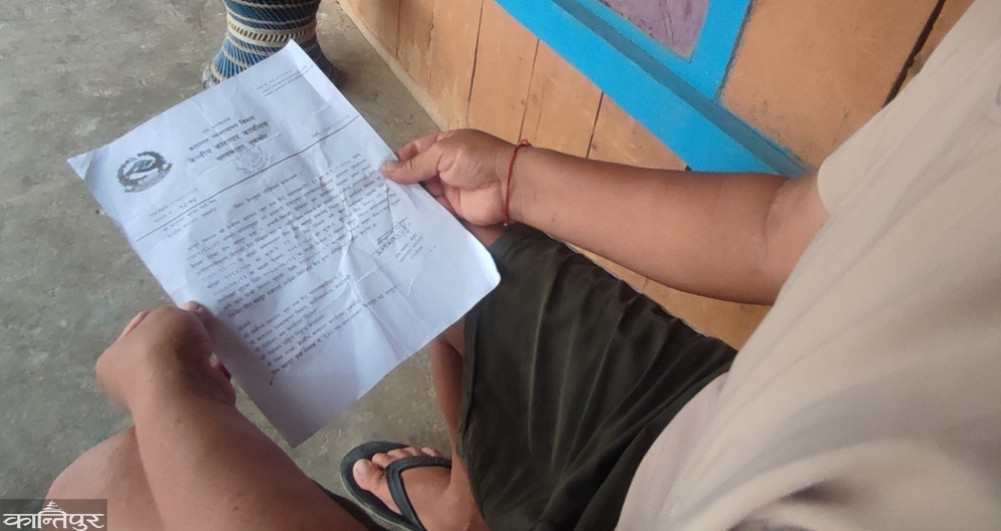
Deep Bahadur of Chipleti, who spent 13 years in prison in a rhino-related case, was released after a delay of 61 days following an order from the Supreme Court.
We use Google Cloud Translation Services. Google requires we provide the following disclaimer relating to use of this service:
This service may contain translations powered by Google. Google disclaims all warranties related to the translations, expressed or implied, including any warranties of accuracy, reliability, and any implied warranties of merchantability, fitness for a particular purpose, and noninfringement.
After completing his 13-year prison sentence, he was sure to be released from prison on Magh 2. But when he was told that he would have to spend another seven years in prison on the same day, Deep Bahadur Praja Chepang of Chipleti, Korak, Chitwan, could not help but cry. After the matter reached the Supreme Court, an order was issued in Deep Bahadur's favor. Due to this, he was released from prison on Chaitra 3, 61 days after the date of his release.
Khurkhure Bazaar is located east of Bharatpur, the Chitwan district headquarters. Chipleti village of Korak, located in Rapti Municipality-10, is located north of Khurkhure on the east-west Mahendra Highway, about 20 kilometers from Bharatpur. When you reach Chipleti in the lower part of Korak, the hilly region, you come to the forest area. Some youths from the village beyond the forest were once involved in a rhinoceros-related case. Some people were arrested in Chipleti, Samitar and the nearby Kalikhola area on charges of being involved in rhino poaching in the past.
Those who were arrested have also started to be released. Dip Bahadur of Chipleti, who was sentenced to 13 years in prison and a fine of 80,000 rupees in the rhino case, was being released on Magh 2 after completing his sentence. At the time of his release, the prison administration informed him that he would have to serve time in prison in two more cases of the District Forest Office, Chitwan. Dip Bahadur, who was arrested on the day of Maghe Sankranti in 2069 BS, had reached Nuwakot Prison a year and a half ago via Chitwan Prison and Parasi Prison in Nawalparasi.
The Chitwan National Park had filed three cases against Dip Bahadur on charges of killing rhinos and selling their horns. In two cases, he was sentenced to 15 years in prison and in one case, he was sentenced to 13 years in prison and a fine of 80,000 rupees. The Supreme Court acquitted Deep Bahadur in two cases filed by the park, which carried a 15-year prison sentence. The prison sentence and fine in the other case remained. But Deep Bahadur claims that he was not involved in any of the incidents. He had gone to Saudi Arabia for employment on Magh 10, 2063 BS. The eldest son of the
family, Deep Bahadur, was born in 2039 BS. He returned home after living abroad for four years for the first time. After that, he started coming and going frequently. In 2069 BS, he returned home after falling ill and unable to work. He was arrested here that same year. ‘I was accused of an incident that happened around 2064/65 BS. How could I kill rhinos when I was not in Nepal? That is why I was acquitted by the Supreme Court in the case that led to my 15-year prison sentence,’ said Deep Bahadur. The incident in which he was imprisoned for 13 years dates back to 2060. He claims that the sentence was upheld even though he denied it.
He was being sought for his involvement in the 2060 incident and was absconding. He was caught in the process. After reaching the prison, it was learned that the Chitwan District Forest Department had also convicted him in two cases and sentenced him to five years in prison in one case and seven years in prison in the other. It was learned that the forest department had also put Deep Bahadur on the absconding list. Then his younger brother Arjun went to the District Forest Department. 'I went to the District Forest Department in 2074 BS and told Deep Bahadur that he had been in Bharatpur Jail since 2069 BS, and a prisoner certificate was issued. After this, it turned out that he was not absconding. Based on the prisoner certificate, the forest department's sentence was completed in 80/81 BS,' said Deep Bahadur's brother Arjun.
If the forest department were to count from the year Deep Bahadur was arrested, his forest imprisonment would have been completed in 2076 BS. There is a provision that no matter how many cases there are for the same crime, the sentence will be the same whichever is longer. The District Forest Department had filed two cases and sentenced him to five years and seven years in prison. According to the law, Deep Bahadur would have served seven years in prison in the forest case. Moreover, Chitwan National Park had also sentenced him for the same crime. That is why Deep Bahadur was confident of being released from jail on Magh 2. ‘But in 2074 BS, when the District Forest Department prepared the prisoner certificate, it was said that he would be released after being released. Based on that, even though the park imprisonment was completed on Magh 2, it was assumed that the forest imprisonment would begin after that,’ said Deep Bahadur.
When his brother Arjun, who was in Chiplet, came to know about this news, he went to meet his brother. After receiving a reply that nothing could be done until another order came from the court, Bhai Arjun started looking for a lawyer in Kathmandu. Senior advocate Gopal Krishna Ghimire decided to fight the case for Deep Bahadur. A writ of habeas corpus was filed in the Supreme Court demanding Deep Bahadur's release.
Senior advocate Ghimire said that it was argued that Deep Bahadur could not be detained further as per the provisions of the Criminal Offences (Determination and Implementation of Punishment) Act 2074 BS and the previous old Civil Act. Section 36 of the Criminal Offences (Determination and Implementation of Punishment) Act 2074 BS contains provisions on how to implement the imprisonment sentence for various offences.
Section 36 (1) provides that if a person who is serving a sentence for more than one offence is sentenced to imprisonment, if the period of sentence as per the earlier judgment is greater than or equal to the latest judgment, the earlier sentence must be implemented. Similarly, if the period of the subsequent sentence is longer than the previous one, it is mentioned that the period of the latest sentence should be extended by the same period. Legal practitioners argued that this provision would not result in any other punishment for Deep Bahadur other than the prison sentence imposed by the park. The court ordered accordingly.
According to the order of the Supreme Court's Cases and Writ Division on Chaitra 2, Nuwakot Prison released Deep Bahadur from all three cases filed in Chitwan District Forest and Chitwan Park on Chaitra 3. Deep Bahadur, who was released 61 days later than he should have been released, is now at home. Prison Administrator of Nuwakot Prison, Bhesh Bahadur Kunwar, said that Deep Bahadur could not be released immediately due to the details of the letter from the Forest Office. 'Why would we keep any prisoner for more time in matters that are done according to the rules and the forest prisoner certificate was to be kept for more time after he was released from prison in other cases?' He was released after the court corrected it,' Kunwar said.
15-year prison sentence completed, unable to pay fine of Rs. 1.1 million in jail
Deep Bahadur Praja Chepang's house and Kajiman Praja Chepang's yard are connected. Both are facing rhino-related cases. Kajiman is facing nine cases. The maximum prison sentence for him in these cases is 15 years. The Bharatpur Prison Office has stated that he will have to pay an additional Rs. 1 million 90 thousand in various cases.
Kajiman was arrested in 2067, two years before Deep Bahadur. 'According to the sentence imposed by Chitwan National Park, his 15-year prison term ended on last Falgun 15. But he is in jail because he has not paid the fine,' said Chetnath Dhungana, Information Officer of Bharatpur Prison. Kajiman's wife, Dilmaya Praja Chepang, says she has no way to pay the fine.
Chitwan National Park had arrested Dilmaya along with Kajiman. The park had imprisoned her for 10 years. But she was released after the Supreme Court reduced it to five years. 'The children were young. The head of the household and I were also arrested. The case was expensive. I haven't been able to pay the old debt. How will I pay the fine now?' said Dilmaya.
The park has claimed that Kajiman was involved in rhino poaching. He was arrested by the Central Investigation Bureau (CIB). 'We didn't know where he had been living since leaving home. They say that he sold the horns of so many rhinos. We haven't seen anything.' Even if they complete their sentence, there is no way to get out by paying the fine,' she said.
Dilmaya and Kaziman have two sons and a daughter. The daughter is married. The sons have gone abroad to work. If the sons earn money abroad, Dilmaya says that they will pay the fine with that money. Bharatpur Jail Information Officer Chetnath Dhungana says that a day in jail will be deducted at the rate of three hundred rupees. If Kaziman stays in jail without paying the fine, he will not be released for another 10 years.
There is a legal provision that even if he does not pay the fine, he cannot be imprisoned for more than 10 years. 'In the past years, many people from the Chepang community have been imprisoned in the rhinoceros case. What are the difficulties they faced even when they were released after completing their sentence? We are trying to find out. "It is not known who earned money by killing the rhino, but the arrested Chepang has lost a lot," said Govinda Ram Chepang, central president of the Nepal Chepang Association.