The constitution includes all three organs of the state and the opposition parties in constitutional appointments. Although such a structure, designed to prevent the monopoly of any officeholder, is balanced and inclusive, due to lack of accountability, appointments have not been made on time to date, nor have the appointments that have been made been free from controversy.
We use Google Cloud Translation Services. Google requires we provide the following disclaimer relating to use of this service:
This service may contain translations powered by Google. Google disclaims all warranties related to the translations, expressed or implied, including any warranties of accuracy, reliability, and any implied warranties of merchantability, fitness for a particular purpose, and noninfringement.
Even after a month since the February 21 election, the Constitutional Council, which can make appointments to vacant positions in 13 constitutional bodies, including the Commission for the Investigation of Abuse of Authority, the Election Commission, and the Human Rights Commission, is still incomplete. Even after RSVP Deputy Chairman DP Aryal was unanimously elected as the Speaker on Sunday, the council will remain incomplete for a few more days as the Deputy Speaker and the leader of the opposition party have not been elected.
Due to this, the process of appointing the vacant Chief Justice of the Supreme Court and 14 other vacant positions in 8 constitutional bodies will be delayed. This situation of not being able to appoint full-fledged office bearers in constitutional bodies is not just an administrative vacancy, but a problem that has been recurring for three decades.
According to analysts, the process of recommending the appointment of office bearers in Nepal is more inclusive and balanced on paper than in many other countries. For example, in India, the Chief Election Commissioner is nominated by a committee of the Prime Minister, a central minister, and the leader of the opposition party. In the United States, all such political-constitutional appointments are made directly by the President, which must be approved by the Senate.
However, in Nepal, the Constitution has placed officials from all three state bodies in the Constitutional Council, which is formed under the chairmanship of the Prime Minister, so that no single party or individual can monopolize power. Along with the Prime Minister, the Council also includes the Chief Justice of the Supreme Court, the Speaker and Deputy Speaker of the House of Representatives, the leader of the opposition party, and the Speaker of the National Assembly. The President appoints them only after a joint parliamentary committee consisting of 3 members from the National Assembly and 12 members from the House of Representatives has heard their nominations.
Despite such a balanced system on paper, appointments have not been made on time, nor have appointments been free from controversy, and performance is also not satisfactory. Analysts say that when evaluating the recent performance of constitutional bodies and their officials, it seems like a mechanism to set the standard for institutional failure. They say that due to political interference and lack of accountability in the appointment process and the lack of honesty and political will of the officials of the mechanism, the so-called balanced mechanism has become a tool for division of labor.
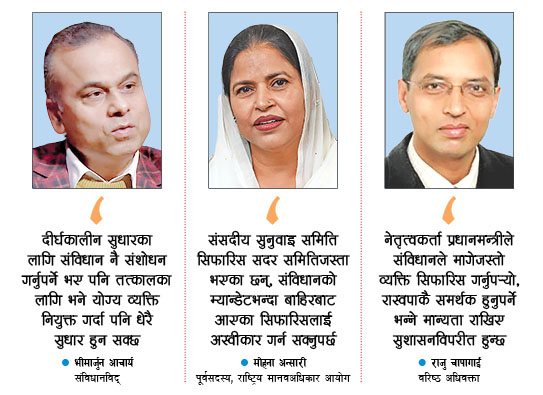
Senior leader of the National Independent Party (NISP) Balendra Shah has become the Prime Minister with a nearly two-thirds majority in parliament through the election. Now a question has arisen again, will the NISP change these constitutional bodies that have not been effective and accountable? Constitutional expert Bhimarjun Acharya says that although the constitution itself needs to be amended for long-term reforms, appointing qualified people for the immediate period will also lead to many improvements.
With the NISP winning a historic victory of 182 out of 275 seats in the House of Representatives, the agenda of institutional reform of these constitutional bodies has appeared politically feasible for the first time. But it is necessary to evaluate together, ‘Why did the structure that the constitution claims to have created a balance fail, and can the new government improve it if it wants to?’
‘What has deteriorated before is mainly due to the division of power among the members of the Constitutional Council,’ says senior advocate Raju Chapagain, ‘The Chief Justice or the leader of the opposition party was made a member of the council for checks and balances. But, we have a division and balance.’
The Gen-G movement that took place last Bhadra was not only about the increasing misgovernance in the country and the ban on social media. There were also allegations that state institutions were being influenced by politics and deviated from their constitutional role, and that anti-corruption bodies were being used as political tools. It has not been long since the Human Rights Commission had to provide an explanation at the international level to protect its legitimacy and status.
In the 40-page pledge made public in the first week of Falgun and the citizen’s contract included in it, the Rashtriya Swayamsevak Sangh (RSS) had promised to implement 100 percent ‘meritocracy’ instead of party division in all constitutional and strategic bodies of the state and bring the feeling of good governance to the people. Similarly, it has also promised to strengthen the institutional good governance of independent, competent and accountable constitutional bodies by amending the Commission for the Investigation of Abuse of Authority Act, the Constitutional Council Act and the Judicial Council Act in terms of institutional capacity, jurisdiction, appointment process, and selection of employees. Thus, the RSP has committed to ending appointments based on quotas, amending laws, and implementing a selection process based on merit and transparency.
The presence in the National Assembly is at least two years away for the RSP. Which means that the RSP will need the support of other parties to change the basic structure of the Constitutional Council. In a meeting of the House of Representatives last Thursday, RSP President Ravi Lamichhane appealed to those who were appointed on the recommendation of leaders and parties under the constitution and law to voluntarily resign and cooperate in following the law, saying, “The government will now implement a fair and competitive appointment process based on new policies, laws, standards, and norms.”
Making a commitment to reform and actually starting reform are two different things. Mohana Ansari, who has been a member of the Women's Commission and the Human Rights Commission, says that the problem has arisen because the office bearers and leaders of the Constitutional Council have set up a center to recruit their people, and if there is to be real reform, then the appointment process itself must be reformed. ‘So far, the appointment process has been compromised,’ she said, ‘the commissions have been made a place to ‘dump’ retired employees.’
Constitutional expert Acharya also says that those who have reached high positions and retired should not be appointed. ‘In the greed of such appointments after retirement, high-ranking employees work to please the leaders,’ he said, ‘Furthermore, after getting an appointment, it has been seen that decisions are made based on yesterday’s work.’ Acharya says that the performance of the constitutional body and its officials has not been satisfactory because the appointees are not honest and the process is not transparent.
Deputy Attorney General Sanjiv Raj Regmi also says that the main problem is in the appointment process. ‘The chief official of the council is the Prime Minister, the rest are only ex-officio members,’ he said, ‘But, everyone took names out of their pockets and distributed them. They did not even consider whether they met the minimum qualifications. The Secretariat should have adopted a continuous voting process by creating a roster, but that never happened.'
The Constitutional Council system has been in place since 2047 BS in the constitution. In the changed political context of 2047 BS, the participation of all three organs of the state in the council was made mandatory to decentralize power and maintain balance. Now, the Deputy Speaker has been added. 'From the beginning, the reason for having representation from all three organs of the state was that the officials appointed in this way would be publicly acceptable,' said senior advocate Chapagain, 'But, the opposite happened. All that happened was to arrange the distribution of shares among the officials of the three state bodies.'
The appointments made in Mangsir 2077 BS and Jestha 2078 BS are considered the most controversial appointments of the Constitutional Council. The then Prime Minister KP Sharma Oli had amended the Constitutional Council Act through an ordinance and appointed 52 officials in the absence of the Speaker and the leader of the opposition party. These included officials from the National Human Rights Commission, Authority, Election Commission and other commissions.
Since Oli had first dissolved the House of Representatives and made these appointments, the parliamentary hearing process could not be completed at that time. As a result, the government was accused of upsetting the constitutional balance through the ordinance. Later, a case was filed in the Supreme Court against these appointments, and the Supreme Court finally upheld it. However, the impact of this was that the Human Rights Commission, which had been in the 'A' category since its establishment, was downgraded to 'B' for the first time by the Global Alliance of National Human Rights Institutions.
Such a downgrade linked to the legality of the appointment raised serious questions at the international level about the institutional credibility of the commission. It took the commission five years to achieve its previous 'A' category. At the same time, Surya Dhungel, who was appointed as a member of the Human Rights Commission, says that the constitutional bodies should be improved by making an overall evaluation based on their performance so far. ‘The appointment process should also be re-evaluated,’ he said, ‘the issue of reforming these commissions should not be treated separately but as a matter of constitutional amendment as a whole.’
Article 284 (3) of the constitution stipulates that successors should be recommended one month before the vacancy of these bodies. However, this is probably the most violated provision of the constitution. So far, in most cases, appointments have not been made on time. Looking at past practice, another big problem after political participation in constitutional appointments is the practice of leaving these institutions without leadership for a long time.
One commissioner each has been vacant in the Authority and Human Rights Commission for a long time. Similarly, two are vacant in the Election Commission, Inclusive Commission, Madhesi, Tharu and Muslim Commissions. The constitution provides for the appointment of up to five office bearers in the Natural Resources and Finance Commission, while five were appointed earlier, and there are currently three.
Sapna Pradhan Malla has become the sixth judge to be appointed as the acting Chief Justice of the Supreme Court as the senior-most judge could not be appointed on time. As per the constitution, a recommendation should be made one month before the vacancy occurs, but Malla has become the acting Chief Justice as no new appointment was made even after Chief Justice Prakash Singh Raut retired on 18 Chaitra.
The new government's powers and limits
According to analysts, it is possible to make the appointment process more transparent and competitive even without amending the constitution. According to experts, the problem is not limited to the appointment process and political participation, there are some structural problems within the constitution itself. For example, according to Article 284 of the constitution, the Chief Justice is a member of the Constitutional Council, which recommends such appointments. On the other hand, Article 137 of the constitution has made a provision for hearing disputes against these appointments by a constitutional bench, which is also headed by the Chief Justice. Which leads to a conflict of interest. For example, it was seen in the appointment of 52 previous officials.
The Chief Justice has been a member of the council continuously since 2047, but before the 2072 constitution, there was no constitutional bench in the Supreme Court. Due to this, the Chief Justice was not mandatory in the bench hearing constitutional disputes on appointments of constitutional bodies. This would not have led to a conflict of interest. Constitutional scholars say that it should be included in the list of upcoming amendments to the constitution. Constitutional scholar Acharya says that the structure of the council should be included in the list of constitutional amendments. Former member of the Human Rights Commission Dhungel also says that ‘there is a serious problem in the structure of the Constitutional Council’.
Senior advocate Chapagain says that even if the structure is changed, it will not work much if the appointees and those who make the appointments are not honest. “We had to make the process transparent and competitive, create a roster of qualified people, and have the council secretariat regularly conduct ‘background checks’ of potential candidates,” he said. “If we can do that, the current system will also work. If we keep changing the system but keeping the intentions and culture the same, it will not improve.”
Former Human Rights Commission member Ansari says that there should be not only a parliamentary hearing of the recommended candidates, but also a public hearing. “The parliamentary hearing committee has become like a recommendation committee. We should be able to reject recommendations that come from outside the mandate of the constitution,” she said. “The practice of holding public hearings is also seen in other countries. We can adopt that here too.”
After the election results, the House of Representatives is clearly under the control of the Rashtriya Swayamsevak Sangh (RSS). It will have its own dominance in the hearing committee, and it has the ability to control all processes of government formation and lawmaking. But that ability is not enough to amend the constitution. A two-thirds majority in both houses is required to amend the constitution. The RSVP, which is two seats short of two-thirds in the House of Representatives, has zero seats in the National Assembly.
The election for one-third (20) seats in the National Assembly, which is elected by the people's representatives at the provincial and local levels, will not be held for two years. Due to this, the RSVP's presence in the National Assembly is at least two years away. Which means that the RSVP will need the support of other parties to change the basic structure of the Constitutional Council.
However, according to analysts, it is possible to make the appointment process more transparent and competitive even without amending the constitution. For that, things like inviting public applications, preparing clear criteria for eligibility, making the 'shortlist' public before recommendations, and adhering to the deadlines made mandatory by the constitution can be done.
Political analysts have interpreted the mandate received by the RSVP as a vote against the partisan politics of the old parties. However, we wonder whether the RSVP will follow the old ways or truly reform them. 'The leader is the Prime Minister. He should have recommended a person as required by the constitution on an objective basis,' said senior advocate Chapagain, 'if it is assumed that he should be a supporter of the RSP, it is against good governance. Such a recommendation will not gain legitimacy and will again be controversial.
The practice so far in constitutional bodies has made one thing clear, that a balanced structure alone is not enough for good governance, the integrity of the council members and the office bearers to be appointed is equally important. The RSP now has the strongest political opportunity in three decades. However, whether that opportunity will be transformed into institutional reforms or a new version of the old practice, the test of which will be seen in the first round of appointments to be made in the next few days.

