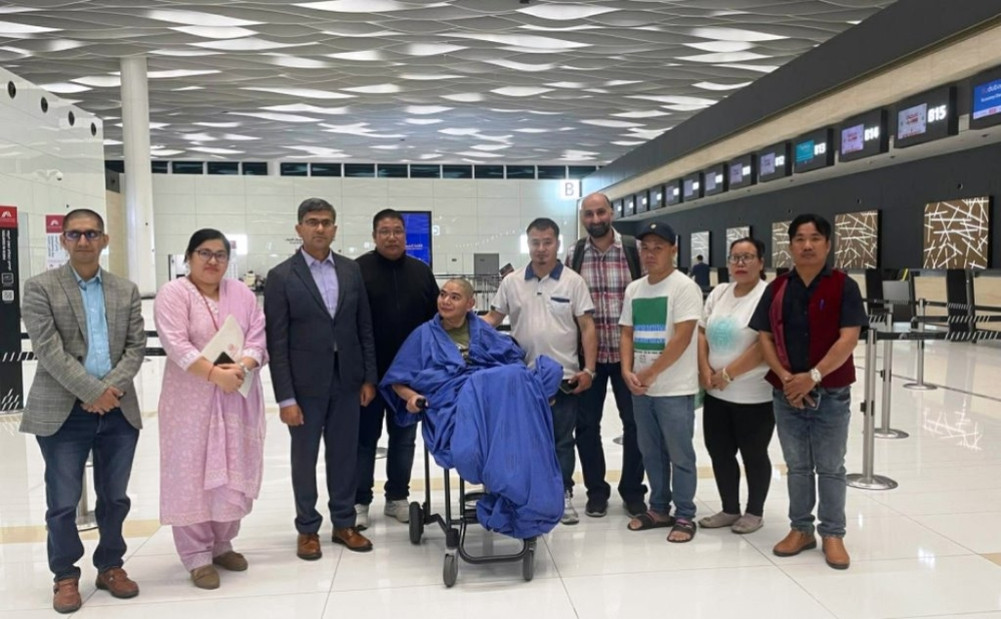
Shyam Kumar Gharti, 41, of Bhayerbonga, Tamankhola Rural Municipality-2, Baglung, had been missing for six months after illegally reaching Bahrain in 2007.
We use Google Cloud Translation Services. Google requires we provide the following disclaimer relating to use of this service:
This service may contain translations powered by Google. Google disclaims all warranties related to the translations, expressed or implied, including any warranties of accuracy, reliability, and any implied warranties of merchantability, fitness for a particular purpose, and noninfringement.
Shyam Kumar Gharti of Bhayerbonga, Tamankhola Rural Municipality-2, Baglung, who was wandering in search of work, went to Bahrain illegally in 2007. He had reached Bahrain 19 years ago through a middleman and did not have a work permit.
41-year-old Gharti went missing six months after reaching Bahrain illegally. His family members did not know what kind of work he did there. Even though his son disappeared, his deaf father Lal Bahadur Gharti could not search for his son. Within a year of Shyam's departure, his mother left Lal Bahadur alone at home.
Lal Bahadur lived in the village for a long time as a wage laborer. He did not know where his son was. In Falgun last year, his family received news from the Nepali Embassy in Bahrain that Shyam was in a coma. When the family was unable to take the initiative, the rural municipality chairman Joklal Budha, the deputy mayor of the neighboring Jaimini municipality, Harihar Sharma, and others informed the Foreign Employment Board. Gangakumari Sharma, a consultant at the Immigrant Resource Center, helped send the necessary documents to the embassy through the Chief District Officer.
The embassy could not find Shyam's company because he had gone to work illegally. Due to this, there was no way to provide insurance, relief, or other funds. Lal Bahadur, who was unaware of the process, could not search for his son. Since the embassy and diplomatic mission were not informed, it is not known what he had done for 19 years.
Shyam has been ill for the last two years. He was unidentified for a year. He was treated at the hospital there, but since he was staying illegally, the Nepal government had to pay for the treatment expenses. After his identity was revealed, he was sent to Nepal. The Nepal government was forced to pay for the treatment he received at a hospital in Bahrain to bring him to Nepal. He has lost his memory and is in a disabled state. He cannot remember how he got into this situation. Now he is in bed day and night.
His mother is not there when he returns home. His father is deaf. Since his mother has left home and his financial situation is weak, the father and son are in trouble. The rural municipality has provided him with food and accommodation expenses while he is lying in bed all day. Chairman Budha has installed a TV in his house at his own expense.
Shyam arrived in Nepal a year after starting the registration process in 2081 Falgun and sending the documents requested by the consulate and embassy. But his problem is not going to be solved. Sunita Thapa, an employee working at the Nepali embassy in Bahrain, said that the Nepal government had to pay for the treatment expenses as he was living here illegally. He said that the initiative to create a treatment fund, even though it was not possible to provide relief and insurance funds, was affected by the conflict in the Gulf countries.
Bhava Bahadur Kunwar, General Secretary of the Bahrain Baglung Contact Committee, said that after the efforts to return Shyam home were successful, they would now try to raise the treatment expenses. However, he said that the situation was affected for the time being as he was unable to leave his home due to the ongoing conflict in West Asia.
The Nepal government had paid nearly 1.5 million rupees for Shyam's treatment expenses in Bahrain. Chairman Budha said that the Council of Ministers had to make a decision to pay the amount. ‘It is not easy to get the decision of the Council of Ministers for everyone who has such a problem,’ he said, ‘When going for foreign employment, one should go according to the law and follow the procedure.’ Most of the people who die abroad every year are those who went illegally, did different work than prescribed, and did not renew their labor permits on time.
He currently lives with his father in the village of Borbonga, located in Tamankhola-2, 120 km west of the district headquarters. ‘There was a problem even in bringing them back through search and rescue, we were able to bring them back only after a lot of effort,’ said Joklal Budha, the chairman of the rural municipality, ‘Now their daily lives are running with the help of the municipality.’ He said that the municipality cannot always support them. Budha informed that even if they provide humanitarian assistance, they are in a situation of being left behind when there are procedural difficulties.’
It is not clear what they did or how much they earned because they were working illegally, said Ganga Sharma, a consultant at the Migrant Resource Center in Baglung. ‘We were able to bring them safely to the village, but their families are in distress,’ said Sharma. ‘It was necessary to create a relief fund to help people in such a situation.’ She said that those who go abroad illegally have been facing similar problems recently. She said that those who go abroad illegally do not even get treatment there, and then have to pay the expenses from Nepal.
According to the center’s data, 7 people from Baglung who went abroad illegally have died in the current fiscal year. 10 people with labor permits have died. One of them is a woman. Out of 138 workers in Baglung who fell into trouble in the current fiscal year, 58 have been rescued safely. The District Administration Office facilitated the rescue of 22 of them.
In the fiscal year 2080/81, 17 youth from Baglung also died in foreign employment. Most of the deceased are under the age of 40. The highest number of deaths are in Saudi Arabia. In 2080/81, an additional 156 people who went for foreign employment from Baglung faced various problems. Of these, 137 were male and 19 were female victims. The center provides regular counseling services to ensure that they do not face problems while going abroad. Sharma informed that more than 9,000 people have been counseled this year as well.