What are the prospects and challenges of the new government's 100-point agenda?
We use Google Cloud Translation Services. Google requires we provide the following disclaimer relating to use of this service:
This service may contain translations powered by Google. Google disclaims all warranties related to the translations, expressed or implied, including any warranties of accuracy, reliability, and any implied warranties of merchantability, fitness for a particular purpose, and noninfringement.
The 1000-point agenda for governance reforms made public by the first meeting of the new government's Council of Ministers states that a study will be conducted to develop systematic tourism in the mountains of the Far West and an actionable blueprint will be presented within a month.
Those interested in tourism development in the Far West are excited that the Ramaroshan in Achham, Badimalika in Bajura, and Api Himal trekking routes in Darchula have been included in the government's high-priority list.
Tourism activist Bharat Bikram Shah says that if the government prioritizes the development of tourism in mountains like Api and Saipal, which can become world-class destinations for mountain climbing and mountain trekking, the lives of the people in this region will change. ‘I am happy to hear that remote destinations have been included in the government’s agenda,’ he says. ‘If tourism infrastructure can be developed in mountains like Api and Saipal, not only the Far West but also the country’s tourism will reach new heights.’ Having traveled to this region many times, he said that although the mountainous geography, environment, art and culture here are sufficient to attract tourists, they are overshadowed by the lack of tourism infrastructure.’
Even world-famous mountaineers who have reached here have said that the remote mountains are very attractive from the perspective of both climbing and trekking. In 2018, Spanish climber Dr. Jorge Igocheaga, who came to climb Saipal in Bajhang, said that Saipal and the people of this region are unique. He said, ‘This region is a hidden diamond.’ One day the world will be eager to see this diamond. He is one of the Guinness Book of Records holders who has climbed all 14 mountains in the world with a height of more than 8,000 meters.
Climbers from Spain, America, Italy, Canada and other countries who arrived here with him said that they were overwhelmed by the beauty of this place. 'Words cannot describe the beauty here,' said mountaineer Jeff Haven, who is also a doctor from Spain, 'I can say with certainty that there are few mountains in the world as beautiful as this.' Those who have been there say that the attractive landscape, geographical beauty and local life of the mountains here are enchanting to anyone.
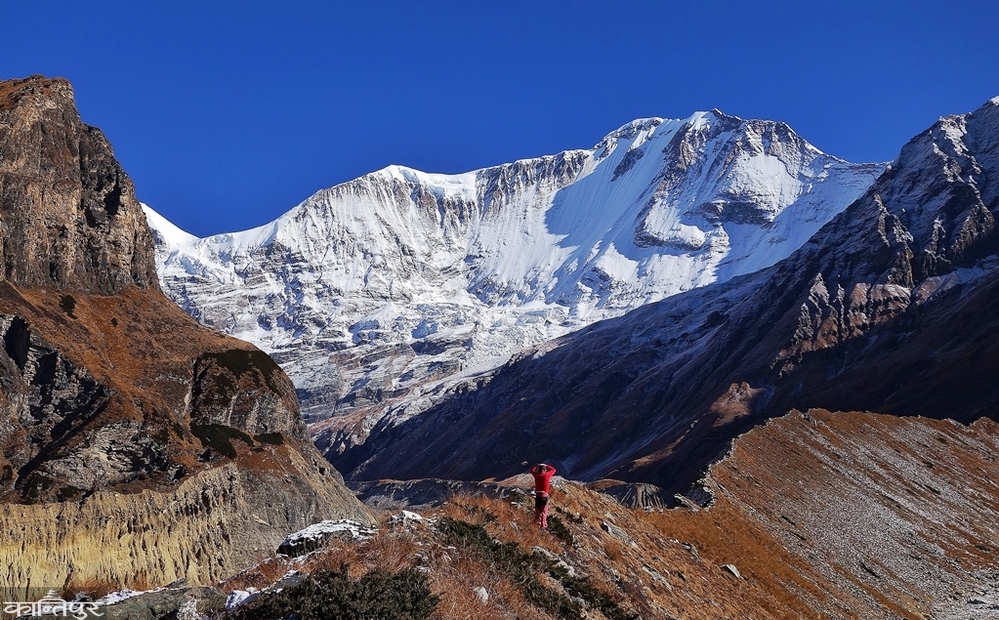
The combination of waterfalls, lakes and rivers on the way to the Api and Saipal base camps, the colorful flower-covered slopes, and the geographical and biological diversity make this area a new experience not only for climbers but also for hikers and those interested in the environment. To realize this potential, the Nepal Tourism Board's Sustainable Tourism Project, in coordination with Api Himal in Darchula and Saipal and Surma rural municipalities in Bajhang, is working to develop the Api Saipal trekking route.
Dozens of mountains can be seen during this 14-day journey. Since the altitude is not too high and the path is very easy, those who visit here say that this area can be an attractive destination not only for mountain climbers but also for anyone who wants to enjoy the trip. Residents of this area say that those who walk this path easily get the opportunity to observe birds like Danphe, Munal, and herds of Naur and Jharal. Various types of herbs and plants found in the Himalayan region also make this journey more exciting. In this area, you can also see the Himalayan life, the Malesi of Deuda, Darchula, and the Dhuleli culture of Bajhang. One of the beautiful destinations of the Far West, the hot springs on the Surmasarovar route, the vast Himalayan plateau, and the environment can also be experienced. Tourists who come here also return with a sweet experience due to the traditional way of farming, lifestyle, and warm hospitality.
A bright prospect that has been overlooked
Out of the nine districts of the Far West, Bajhang, Darchula, and Bajura are mountainous districts. About 41 percent of the total area of the Far West is mountainous. It is located in the Himalayas. Out of the total area of this province, 7,933 square kilometers are above 5,000 meters above sea level. Bajhang, the district with the highest snow area among the 77 districts of Nepal, is also in this province. 30 percent of Bajhang's land area (about 1,270 square kilometers) is in the Himalayas. The highest mountains in this province are Api Himal at 7,132 meters and Saipal at 7,031 meters. There are dozens of mountains above 6,000 meters and below 7,000 meters, including Byans, Nampa, Kapuchuli, Babbe, Firankov, Donglip, Yokapahad Rani Himal, Jethibahurani, Sunkhani, Shankhamala, Chande Shikhar, Gaisera, Gudupal, and Byansimare. There are hundreds of peaks above five thousand meters.
The biggest attraction for foreign tourists in Nepal is the mountains. Most foreign tourists who come to Nepal come to see and climb the mountains. According to the revenue collection details collected by the Department of Tourism, among the five different tourism sectors, mountaineering has the highest revenue after casinos. Since tourists spend more money during trekking and climbing in the mountainous region, the share of benefits received by tourism entrepreneurs, hoteliers and locals is still large.
However, not all the mountains in the Far West, which have great potential for mountain climbing and trekking, have been identified and promoted. Therefore, even though almost half of the geography is mountainous, this province is almost deprived of the benefits it should receive from the mountains. According to Picvisor, a web portal that provides information about mountains around the world, only 71 mountains in the Far West have been named. But it is estimated that there are more than 200 mountains above 5,500 meters in this region. Since the mountains in this province have not been counted, measured, and named, the mountains, which are the main attractions of tourism, are still hidden in the womb of nature.
Another attraction associated with the mountains of the Far West is the mountainous environment and life here. Except for Kailali and Kanchanpur, the mountain range can be viewed from all the districts here. The unique biodiversity, unique landforms, and traditional lifestyle in the far west are such that they provide a new and unforgettable experience for tourists. The journey of those who reach the Far West to see or climb the mountains is made more exciting by the beautiful combination of different dialects, cuisine, costumes, and art and culture.
Infrastructure required
The Nepal government's cabinet meeting on July 12 has decided not to charge a tourist tax for the mountains of the Far West and Karnali for two years. This government decision will provide relief to tourists who are hesitant to come here due to the high cost of living away from the capital and will increase the number of tourists, says Bharat Singh Thekere Bohara, chairman of Apihimal Rural Municipality in Darchula. 'The cost of paying the tourist tax to the government will make more than half of the tourists' expenses cheaper,' he said. 'We hope that even tourists who cannot afford to spend a lot will come here.'
He said that although the roads from Darchula to the base camp of the Saipal Himal from Api and Bajhang are good, a lot of infrastructure needs to be developed to connect the Apihimal-Saipal region. He said that if remote mountains are to be promoted as a climbing or trekking destination, infrastructure such as safe trails leading to the base camp of the mountains, campsites, tea houses with food and drink along the way, signs providing information about the route, and toilets should be built.
Naming the mountains here, preparing peak profiles with their heights, and developing climbing routes in the mountains with climbing potential can not only increase mountain trekking but also increase the number of tourists interested in mountain climbing, says Dolma Tamang, vice-chairman of Saipal Rural Municipality. "There are so many mountains here. If we can measure their heights and create climbing routes and promote them, we can attract climbers," she said. In addition, she said that it is necessary to train trained porters, trekking and mountain guides at the local level, and manage homestays along the way.
The Himalayan region of the Far West is home to hundreds of species of valuable herbs including Yarsagumba, wild animals such as Danfe, Musk, Snow Leopard, and Himalayan plants such as Bhojpatra, Dhupi. The biodiversity here is not only for viewing but also the basis of the livelihood of the locals. The Himalayan ecosystem, which is becoming rare in the world, is equally sensitive in terms of conservation. Due to complete neglect of the aspect of conservation, the unnatural exploitation that has been going on for a few years has been raising concerns that its very existence is in danger.
On the one hand, the mountains are being transformed into black mountains due to increasing global temperatures and unnatural seasonal changes, while on the other hand, the biodiversity of the Himalayan region is being destroyed due to indiscriminate poaching, setting fires, dumping garbage, and deforestation by the large number of people who reach the Himalayan region every year to collect herbs. Glaciers, glacial lakes and water sources have started drying up. Forests, herbs and wildlife are facing extinction. The lush Himalayan region is on the verge of being transformed into a wasteland devoid of vegetation and life.
If we want to protect the Himalayas and their biodiversity, the main challenge now is to control and regulate human activities and replenish the depleted forest areas. For this, there are also voices that certain areas should be designated as conservation areas or national parks based on their sensitivity.
How to reach?
Those who want to do the Api-Saipal trek can come to Bajhang via Darchula or Dachurla. From Dhangadhi, one can reach Makrigad in Darchula by road via Dadeldhura, Baitadi. From there, you can reach the base camp of Api Himal in a four-day trek via Khaikot, Bhalyakhola, Dhauli Odar.
You can reach Saipal Rural Municipality by trekking through Thumti and Chhiti in Darchula, then via Bire Odar Gaisera on Surma Lake in Bajhang. On this journey, you have to trek for five days from Darchula to reach Dhuli Village, the last human settlement in the northern part of Bajhang, and then to reach Kanda and Saipal Base Camp.
After reaching Saipal Base Camp, it takes two days to reach Chainpur, the district headquarters of Bajhang. From there, you can reach Dhangadhi by road in a day. You can also travel to Saipal and Api Himal separately. When traveling in this way, it takes 10 days to go back and forth from Kathmandu to Api Himal and eight days to Saipal. Since herb collectors live in this area from Chaitra to Masinar, temporary hotels are available for food and lodging.

