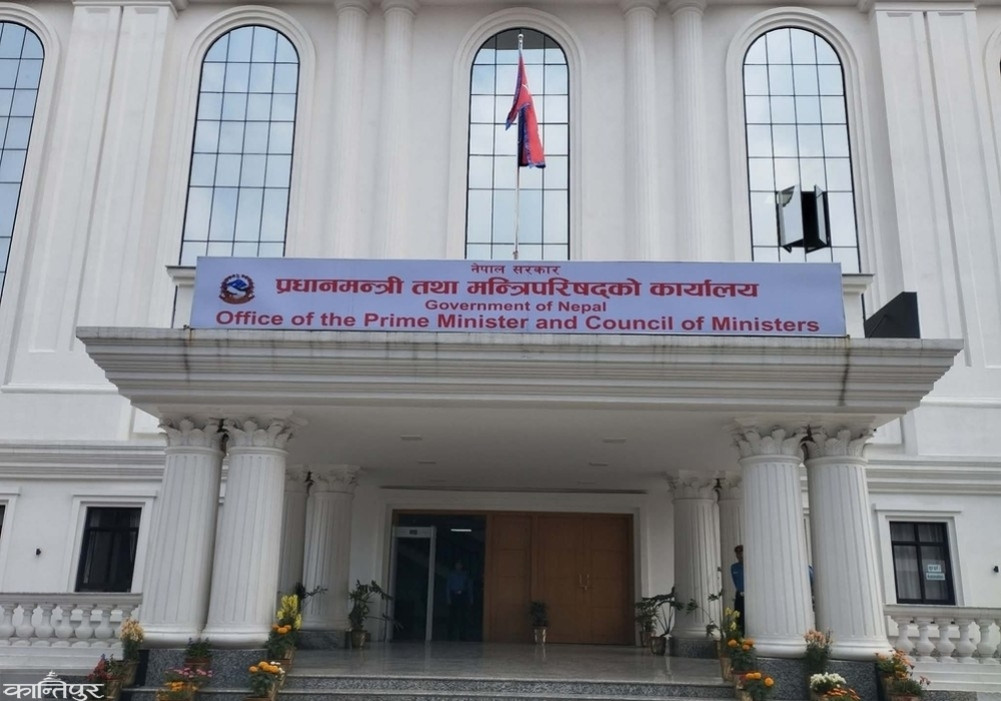
The Prime Minister's Secretariat clarified that this decision was made after it was observed that agencies were charging huge commissions by acting as brokers but the government and the media were not benefiting from it.
We use Google Cloud Translation Services. Google requires we provide the following disclaimer relating to use of this service:
This service may contain translations powered by Google. Google disclaims all warranties related to the translations, expressed or implied, including any warranties of accuracy, reliability, and any implied warranties of merchantability, fitness for a particular purpose, and noninfringement.
The government has directed government bodies at all three levels to publish and broadcast all types of advertisements and information only through government media. The Office of the Prime Minister and Council of Ministers issued a circular to all bodies at the federal, provincial and local levels on Wednesday, taking a secretary-level decision.
‘While publishing and broadcasting information, including public procurement from public bodies, through the media, the Government of Nepal, provincial governments and local levels and their subordinate bodies and all public bodies working using public funds shall make arrangements for publishing and broadcasting their information only through government and government-owned media such as Gorkhapatra Sansthan, Radio Nepal, and Nepal Television,’ the letter states. While paying for advertisements, arrangements have been made to deposit the amount only in the official bank account of the concerned media organization. The letter also states that the payment rate and discount related to advertisements should be approved by the concerned government media.
Private sector media, Federation of Nepali Journalists, Nepal Advertising Agencies Association (AN), Media Society and others have issued a statement opposing the decision. The federation has drawn serious attention, expressed disagreement and objection to the government's decision. The federation has interpreted this move as an attempt to create a situation of 'press censorship'.
A source from the Secretariat of the Office of the Prime Minister and Council of Ministers has stated that such a policy has been issued to stop the chaos prevailing in the advertising market. The Secretariat believes that the state treasury is being misused as most of the advertisements are being published in newspapers that are considered to be of the so-called 'A' category but are limited to bags and do not reach the public.
'Advertising agencies act as brokers and take huge commissions, but neither the government nor the media benefit from the advertisements,' said a Secretariat source. 'Kantipur Daily had also made public an investigative report on such irregularities.' While making this decision, a study was also conducted on the details in that news. This decision has been made to eliminate such a situation.'
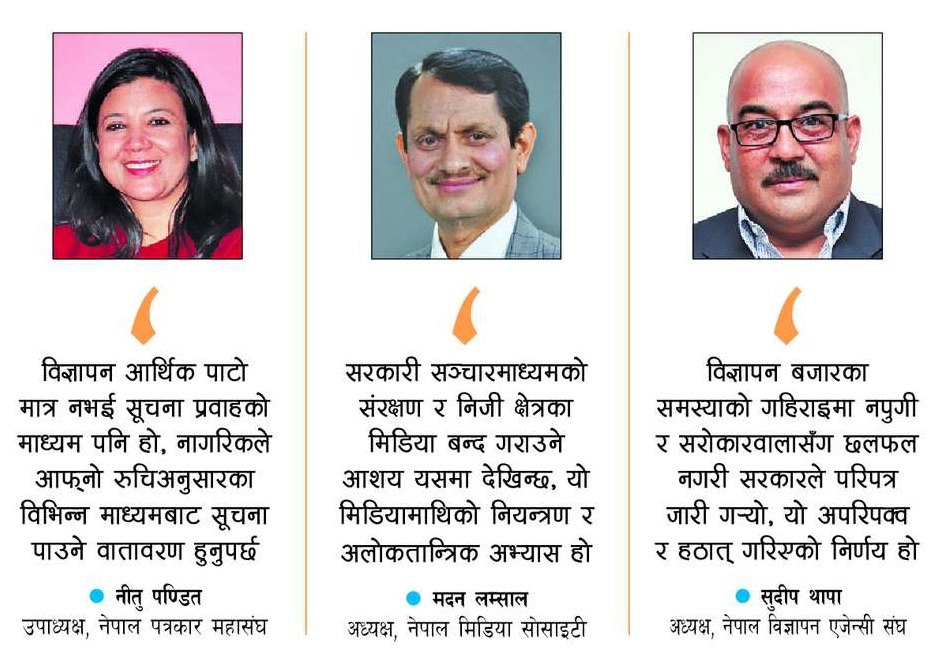
The Federation has pointed out that the government's decision will directly affect independent journalism and increase the risk of closing the medium that becomes the voice of the voiceless. Federation Vice President Neetu Pandit says that there should be no discrimination between the government and private sectors for social development. 'The current media sector is not limited to government media, the decision to give advertisements only to the government will not take the media sector in the right direction,' she said, 'Advertising is not only an economic aspect but also a medium for information flow. Citizens should have an environment to get information through various media according to their interests.'
Annapurna Post Editor-in-Chief Balkrishna Basnet, who is also the former chairman of the Press Council Nepal, called it an ‘economic blockade’ and a ‘stab in the back’ on the media. ‘This decision has violated the right to publication and information guaranteed by democracy and the constitution,’ he said, ‘The information and advertisements that the federal, provincial and local levels can provide to newspapers, radio, TV and online portals should have been made transparent and systematic, and strong steps should have been taken to stop the distortions and corruption in the advertising business.’ Without doing so, this order to not advertise is like saying that the patient should be killed, not treated.' Nepal Media Society President Madan Lamsal also mentioned that this decision seems to be motivated by wrong intentions. He said that such a move would weaken the fourth pillar of democracy. ‘The intention to protect government media and shut down private sector media is clear,’ he said, ‘This is control over the media and an undemocratic practice.’ Admitting that there is corruption and disorder in the advertising market, he commented that the government has made a short-sighted decision like ‘cutting down the tree’ just because a branch of a tree has a disease.
Advertising agencies have said that this decision will have a huge economic impact and thousands of jobs will be lost. Sudeep Thapa, president of AAN, has described the government's decision as an 'immature' and 'hasty step'. He says that the government has issued the circular without getting to the bottom of the problems in the advertising market and without discussing with stakeholders.
The intention is to protect government media and shut down private sector media. This is control over the media and an undemocratic practice: Madan Lamsal, president of Nepal Media Society
This decision has also become controversial from the perspective of the right to and access to information. Shiva Gaunle, former president of the Federation of Nepali Journalists, said that the government made the decision without understanding the basic concept of what advertising is. 'Advertising is not money from the government's pocket, but the development cost of the related project,' he said, 'its purpose is to provide information to as many people as possible.' He said that it is sad that the government is dividing the media into 'mine and yours' since all the media outlets published and broadcast in Nepal are 'state media outlets'. 'A negative narrative has been created at the society and government level regarding some of the distortions in the advertising market and media pricing. On that basis, such a decision has been taken,' Thapa said, 'There are problems such as unhealthy competition and non-compliance with the rate card in the government advertising market. There is a scientific system to solve this.' But the policy of strengthening only the government media and weakening the private sector will ultimately weaken the Nepal government.'
At a time when the media world is going through an uncomfortable situation, if any policy creates further difficulties, it will hurt the essence of independent journalism along with the media industry, said Mahesh Swaran, CEO of Kantipur Media Group. He said that in a country where 99.9 percent of the media is private, the risk of citizens being deprived of important information increases if information is provided only through government media.
The government issued the circular without delving into the depth of the problems in the advertising market and without consulting stakeholders. This is an immature and hasty decision: Sudeep Thapa, President, Nepal Advertising Agencies Association.
The government's vision of making a corruption-free country is positive and the policy change at a time when the economy should be dynamic by encouraging the private sector has made the market suspicious. 'The government can classify advertisements (select media according to large and small tenders) to prevent distortions in the advertising market,' he said. 'If third-party billing is made mandatory and monitored strictly, the situation will end. If the Advertising Board, the Commission for the Investigation of Abuse of Authority or the Audit Bureau monitor it effectively, the loopholes in the advertising sector can be closed. But the decision to ban government advertising will hit independent journalism.'