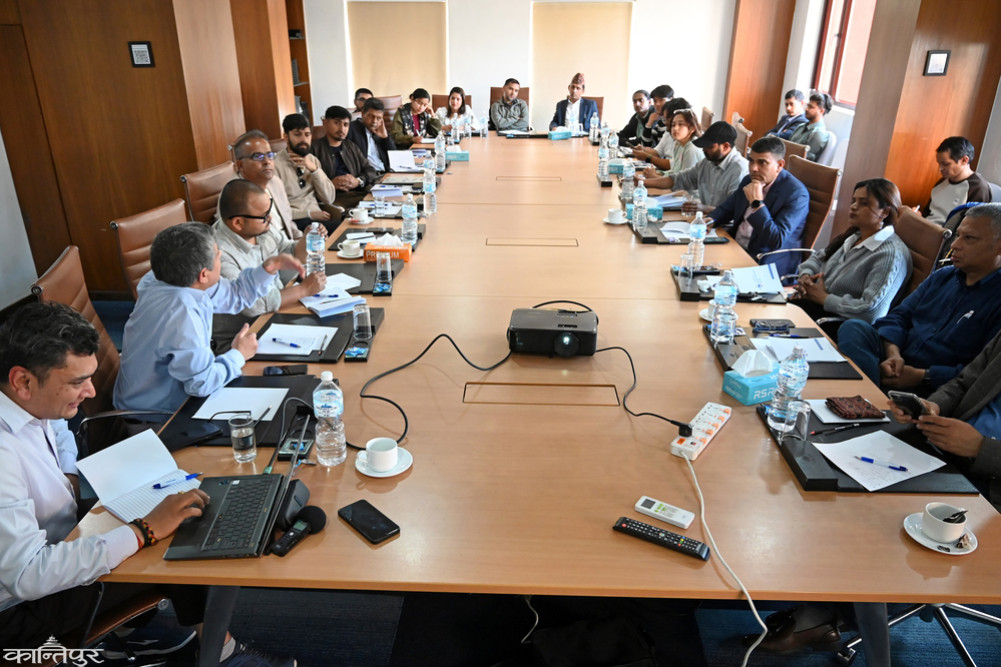
A discussion organized by the Center for Media Research (CMR) on the occasion of World Fact-Checking Day reviewed the trend of misinformation spreading on social media during this year's election.
We use Google Cloud Translation Services. Google requires we provide the following disclaimer relating to use of this service:
This service may contain translations powered by Google. Google disclaims all warranties related to the translations, expressed or implied, including any warranties of accuracy, reliability, and any implied warranties of merchantability, fitness for a particular purpose, and noninfringement.
A study has shown that the flow of misinformation on social media during the 2082 House of Representatives elections was higher and more risky than in previous elections.
A discussion organized by the Center for Media Research (CMR) on the occasion of World Fact-Checking Day reviewed the trend of misinformation spread on social media during this election.
A study titled 'Trends of Misinformation and Fact-Checking in the 2082 Elections' presented by Umesh Shrestha, editor of 'NepalFactCheck.org', concluded that the amount of misinformation has increased significantly compared to the previous elections.
According to the study, 'NepalFactCheck', 'Tekpana' and 'NepalCheck' conducted 125 fact-checks from February 1 to March 7. Out of these, 113 materials directly related to the elections were used as the basis for analysis. "The volume of misinformation was very high, significantly higher than in previous elections," the letter submitted by editor Shrestha states.
The study notes that the flow of misinformation, which began about five weeks before the vote, has been observed in a weekly pattern. In the early weeks, content inciting religious and ethnic hatred and attempts at character assassination through AI were seen. Then, misleading videos in the style of 'breaking news' and content that undermines confidence in the election have increased. In recent weeks, rumors about foreign troops and 'chip fake' content that distorts old videos and gives new meanings have been widely spread.
The study concludes that misinformation has had a significant impact on voter psychology. However, although there is no concrete evidence that it directly changed the final outcome of the election, it is noted that it can affect voter perceptions and behavior during the campaign period.
The study has shown that rumors of violence and fraud have been systematically used to create distrust in the electoral process and its credibility. The increase in misinformation based on gender, religion, ethnicity and regional identity has been pointed out as the most worrying aspect. The study mentions that hate speech targeting the opposition increases the risk of deepening social divisions even beyond the election cycle.
This time, the study has found that ‘chipfake’ content, which is a re-edit of old videos and presented in a new context, has had a greater impact than completely fake ‘deepfake’ content. The study concludes that there is also a tendency to spread confusion through visual content and to target individual political figures with personal character assassinations.