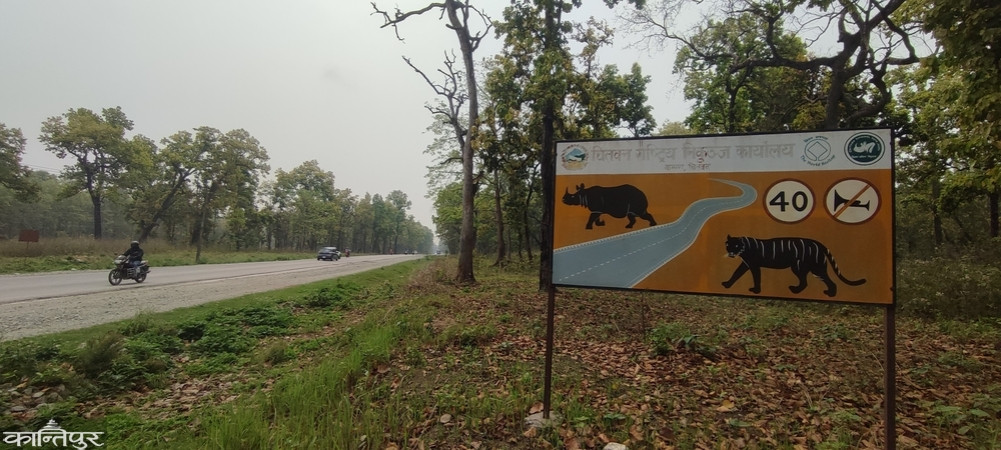
Along with the road expansion, a wide animal pass is also being built for the first time in Nepal to protect wildlife including elephants, rhinos, and tigers.
We use Google Cloud Translation Services. Google requires we provide the following disclaimer relating to use of this service:
This service may contain translations powered by Google. Google disclaims all warranties related to the translations, expressed or implied, including any warranties of accuracy, reliability, and any implied warranties of merchantability, fitness for a particular purpose, and noninfringement.
The Narayangadh-Pathlaiya section of the East-West Highway is being expanded. The process has moved forward with a plan to convert the currently two-lane road, which is 100 kilometers long, into four lanes. Within this distance, lies the Barandabhar forest, an important biological route connecting Chitwan National Park with the Chure and Mahabharat Mountains. In addition, the important half-bar forest of Parsa National Park also falls within this.
Converting the two-lane road into four lanes will certainly make movement easier. But what will happen to the wildlife? Since it will also affect the wildlife, a two-kilometer-long wide animal pass (a structure, viaduct, that allows animals to cross) is being built at two places on this section. Such a large structure is the first in Nepal. Also, there is a plan not to affect animals and birds during construction.
This plan will adopt measures to protect large wild animals from elephants, rhinos, tigers to vulture nests. The Road Department has made public the Environmental Impact Assessment (EIA) report of the Pathlaiya-Hetauda-Narayangadh road upgrade on Chaitra 16 and invited comments and suggestions to finalize it. The report mentions the impact on the environment and wildlife and measures to reduce it.
A tragic incident occurred in Magh 2078 BS during the construction of a 6-lane road from Narayangadh-Pulchowk to Bharatpur Gondrang on the highway. After a rhino died after falling into a ditch dug for a drain, conservationists protested, saying there was negligence in the development work. There was a demand for legal action against the concerned parties.
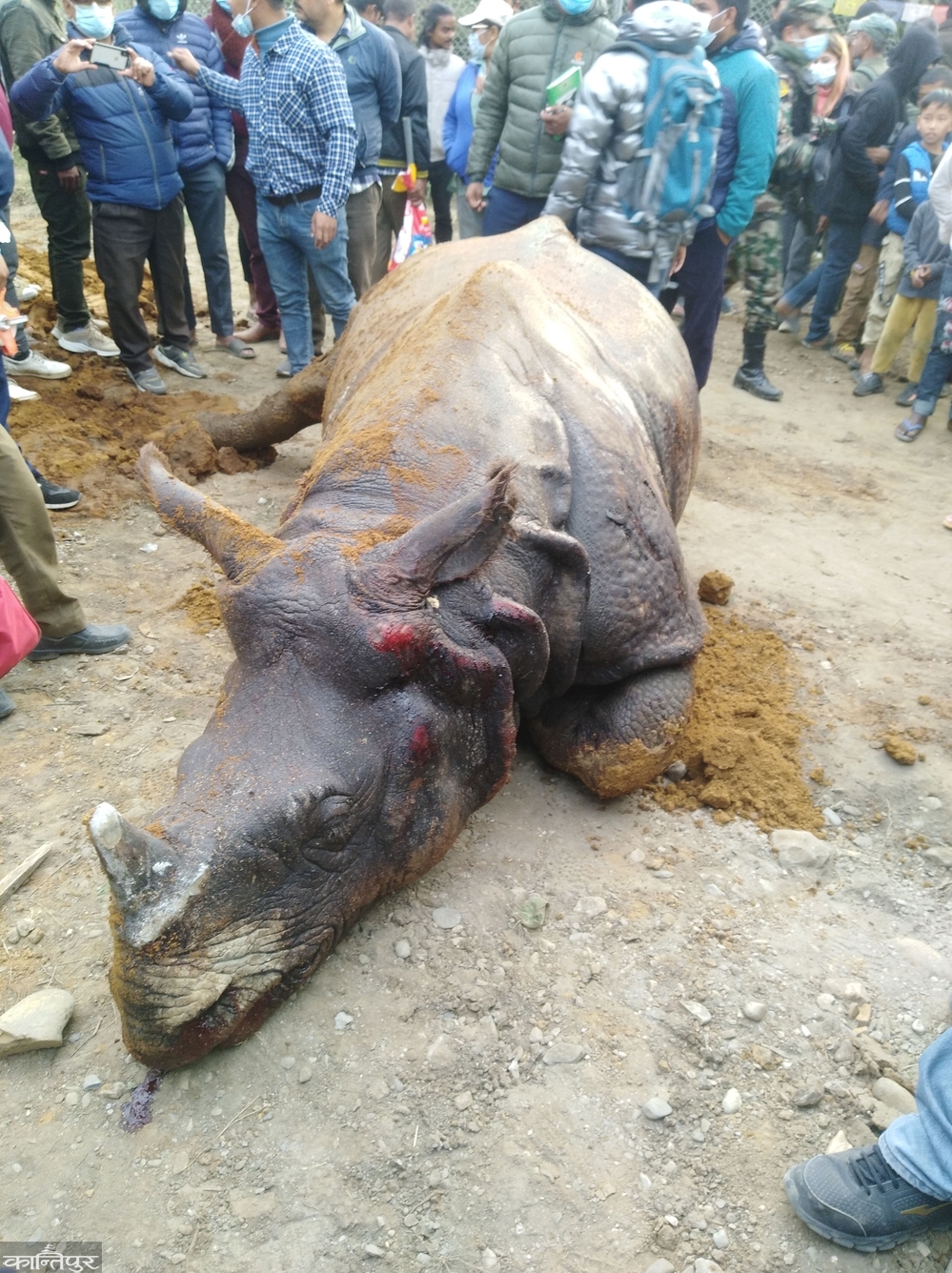
As the possibility of action increased, construction entrepreneurs also protested. The highway expansion work is going to start from just east of where the 6-lane road was completed. The EIA report states that the safety of workers and wildlife will also be taken into account while working on the road passing through the national park, the Baranda Bhar corridor (biological route) and the buffer zone during the expansion.
It has been said that work will not be done in the park area during the morning and evening hours when wildlife is active. The plan is to work from 8 am to 6 pm in the summer and from 9 am to 5 pm in the winter. The construction schedule will also be made available to the park office and other related offices. Work will be coordinated accordingly. After work is stopped, holes and empty spaces will have to be covered.
‘This will be a mandatory exercise for wildlife and construction team members,’ the EIA report states. Training should also be provided on how to avoid setting up camps in parks and forest areas, work in groups, and stay safe if wildlife is encountered. The report also mentions concerns about large animals that can conflict with humans, as well as birds.
The width of the road in the forest area is kept at 24 meters less than elsewhere, which is said to have less impact on birds. The project is committed to not storing any construction materials in important forest and wetland areas. If the time comes for clearing vegetation between October and April, when the breeding season for birds (including vultures) comes, nests of sensitive hawks and large birds will be checked before cutting trees and stones.
‘If an active nest is found, a no-go zone will be established around it and no obstacles or inconvenience will be caused until small birds can fly away,’ the report says. Similarly, the project should also adopt measures to protect fish and other aquatic life. Workers engaged in the expansion work will not be allowed to fish. It has been said that no bridge or cross-drainage work will be done during the fish breeding season.
‘Special policies should be followed in forest and park areas, keeping in mind the environment and animal welfare. This has happened before. And from time to time, some specific issues arise and we will work taking them into account,' said Pradeep Raj Shakya, Deputy Project Director of the Road Department. Like the rhinoceros in Gondrang, the issue of vulture nests came up in the Muglin-Pokhara road expansion.
Senior Conservation Officer Ganesh Pant, who is also the head of Chitwan National Park, said that although it seems like such a provision has been made for the welfare of animals, it has to be done for the welfare of humans. 'The issue of protecting animals is for the welfare of humans. Removing the obstacles that development creates for them is also good for humans. Therefore, the welfare of animals should also be considered in development,' he said.
Since the Barandabhar forest is an important biological route connecting Chitwan National Park with the Mahabharata and Chure, the structures built in it should not hinder the movement of wildlife, he said. 'Also, if provisions have been made to ensure that animals are not affected during construction, it should be fully implemented. We are also interested in this,' said Pant.
The East-West Highway is a major domestic and international trade highway in Nepal and is also a section of the Asian Highway-2 (AH-2). The South Asian Subregional Economic Cooperation (SACEAC) Road Improvement Project is upgrading 270 km of road sections, including bridges, on the East-West Highway. Of these, the Kakadbhita-Laukahi road section is 120 km, the Butbal-Gorusinghe road section is 50 km, and the Pathlaiya-Hetauda-Narayangadh road section is 100 km.
The proposed project will upgrade all the bridges and bridges on the Pathlaiya-Hetauda-Narayangadh road section from two lanes to four lanes. This road section touches Bara district of Madhesh province and Makawanpur and Chitwan districts of Bagmati province. The upgrade of the Pathlaiya-Hetauda-Narayangadh road is expected to reduce traffic congestion, improve travel quality, and improve road safety. The base of this road section from Pathlaiya to Amlekhgunj is the dense forest of Parsa National Park, followed by the Shivalik region, Rajaiya forest section, and the Manhari Lothar region. And in Chitwan, the Barandabhar corridor is also included. The width of the road will be 50 meters in the urban area, 37.4 meters in the semi-urban area, and 24 meters in the rural and forest areas.
There will be flyovers at 6 places and underpasses at 12 places for pedestrian crossings in the urban area. In the forest area, there will be wildlife crossings at 21 places, including a four-kilometer viaduct between Barandabhar forest and Bharatpur Tikauli, including the half-way forest of Parsa National Park. The estimated cost of the road and bridge construction is Rs 54.29 billion 364.7 million 526.
This project, which aims to be completed in three and a half years, is said to be started in 2026. This is a road with a daily traffic volume of 12 to 25 thousand vehicles. During the road expansion phase, 23 thousand 326 trees will have to be cut. Out of which 9 thousand 646 will be cut in Bara, 10 thousand 278 in Makawanpur and the remaining 3 thousand 402 trees will have to be cut in Chitwan.
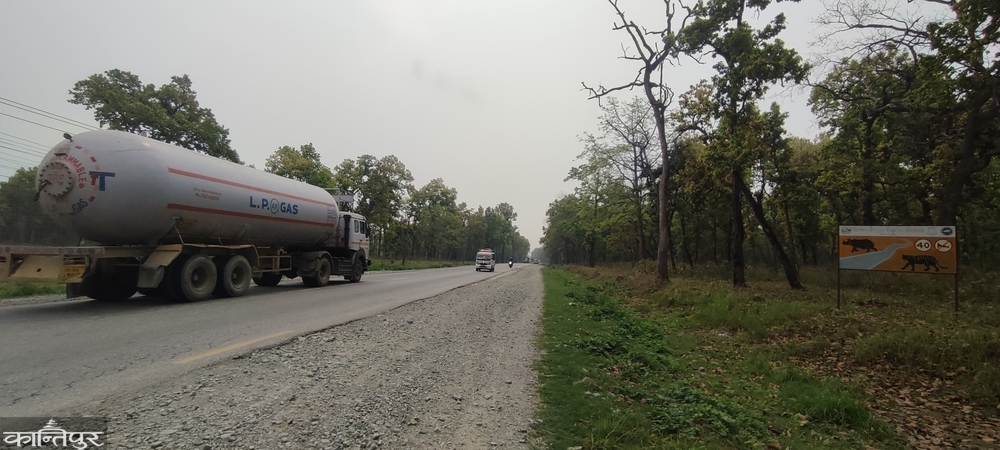
404 trees including Bara, Peepal and Sami will have to be cut. There are 22 streams and rivers in the road expansion area. There are 59 species of mammals including rare wild animals like wild elephants, rhinos and black tigers, four highly active biological pathways, 31 species of birds, such as king goman, golden gohoro and frogs, 23 species of reptiles and amphibians and 15 species of fish have been found in the streams.
The report states that there are 1 thousand 867 households with a population of 9 lakh 57 thousand 699 living in three districts including one metropolis, two sub-metropolitan cities, three municipalities and one rural municipality within the expansion area. Pradeep Raj Shakya, the deputy project director, said that after the EIA is approved, the design will be approved and the contract will be called. He said that the contract agreement will be signed within 2026.
This project, which is located in a densely populated and urban area, has a habitat for rare wildlife as well as corridors for movement. That is why conservationist Doma Poudel says that development should be carried out in a wildlife-friendly manner. 'We cannot say that development should not be done, but the impact of development should not be on wildlife. Let's adopt measures that can reduce it. Let's not just write it on paper, let's also implement it,' she said.