Opium cultivation in the hilly villages of Chitwan has been increasing year by year. According to the police, opium cultivation spread over 14 bighas has been destroyed this year alone.
We use Google Cloud Translation Services. Google requires we provide the following disclaimer relating to use of this service:
This service may contain translations powered by Google. Google disclaims all warranties related to the translations, expressed or implied, including any warranties of accuracy, reliability, and any implied warranties of merchantability, fitness for a particular purpose, and noninfringement.
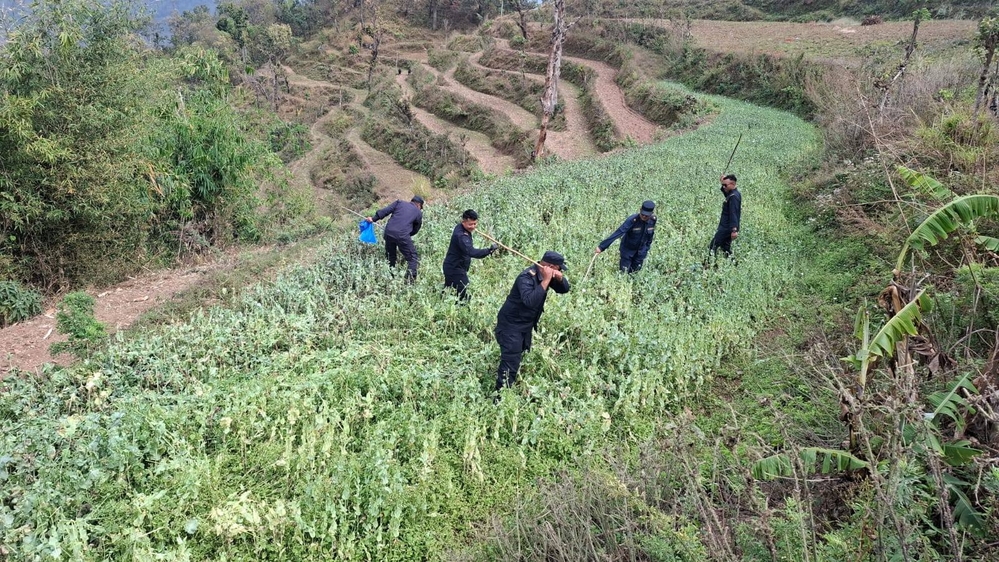
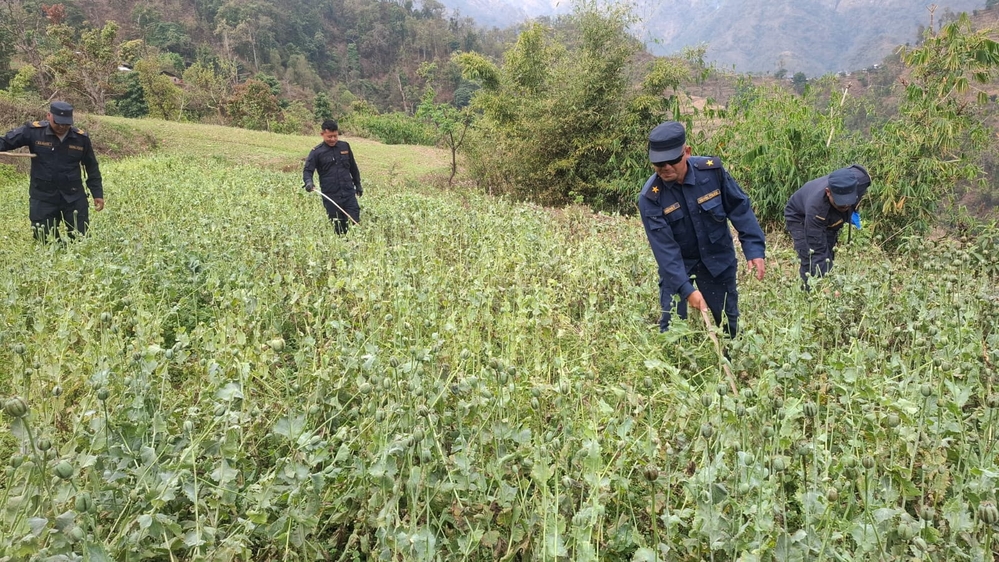
The District Police Office, Chitwan, made public information about the destruction of opium cultivation on Chaitra 20. The police had destroyed opium cultivation planted on an estimated 10 kattas in various places in Wards 10, 11 and 12 of Rapti Municipality in the northern hilly part of the district. Since then, Chitwan Police has destroyed opium cultivation planted on 14 bighas.
Analyzing the activities of the past five years, the size of the opium cultivation destroyed by the police is increasing. Five years ago, in the fiscal year 078/79, the police had destroyed a marijuana cultivation planted on 48 bighas and 12 kattas of land. It is seen in the police report that opium was not destroyed that year. Since then, it has increased from five kattas to 14 bighas. There is no accounting of the cultivation that has not been uprooted and that the police have not seen.
Bhandara Bazaar is located on the East-West Highway, about 20 kilometers east of Bharatpur, the headquarters of Chitwan. After going north from Bhandara, there are hill villages inhabited by the Chepang, a very marginalized indigenous community. Last Chaitra, the police destroyed opium in these villages. The police have also destroyed opium in the hilly areas of Kalika Municipality, which is connected to these areas of Rapti.
Opium is cultivated not only in the hilly areas far from the district headquarters, but also in the hilly areas of ward number 29 of Bharatpur Metropolitan City. On Pagun 10 last year, the police had destroyed opium planted in 6 bighas in the Chowkidanda, Dhodeni, and Bhorle areas. Even though it was a ward of the metropolis, opium was cultivated in villages that were not immediately noticeable, a little inside the road network.
It is easy to hide cultivation due to the lack of roads.
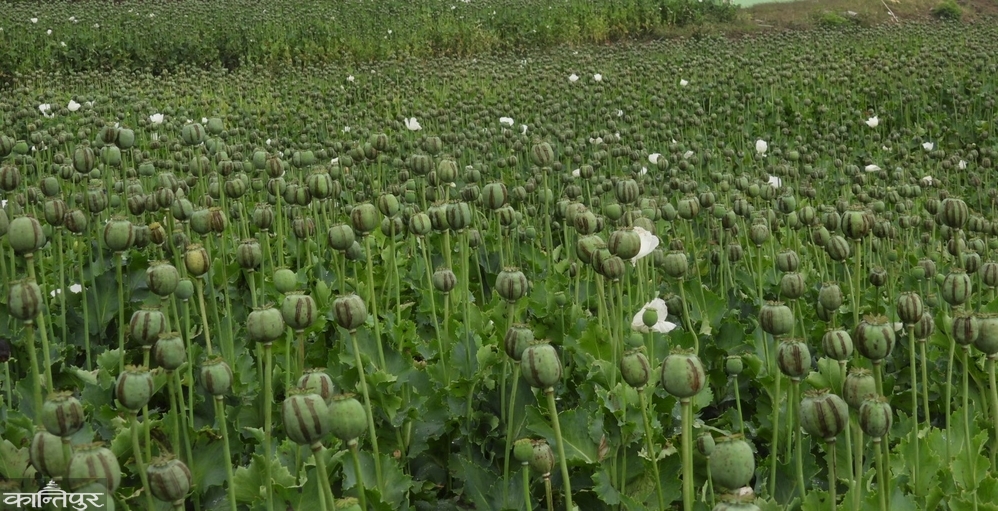
A hilly village in Lothar, the northern part of Rapti Municipality. The road does not reach here. It takes more than half an hour to get to the vehicle. The land on the slope was green. The seeds on the top of the plant are like onion seedlings. The locals jokingly call it an onion that grows on the top. This is not the fruit, but the pulp is extracted from the fruit and made into powder to sell.
The pulp comes out after a sharp object like a blade is cut into the fruit. After the pulp dries, it is scraped and collected. A young man of about 25/30 years old was collecting the pulp in this way. When he suddenly saw a stranger in the field, he was a little startled. It looked like he was trying to hide. But there was no place to hide around. Seeing that I was taking pictures of the farm, he came in a retaliatory manner. He wanted to hide this farm. Slowly, he said something.
The Narcotics (Control) Act 2033 has banned opium cultivation. But he is busy with this cultivation. Section 4 (B) of the Act prohibits the cultivation of opium or coca. He does not need this section. ‘There is no motorable road coming here. Who will come here to harvest it when there is no road? That is why it is easy for us,’ he said.
He has planted opium in about five acres of the hilly field. He said that in Asoj, the opium seeds are sown in the field like mustard seeds. Then, they start blooming in the end of Magh. After the flowers fall, the seeds are visible. He said that from the middle of Falgun, he makes a slight incision in the seeds and starts drying the sap that comes out of them. I met him in the field in the last week of Falgun.
By that time, the chop had been collected three or four times. If the grain is strong and good, he said, if there is no rain, he can harvest up to 12 times. But since it was cloudy, he was worried that he would not be able to harvest the entire 'harvest'. The locals used to cook its leaves and eat them as vegetables. After the chop, which is extracted by cutting the fruit, dries, it has to be collected and weighed into one kilogram and handed over to another person. 'One kilogram of powder is worth 1.5 lakh rupees,' he said. 'How much trouble would it have been to sell something else that would bring in 1.5 lakh rupees from this village. There is nothing like that,' he said.
Concerns raised by illegal activities
Sunimaya Chepang says that the increase in opium cultivation in the hilly areas is a matter of concern. She is also the former senior vice-president of the Nepal Chepang Association and says that such activities should be stopped. ‘Doing illegal activities just to make money will cause a lot of harm to society. It is also difficult for the individual. We all need to engage in awareness campaigns to stop such activities,’ she said.
Section 14 of the Narcotics Control Act provides for punishment. Section 14 (c) provides for imprisonment for one to three years and a fine of Rs. 5,000 to Rs. 25,000 for those who cultivate opium or coca up to 25 plants. Any number of plants above 25 plants will be imprisoned for three to 10 years and a fine of Rs. 25,000 to Rs. 200,000.
Chitwan District Police Office Chief SP Govinda Puri said that although the police have been destroying marijuana and opium cultivation since receiving information, the cultivators have not been caught. ‘Ganja and opium production and distribution are not allowed.’ Even if you do it secretly, if you are caught, you will regret it for the rest of your life. We are trying to increase the feeling that illegal activities should not be done,' said Puri. SP Puri also said that illegal activities can be stopped only if the local residents are given reliable alternatives for income generation and employment.
Arjun Chepang, the ward chairman of Rapti Municipality-12, which the police have mentioned as an area where opium is being cultivated the most, said that he was not aware of opium cultivation in this area. 'We were not informed about this matter. It is the job of the police to look into it. The police must have found out. I have heard that they have come and destroyed it somewhere. But I have not seen such cultivation here,' said Ward Chairman Chepang.
SP Puri says that there is a plan to set up a police post covering the northern part of Rapti Municipality. He says that this can stop such illegal cultivation. According to the details received from Chitwan Police, in the fiscal year 079/80, five kathas of opium planted in various places in Rapti Municipality-11, 12 and 13 were destroyed by the police.
Then in the fiscal year 080/81, 16 kathas of opium were destroyed by the police in various places in wards 1, 2, 10, 11, 12 and 13 of Rapti Municipality. In the fiscal year 081/82, the police have informed that opium planted in three bighas and seven kathas in various wards of Rapti and six bighas in Bharatpur Metropolitan City, for a total of nine bighas and seven kathas was destroyed.
In this fiscal year, 14 bighas of opium have been destroyed till the first week of Chaitra. This year, the police have destroyed 15 katthas of opium cultivation in Rapti Municipality in Poush, five bighas in Magh, 10 bighas in Chait, and 15 katthas in Chait, totaling seven bighas, and in the hilly areas of Kalika Municipality, three bighas in Magh and four bighas in Falgun, totaling seven bighas, totaling 14 bighas.
Since the dry land did not grow well in the hilly areas, there was a risk of famine with the onset of Chait. Maize sown in Chait and Baisakh would ripen by the onset of Bhadau. How far will the illegal opium cultivation sown in Asoj flourish in Chepang village, where there is not much other farming after Bhadau? And this has also increased the fear of how many individuals and families will be found guilty.

