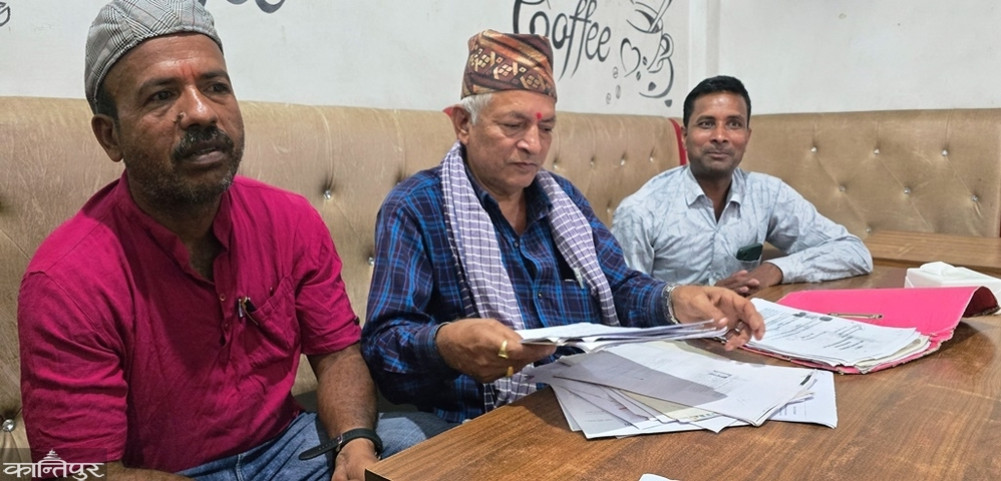
Many families in Rautahat, suffering from metered rates, high interest rates, and legal complications, have become homeless. They have been running to the administration and courts for years for justice.
We use Google Cloud Translation Services. Google requires we provide the following disclaimer relating to use of this service:
This service may contain translations powered by Google. Google disclaims all warranties related to the translations, expressed or implied, including any warranties of accuracy, reliability, and any implied warranties of merchantability, fitness for a particular purpose, and noninfringement.
Arjun Phuyal, 61, of Chandrapur Municipality-4, had a grocery shop in Chandranigahpur Chowk. The shop was always crowded with customers. His income was also good. When everything was going well, he became friends with neighboring cloth merchant Ram Babu Sah Kalwar. The friendship progressed well. The two agreed to buy land. Phuyal borrowed Rs. 2 million from Kalwar and added Rs. 1 million of his own investment and bought 10 and a half katthas of land in Chandrapur-5 in 066 BS. He kept one plot in the name of Phuyal and the remaining two plots in the name of Kalwar. Later, he agreed to transfer the land of plots number 2027 and 1028 to Kalwar. As time passed, Kalwar, thinking of buying land elsewhere, transferred the two plots of land in Phuyal's name to his own name in 068 BS. As per the terms, Kalwar was supposed to give Phuyal money to buy land elsewhere. But he did not do so.
He did not even return Phuyal's 1 million. Instead, he filed a case in 2081 Kartik alleging that he had looted cash and gold. The district court ruled in 2081 Baisakh 1 that the claim filed by Kalwar was not sufficient. After an agreement was reached between Phuyal and Kalwar to buy and sell land, Phuyal had trusted and kept all three plots in Kalwar's name. After years of earning money was like pouring water into sand, he is currently in deep mental and financial crisis.
Neither the money paid to businessman Kalwar for the purchase of land was returned nor the land was delivered. After his hard-earned money ended up in someone else's pocket, Phuyal is tired of running to various agencies for justice. After committing fraud in the land purchase and sale agreement, he has been wandering for 10 years for justice. ‘Even after a decade, neither the land came in his name nor the money he gave was returned,’ he says, ‘I reached the streets, where can I go to seek justice? I had invested all my assets in this land, now I have no house or ghat.’
Feeling cheated, Phuyal has been appealing to the local administration and public representatives. In 2080, the judicial committee of Chandrapur Municipality even summoned Kalwar and asked him to return the land. But Kalwar has been insisting that he had no dealings with Phuyal. ‘Kalwar used to give money to many people and make them write checks and promissory notes. He would accept the principal and interest in cash and not return the checks. He would blacklist the check from the bank and file a case,’ Phuyal said. He was arrested by the police in a case of unfair transaction and produced before the court a week ago. He was released on a bail of Rs 50,000.
Narayan Ghimire of Chandrapur-4 had also taken Rs 500,000 from Kalwar on 2076 on interest. But despite paying him Rs 27,000 with interest several times, he has instead filed a case in court by filling in a blank check with Rs 2.3 million on deposit. He has been appealing to the police administration for justice, saying that he is a victim. Kalwar had taken a blank check from Ghimire as a deposit for a loan of Rs 500,000. Ghimire said that he filled the check and filed a case in court. “We had approached the police saying that we had been wronged. Instead, businessman Kalwar filed a case in court,” he said. Not only Phuyal and Ghimire, but 7,000 locals across the district have filed complaints about meter interest at the District Administration Office Gaur, saying they were victims of moneylenders.
Brindavan Municipality-2 Rambabu Mahato and Kalwar had a very good relationship for a long time. Mahato first took a loan of Rs 500,000 from Kalwar in 2074 BS at an interest rate of 6 percent. Kalwar made Mahato pay a four-fold increase of Rs 20,000 as a deposit for the loan. Mahato returned the amount after about 4 months with an interest of Rs 140,000. The bank statement paid by Mahato shows that he had taken a loan of Rs 1.6 million repeatedly since then. The last time Mahato took a loan of Rs 2.4 million was in 2075 BS. For that, he gave Kalwar 5 blank checks as collateral. Kalwar had also kept the old deposit of Rs 20,000. The relationship between the two was going on. Mahato paid 5.4 million rupees in interest and principal over a period of 2 years. But after the check and the tamsuk were not returned, he approached the police for justice.
Phuyal, Mahato and Ghimire had filed a complaint with the administration a year ago regarding unfair transactions. ‘Kalwar is an expert in taking 72 percent interest, tamsuk and checks on top of that,’ Mahato said, ‘He has been bringing us on the road. This should be accounted for.’ A complaint regarding dual citizenship has also been filed against Kalwar. The District Administration Office has stated that the case is being investigated.
Such incidents in Rautahat highlight the fraud and legal complexities in loan transactions at the local level. Since most transactions are done without written documents or on the basis of simple tamsuk, it is difficult for the victims to seek legal redress. ‘When a daughter gets married or needs treatment, the first door for the common people in rural areas of Madhesh is the village moneylender. This is the means of avoiding trouble, which has now become a trap for hundreds of families in Rautahat,’ said a local.
Tamsuk of many times more than the loan
It has been found that meter interest lenders in the district force the borrower to make a tamsuk of double or triple the amount when investing. For example, Mahato had made a paper of 2 million when he took a loan of 5 lakhs from Kalwar. The victim says that Kalwar charges interest of up to 72 percent. Even after the borrower has paid the interest, the moneylender does not return the tamsuk and threatens to sue.
Many families in the district have become homeless due to meter interest. The moneylenders have been transferring the land of the debtor to their own or relative's name on the pretext of a loan. Many victims are now in trouble after their ancestral property ended up in the name of the moneylender due to failure to pay the interest on a small loan. It has been found that when the money is delayed, the moneylenders come to their homes, abuse them and cause mental stress.
After her husband went to Dubai for overseas employment, Mantidevi Thakur of Garuda Municipality-4 Shantitol took a loan of Rs 50,000 from Anil Sahasit of the village on Magh 3, 2068 at an interest rate of Rs 3 per cent. As collateral for the loan, she resigned from 4 kathas of land and a small hut built on it. There was a verbal agreement between the two to return the house and land on the day the loan was repaid. However, the moneylender did not return the house and land of the Thakur family until now. Instead, they took possession of the house and forced the Thakur family to live. The lender has already demolished the house. The meter-interest lender has claimed that none of them have returned the loan even though they have given them loans at interest.
After the government declared meter-interest a crime and formed an inquiry commission against unfair transactions (meter-interest), more than 7,000 complaints have been filed in Rautahat, the District Administration Office has said. Recently, the victims of meter-interest (unfair transactions) in the village have been wandering for justice. The victims complain of non-cooperation from the police, administration and courts.
The network of meter-interest lenders has spread very deep in the district. Locals who took small loans for their daughter's marriage, treatment of patients or foreign employment are now facing homelessness due to the extortion of crores of rupees, said Shivshankar Mahato, in-charge of the Bhojpura Command of the Farmers and Workers' Movement against Meter-interest. ‘Neither the police have helped us victims. Nor will the courts,’ he said, ‘Everyone listens to the moneylenders. Where should we go for justice.’ According to Incharge Mahato, problems such as making a bribe of three or four times more than the amount taken by the meter-billing, threatening to arrest them by filing a case of check bounce, and even filing a case without returning the bribe even when the loan is repaid have been seen more frequently.’
Even though the government has amended the law to make meter-billing a crime, victims who have filed complaints with the District Administration Office and the police have complained that they have not received the expected justice. Victims say that the administration pressures them to settle their complaints when they go to file complaints. Incharge Mahato alleges that the real victims are always in the shadows because meter-billing agents who have access to administrative bodies get political protection and financially entice employees. In some cases, they say that the verdicts coming from the courts have further traumatized the victims.
The meter-badge victims say that the victims are losing their ancestral property as the meter-badge owners base their decisions on the pre-arranged documents (tamsuk). Seeing all the doors of justice closed, the meter-badge victims were forced to walk to Kathmandu and stage sit-ins repeatedly.