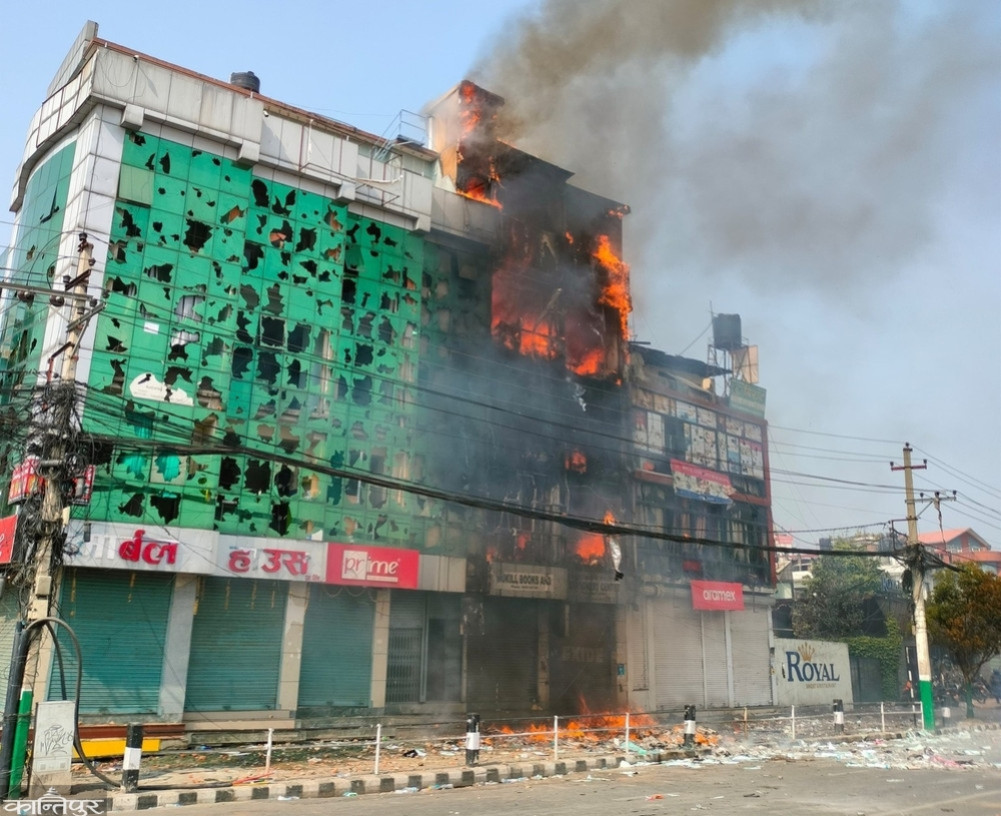
The Tinkune area became a battlefield when clashes broke out between protesters and security personnel during the protest led by medical professionals Durga Prasai and Nawaraj Subedi.
We use Google Cloud Translation Services. Google requires we provide the following disclaimer relating to use of this service:
This service may contain translations powered by Google. Google disclaims all warranties related to the translations, expressed or implied, including any warranties of accuracy, reliability, and any implied warranties of merchantability, fitness for a particular purpose, and noninfringement.
Today marks exactly one year since the violent protests in Tinkune, Kathmandu, demanding the restoration of the monarchy. However, the families of those injured and those who lost their lives during the protests have yet to receive justice and appropriate compensation.
The Tinkune area became a battlefield when protesters and security personnel clashed during the protests led by medical professionals Durga Prasai and Nawaraj Subedi. A total of 129 people, including 20 people, were injured in police firing amid stone-pelting, arson and vandalism, and two people lost their lives. The injured included police, protesters and the general public.
The police had arrested 67 people, including the then senior vice-president of the Rastriya Prajatantra Party (RPP) Rabindra Mishra and general secretary Dhaval Shamsher Rana, on charges of involvement in the violent protests and vandalism of public property. Mishra and Rana have been released despite investigations into charges of crimes against the state, criminal mischief and organized crime.
The injured have complained that they have not received the support they deserve from the state even after a year has passed since the incident. Rebika Khatri, who was injured in a bullet wound to her right leg, says that the government has not fulfilled its promise to bear the treatment expenses. 'While in the hospital, the Ministry of Health bore the doctor and bed charges, but we had to buy expensive medicines ourselves,' Khatri told Kantipur. 'We had submitted the treatment bills, but later we received an irresponsible response that 'all those bills were burned during the agency's agitation.'
The then Home Minister Ramesh Lekhak had assured that the money would be refunded if the bills were submitted at the hospital, but she says that she has not received it yet. Khatri, who took the exam from the hospital under the coordination of the CDO, says, 'The state had assured that it would look into the future as well, but now when I understand it at the civil hospital, they say that only the cost of external medicines is available and nothing else is available. The government's commitments have not been fulfilled.'
Commission's report in the drawer, victim's family angry
Avenues Television journalist Suresh Rajak lost his life during the protest. The National Human Rights Commission had formed a committee under the coordination of Manju Khatiwada to investigate the incident. Although the committee has prepared a report and submitted it to the commission, the commission has not made it public yet. Commission employees say that the report could not be made public because the leadership did not take a decision.
The committee formed to investigate the death of Suresh Rajak has prepared a report and submitted it to the commission. Even though the committee submitted the report, the reason it has not been made public is because the commission has not taken any decision on it yet,' said Tikaram Pokharel, spokesperson of the commission. 'We are not in a position to officially say anything about why the commission did not take a decision or why the report was not made public from the staff level.'
Rajak's brother Dinesh Rajak has expressed his anger over the commission's delay. 'The report that was said to be made public in two/three days has not come even after a year. I do not see the justification for the Human Rights Commission,' he said.
He complained that the Federation of Nepali Journalists discriminated against journalists who filmed videos and did not take any initiative for justice for his brother. He says that the amount given in the name of relief has humiliated him. 'We did not ask for money from anyone. When the Federation of Nepali Journalists gave me a check for 15,000, I felt like I was insulted,' he said.
Commenting that the police investigation was like 'giving a child chocolates', he said that even Avenues Television did not show interest in searching for his brother's camera and property. Suspecting that the incident was being suppressed despite ample evidence, he has demanded a high-level investigation committee from the new government.
State discrimination in the deceased's family
The government has already declared journalist Rajak a martyr on behalf of the state. The decision was taken by the then civilian government's cabinet meeting on 22 Mangs.
Earlier, at the initiative of the then Minister for Communications and Information Technology Jagdish Kharel, Rajak's wife Sujan Magiya was provided employment as a 'computer operator' at the Security Printing Center under the Ministry of Communications.
However, the family of Sabin Maharjan, who was shot dead by the police in the same incident, said that Sabin's uncle Kiran Maharjan did not receive any services from the state. He complains that the state has not taken any action in Sabin's case even though the civilian government declared Suresh Rajak a martyr.
'The government provided Rs 1 million in assistance but has done nothing else. The main thing is that there was no investigation into the incident. Everyone knows who is guilty. The government fired shots,' Maharjan told Kantipur, 'It feels like the state has ignored us. Others were declared martyrs but not Sabin. Whether it is because we are poor or because we cannot afford it, everyone seems to have forgotten this incident now.'
After the incident, the state promised to provide employment to Sabin's wife, but the family says that it has not been implemented so far. Sabin has a 7-year-old son, whose care and future the family is very worried about. 'Sabin has a 7-year-old child. "The state has not done anything so far to provide employment to his wife," says Kiran. "Is it just trying to save Rs 10 lakh? We are very worried about the child's care and future."