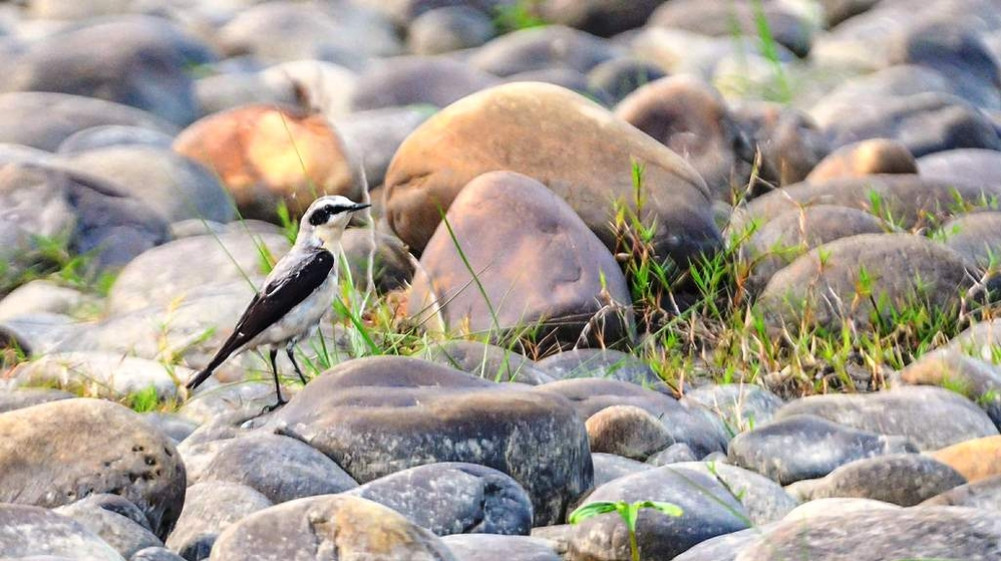
A bird was first seen in Nepal 43 years ago, and it was seen for the second time 24 days after the person who saw it died.
We use Google Cloud Translation Services. Google requires we provide the following disclaimer relating to use of this service:
This service may contain translations powered by Google. Google disclaims all warranties related to the translations, expressed or implied, including any warranties of accuracy, reliability, and any implied warranties of merchantability, fitness for a particular purpose, and noninfringement.
The famous British ornithologist Clive Byers was the first to see the migratory bird, the Ground Irvine, in Nepal 43 years ago. Another British ornithologist, Alan Adams, who came with him, also saw the bird for the first time. However, by coincidence, this is the second time the bird has been seen in Nepal after both of them died.
The bird was seen in Nepal on Saturday, March 28, near the Narayani River in Amaltari, eastern Nawalparasi. Nature guides Man Chaudhary, Manish Mahatto, Amrit Mahato, Dinesh Mahatto and Kanchan Mahatto saw the bird while observing the bird. Man Chaudhary and Manish Mahatto also took photos.
However, the ornithologist and author Clive Byers, who first documented the bird in Nepal, died on March 4 (Falgun 20) at the age of 68, according to his friend Stephen Moss, in an obituary in the British online newspaper The Guardian.
Senior ornithologist Dr. Hemsagar Baral said that it was a strange coincidence that the irvine was seen in almost the same area 24 days after Byers' death. 'I go to the forests, forest edges, and rivers in Nepal every day to watch and take pictures of birds,' he said, 'A bird that had not been seen for 4 decades has suddenly appeared.'
Clive Byers and Alan Adams first saw the bird on April 1, 1983, in Meghauli, the buffer zone of Chitwan National Park. It has now been seen in the Narayani River in Amaltari, the buffer zone of Chitwan National Park. Byers was one of the last people to see the now extinct Atitlan grebe in Guatemala in 1981. Alan Adams, another person who first saw the grebe, also disappeared in Nepal 45 days after seeing the bird. He has not been found. He lost his way on May 14, 1983, when a sudden change in weather occurred in Tharepati, Langtang, Nepal. Byers was on a trek with Byers and Adams, but he returned safely. Both had come to ‘expose’ the birds of Nepal. Then, in 1985, ornithologist duo Tim Inskip and Carol Inskip published a book dedicated to the missing Adams, ‘A Guide to the Birds of Nepal.’ The second edition of the book was published in 1991.
Byers, who was interested in bird watching since the age of eight, was one of the famous bird artists in Britain. Many of his bird drawings are included in the ‘Handbook of the Birds of the World’. He started sketching birds when a friend offered him a dollar for a sketch of a bird when he was young.
Senior ornithologist Baral said that this bird, a winter visitor to India, may have stopped in Nepal to rest while returning to its nesting grounds to breed. He said that this bird stopped here on its way to China, Mongolia and Siberia. A bird that stops for two to four days to rest or stay on the way to its destination through Nepal is called a passerine. It is a bird of the raven family that prefers to live on the ground, so it is named the ground irvine. It likes to feed in open fields, rocky areas and farmlands.
During the breeding season, the male is a beautiful blue-gray color, with a black face and a pale orange chest. During the breeding season, the female's upperparts are pale to yellowish brown, with a dark throat and a white tail, making her look attractive, said wildlife photographer Sanjay Tha Shrestha. So far, 903 birds have been recorded in Nepal.