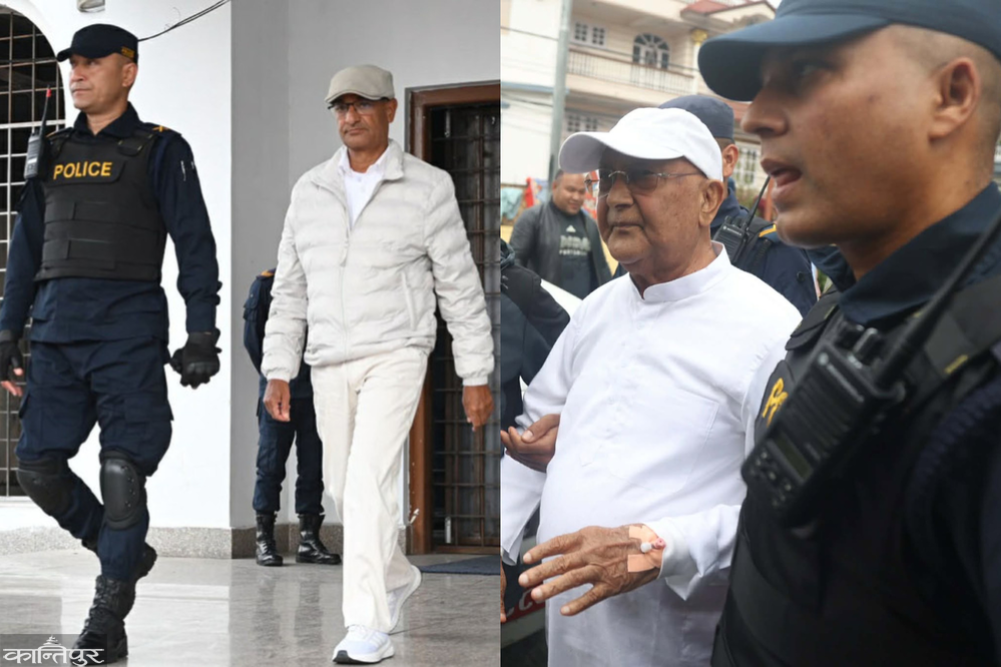
Everything is being done procedurally, in the case of others, a study committee will be formed soon and the government will move forward according to its recommendations: Sasmit Pokharel, Minister of Education and Government Spokesperson
We use Google Cloud Translation Services. Google requires we provide the following disclaimer relating to use of this service:
This service may contain translations powered by Google. Google disclaims all warranties related to the translations, expressed or implied, including any warranties of accuracy, reliability, and any implied warranties of merchantability, fitness for a particular purpose, and noninfringement.
The police on Saturday arrested former Prime Minister KP Sharma Oli and former Home Minister Ramesh Lekhak in pursuance of the report of the inquiry commission led by former Justice Gauri Bahadur Karki. However, the report prepared by the commission recommended that Oli and Lekhak and then Inspector General of Police (IGP) Chandrakuber Khapung be investigated for the same two offenses. The home administration is not prepared to arrest Khapung.
The report had recommended action against Oli, Lekhak and Khapung under Sections 181 and 182 of the Criminal Code. Section 181 states that ‘no one shall kill another by negligent act’ and Section 182 states that ‘no one shall kill another by negligent act’. If the offense under Section 181 is confirmed, there is a provision for imprisonment for 3 to 10 years and a fine of Rs 30,000 to Rs 100,000, while Section 182 provides for imprisonment for up to two years and a fine of up to Rs 30,000.
Apart from Oli, Lekhak and Khapung, the commission had recommended that action be taken against then Home Secretary Gokarna Mani Duwadi, Inspector General of Armed Police Force Raju Aryal, then Chief of the National Investigation Department Hutraj Thapa and then Chief District Officer of Kathmandu Chhabilal Rijal for the offence of negligent act and killing of anyone under Section 182. However, the police have arrested only the political leadership.
Government spokesperson Sasmit Pokharel, who is also the Minister of Education, says that the home administration is currently implementing the decision made by the Council of Ministers. ‘Everything is being done in a procedural manner, it was decided to immediately implement the persons recommended by the commission and to form a study committee in the case of the security mechanism and move forward according to the recommendations it submits,’ he told Kantipur. ‘It is being implemented accordingly, in the case of others, a study committee will be formed soon and the government will move forward according to the recommendations it gives.’ He said that Chief Secretary Suman Raj Aryal and the home administration will work in the context of forming the committee.
Security experts consider the arrest of only the political leadership, leaving the security officers behind, to be a strategic move by the government. ‘The idea of prosecuting the then IGP was in itself inconsistent, and that rank is not enough to give orders to shoot,’ says former Additional Inspector General of Nepal Police Uttam Raj Subedi. ‘If action is taken for discharging one’s duty, not only will the morale of the police be lowered, but it will also be difficult to find people to apply for police service tomorrow.’
During a discussion held by Home Minister Sudhan Gurung with top security officials on Friday midnight, Nepal Police Chief Dan Bahadur Karki and Armed Police Chief Raju Aryal had informed about the difficulties that may arise if the report is suddenly implemented. They had maintained that ‘the legal process should be completed and then move forward.’ The security chief had also warned that a confrontation could occur. However, Home Minister Gurung remained firm in his stance that the arrest should be made. He reminded the Cabinet of the decision to implement it immediately in cases other than security personnel. He had also called Law Secretary Parashwar Dhungana to discuss the legal process. After that, the IGP duo had asked for a written letter from the Ministry regarding the arrest of Oli and the writer.
As per the demand of the security chief, Minister Gurung had sent a letter to the Police Headquarters on the night of 13 Chaitra asking for necessary action. The letter stated that it was a Home Minister-level decision and said that ‘the Council of Ministers has sent the commission’s report along with the points decided in the meeting.’ The letter mentioned the names of Oli and the writer and asked them to move forward with the implementation of the decision. However, the report did not include the names of others who were mentioned to be taken action.
Ever since the commission submitted its report, the police had been alerting the government about the challenges that could arise if they took action against security personnel. The government formed after the 2046 BS people’s movement had also decided not to take action against the police as recommended in the implementation of the Mallik Commission report, which was formed to investigate the repression by the state. The decision of the Council of Ministers meeting held on 18 Ashad 2047 BS stated, ‘.. Although some police abuses occurred during the people’s movement due to faulty arrangements, in the current context, the police must bear the entire responsibility for maintaining the morale of the police and for the stability, efficiency and internal security of the police administration, and considering that the police have a special role to play in making future general elections fair and peaceful, no action will be taken based on the report of the Inquiry Commission.’
Stating that emphasis should be placed on improving systemic issues and internal action in the context of the police, former AIG Subedi says, ‘It seems that the government understands that if criminal action is taken against security personnel, there will be obstacles in the functioning of the state tomorrow, so the decision to conduct a study should be considered positive.’
BP Bhandari, a member of the Inquiry Commission, says that they have completed the work by submitting the report and the responsibility for implementation lies with the government. "We have told you what the situation was on 23 and 24 Bhadra," he said, "but it is up to the government to decide who to take action against and who to postpone."
The commission has also recommended departmental action against officials of the army, police, armed forces and the National Investigation Department in the report. The report mentions that action should be taken against Nepal Police AIG Siddhi Bikram Shah, DIG Om Bahadur Rana, then Kathmandu Police Chief Bishwa Adhikari (currently DIG), then Valley Police SSP Deepshamsher Jabra and Superintendent of Police (SP) Rishiram Kandel.
Action has also been recommended for AIG Narayan Dutt Poudel, DIG Suresh Kumar Shrestha and SP Jeevan KC from the Armed Police. Those recommended for action from the National Investigation Agency are Valley Campaign Division Joint Director Krishna Prasad Khanal and Joint Research Director and Kathmandu District Chief Riben Kumar Gachhadar.
Action has also been recommended for four army commanders in the report. Those recommended for action are Assistant Lieutenant General Manoj Kumar Baidwar, Chief of the team deployed to secure the Presidential Palace, Sheetal Niwas; Lieutenant General Diwakar Khadka, Chief of the security team deployed to the Prime Minister's official residence, Baluwatar; and Lieutenant General Ganesh Khadka, Chief of the team deployed to secure the Singha Durbar Secretariat.