The government, which has set goals ranging from 'government courier' to integrating all government data to delivering services like passports, licenses, and national identity cards to citizens' homes, has not addressed the strategic and specific aspects of cybersecurity as a separate point or clearly.
We use Google Cloud Translation Services. Google requires we provide the following disclaimer relating to use of this service:
This service may contain translations powered by Google. Google disclaims all warranties related to the translations, expressed or implied, including any warranties of accuracy, reliability, and any implied warranties of merchantability, fitness for a particular purpose, and noninfringement.
The government has laid special emphasis on improving public service delivery and the digital system and infrastructure of government agencies in the 100-point program released on Saturday. Various plans have been put forward to make government services such as citizenship, passport, national circular, and postal services, which are directly related to the daily lives of the general public, digital-friendly. However, issues such as cybersecurity, management or regulation of social media have not been included.
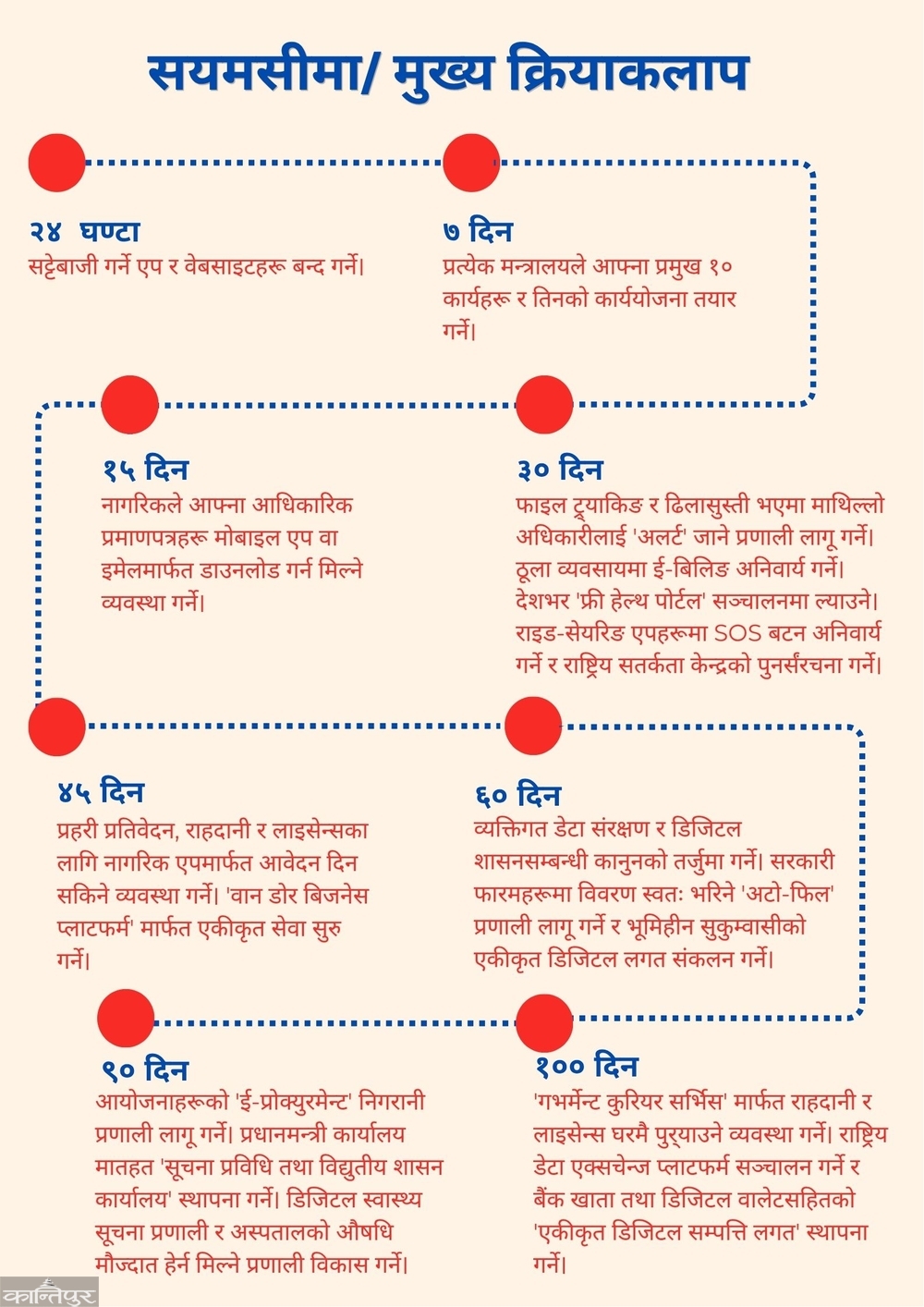
It is mentioned that the ‘Government Courier Service’ will be launched within 100 days to modernize the Hula service and deliver government documents like passports and licenses to the citizens’ homes. The points of the action plan mention making the service process 'faceless, time-bound and trackable' along with the issue of e-governance. The government has stated that it will implement a 'delivery'-based governance system to improve the lives of citizens. Under this, each ministry will have to prepare and implement an action plan of 10 major tasks within 7 days. It has been decided to make services such as citizenship, passport, and national identity card 'faceless' and 'time-bound' through a digital and integrated system to make service delivery hassle-free and free from intermediaries.
To make the use of information technology widespread, the government has stated that it will establish a ‘National Integrated Digital Governance Platform’ and will also start operating a ‘National Data Exchange Platform’ by integrating services and data of all levels of government within 100 days.
Just some time ago, the e-Governance Board had initiated a detailed study process to develop a data exchange platform with the technical assistance of the Foreign, Commonwealth and Development Office (FCDO) of the British Embassy. The study, which started on December 15, was scheduled to be completed and the report submitted on March 31, 2026. The board has informed that the study has been completed.
The government's 100-day plan states that citizens will adopt the principle of 'submitting one detail only once' by implementing the 'Digital Governance Blueprint' prepared by the board. As a result, the government plans to abolish the Information Technology Department and establish the Information Technology and e-Governance Office under the Office of the Prime Minister and Council of Ministers within 3 months to establish a digital governance system. 'The necessary legal and institutional arrangements will be made within 60 days for the establishment of an independent regulatory body to formulate and regulate rules related to information technology and digital governance,' point 38 states.
It has been decided to implement a system within 30 days to track the time a file has been on a table to measure the effectiveness of government work and to send an 'alert' to higher officials if the specified time is exceeded. The goal is to make public service delivery transparent, paperless and interconnected. Under this, it is mentioned that the integrated office management system being used in all government bodies will be made robust and user-friendly within 100 days.
The communication side includes shutting down betting apps and websites within 24 hours and making government apps or portals simple so that they can be used by people with disabilities and citizens with less technical knowledge. Similarly, the government has decided that the Rastra Bank will establish an ‘integrated digital asset register’ covering bank accounts, digital wallets, share investments and other financial activities within 100 days.
The procurement system will be made fully digital, transparent and trackable to prevent corruption and delays in the public procurement process, and it is mentioned that the ‘data-best end-to-end e-procurement monitoring’ system will be implemented within 90 days to monitor project selection to payment.
The goal is to upgrade the 'Hello Government' mechanism to address citizens' complaints to promote good governance and provide real-time monitoring through an integrated dashboard. The government plans to make the digital system mandatory in the trade and investment sector, requiring large businesses to implement the e-billing system within a month, and to make the process from industry registration to bank accounts digital through the 'One Door Business Platform'.
A digital and integrated health information system will be developed within 3 months to keep patient treatment history and records in the health sector, and a 'Free Health Portal' will be launched to view details of free services in hospitals across the country.
Similarly, the government has decided to collect integrated digital data of landless squatters to solve land-related problems and prepare digital records for the protection of public land. In decisions related to social security, it has been said that at least Rs 10 million will be provided immediately to make the Central Investigation Bureau of Nepal Police technologically equipped. For safe travel, ride-sharing apps have been given a 30-day deadline to make an ‘SOS button’ mandatory and to make arrangements to reach the police in case of emergency and danger.
The government has decided to formulate the Information Technology and e-Governance Bill within 60 days to implement all these digital initiatives and to establish a ‘Prime Minister’s Performance Unit’ in the Prime Minister’s Office for direct monitoring.
The government seems to have laid special emphasis on making public service delivery ‘digital, transparent and trackable’, these sentences have been repeated time and again. The word ‘digital’ is mentioned only 28 times in the action plan document, while every section includes plans for online/digital systems.
Previous governments had also repeatedly expressed commitments such as making government services completely digital and providing hassle-free e-governance. However, in practice, there were problems such as servers going down, sites not working, getting hacked, and requiring the person to be present even for services called online. This time, the plan also does not include any significant measures to deal with such practical and technical problems as well as limitations such as lack of manpower.
Nagarik app in government service delivery
The government's 100-point agenda describes the Nagarik app as the main digital platform for government service delivery and addressing citizen complaints. It is mentioned that arrangements will be made to apply through the app to facilitate the online application process.
'A system will be made within 45 days to apply for police reports, passports and driving licenses,' point number 31 says, 'When applying through the Nagarik app, arrangements will be made to allow individuals to fill out the form based on the details stored locally by the app on their phone or details obtained from other systems, but the Nagarik app will not be able to store data centrally.'
The agenda mentions that arrangements will be made within 15 days to allow citizens to download their official certificates directly through the Nagarik app or email. It has been said that the Nagarik app will also be used as an important channel for registering complaints, suggestions and service requests of citizens across the country. It is mentioned that government digital platforms like the Nagarik app will be made simple within 100 days so that people with disabilities and citizens with less technical knowledge can easily use it.
Single Identity System: National Identity Card
The government has mentioned that the National Identity Card (NID card) will be used as a mandatory single identity system. It is said that it will be made mandatory to integrate citizenship, passport and all other government services and make it ‘faceless’ (no need to be present), ‘time-bound’ (no time limit) and ‘trackable’.
‘Currently digital Whereas it used to be done through a signature certificate, now citizens will be able to submit their details by e-signing using NID card, biometric or OTP,' point number 33 states, 'For this, the National Identity Card and Registration Department will be physically and organizationally strengthened. A study will be conducted under the coordination of the Ministry of Home Affairs to implement a digital signature authentication system in all citizen services based on the National Identity Card number and a report will be submitted within a month.'
The government has set a goal to modernize the postal service and deliver national identity card-related materials to citizens' homes within 100 days through the 'Government Courier Service', just like passports and citizenship documents.