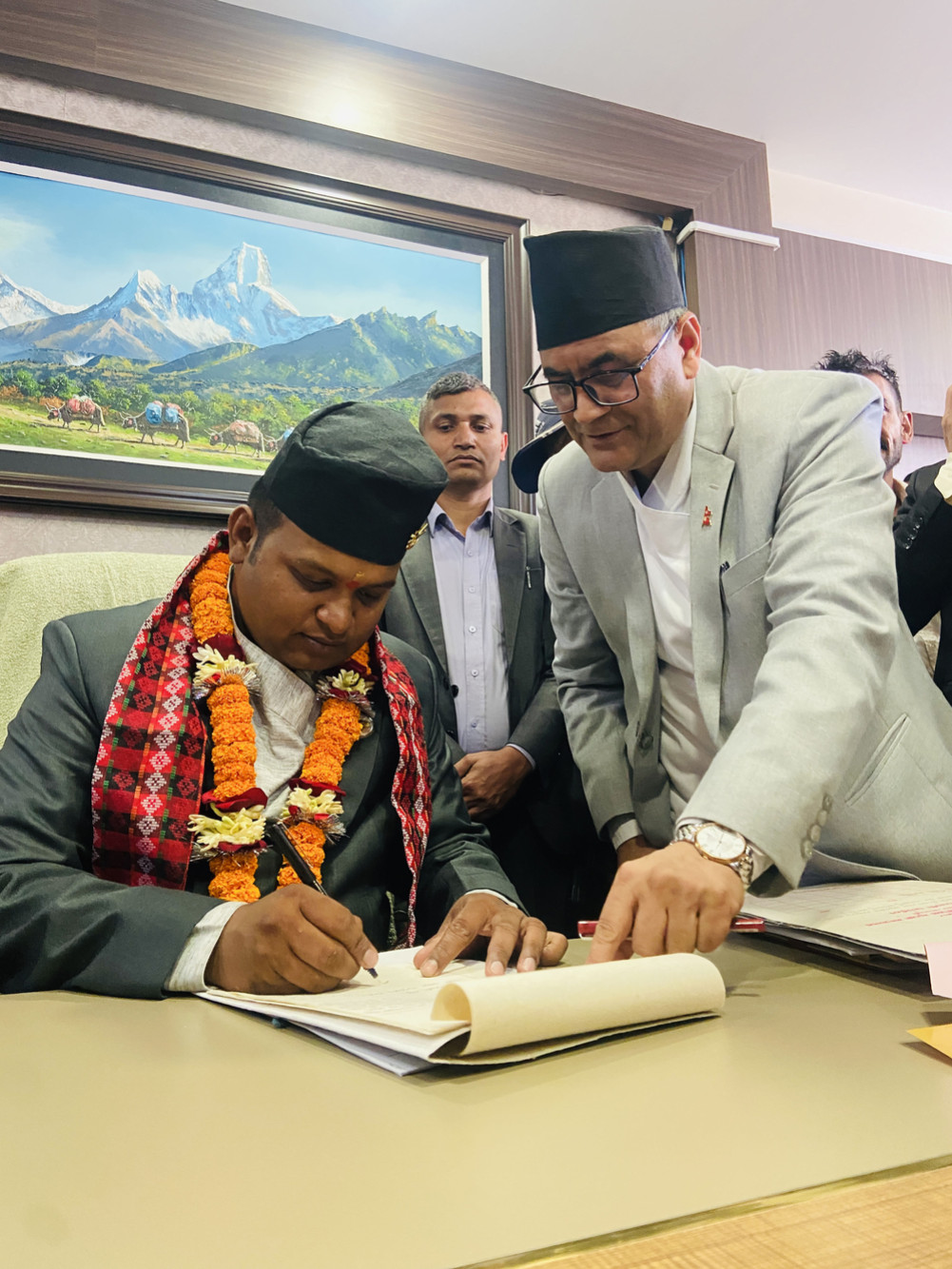
Newly appointed Minister for Labor, Deepak Kumar Sah, is leading the ministry amidst complex challenges including foreign employment, self-employment in the country, labor safety, and policy reforms.
We use Google Cloud Translation Services. Google requires we provide the following disclaimer relating to use of this service:
This service may contain translations powered by Google. Google disclaims all warranties related to the translations, expressed or implied, including any warranties of accuracy, reliability, and any implied warranties of merchantability, fitness for a particular purpose, and noninfringement.
At a time when foreign employment is facing a crisis due to the spread of war and instability in the major destination countries of Nepali workers, Deepak Kumar Sah of Mahottari has arrived as the new Labor Minister to take charge of the Ministry of Labor, Employment and Social Security. 34-year-old Sah, a member of parliament from the National Independent Party, was elected from Mahottari-2. He defeated Sharat Singh Bhandari, who has been a minister 19 times. Bhandari was the Labor Minister until the Gen-G movement.
The biggest challenge seems to be implementing the comprehensive thinking and multi-dimensional plan of the newly appointed Labor Minister Sah to transform the labor sector. Foreign employment management is still a sensitive area. More than 2,000 youth are going for foreign employment as an alternative daily due to the lack of job creation in the domestic labor market. Minister Sah has the responsibility to amend the act, provide transparent service, hear complaints, strengthen the rescue and relief system, search for new labor markets, and expand bilateral agreements.
He said that the task of utilizing the skills and capital of the returned workers in the country, controlling fraud, making the cost of workers going for foreign employment transparent, ensuring labor safety, and developing effective labor diplomacy is not easy .
The RSP's approach to promoting self-employment seems ambitious . There is a challenge to expand vocational education, modernization in agriculture, collective farming through cooperatives, entrepreneurship training, concessional loans, and market access . The goal has also been set to create employment by linking it to traditional professions, handicrafts, and tourism. The commitment to connect youth who have returned from foreign employment to self-employment through reintegration is also noteworthy. But for these programs to be effective, strong coordination is required between education, finance, agriculture, and the local level . Which has always been weak in practice.
Similarly, there is a need for policy reforms in job creation and management . There is a challenge to separate labor policy and employment policy, develop a labor market information system, balance demand and supply, and establish a program to produce skilled manpower . The public and private sectors should encourage labor-intensive systems and emphasize investing remittances in productive sectors. But the lack of reliable data, weak collaboration with the private sector, and slow policy implementation have confused previous governments on these issues.
The plan to make vocational and skill development training integrated and demand-driven is also important. A strategy has been formulated to bring training conducted by various agencies under one roof, develop new trades, conduct training in public-private partnerships, and link training with employment and enterprises. But the current situation has shown that the identification between training and employment is weak. Bridging this gap also seems to be another major challenge for Labor Minister Sah.
Improving internal labor relations is another important agenda. There are plans to revise labor laws, strengthen tripartite mechanisms, make labor inspections effective, create a permanent mechanism for determining minimum wages, and expand social security. But the lack of trust and institutional weaknesses among workers, employers, and the government appear to make implementing these reforms challenging.