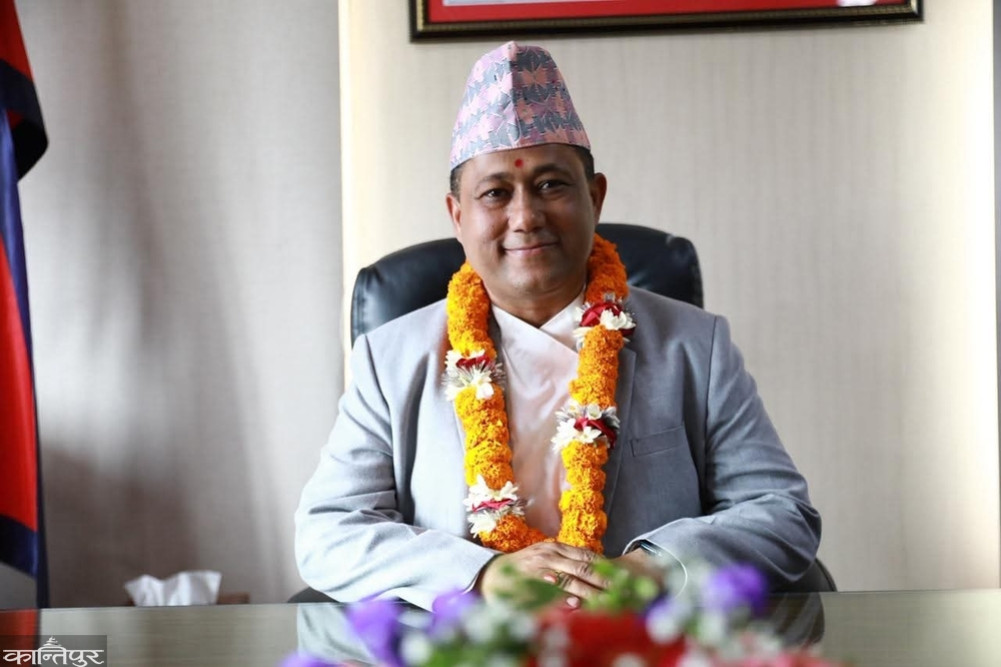
Shishir Khanal, who came to politics from the education sector, has become the Minister of Foreign Affairs. Now he has been given deep responsibility for improving relations with India, China, and other friendly countries and for economic diplomacy.
We use Google Cloud Translation Services. Google requires we provide the following disclaimer relating to use of this service:
This service may contain translations powered by Google. Google disclaims all warranties related to the translations, expressed or implied, including any warranties of accuracy, reliability, and any implied warranties of merchantability, fitness for a particular purpose, and noninfringement.
Shishir Khanal, who entered politics through the public education reform campaign, has been given the responsibility of heading the Ministry of Foreign Affairs in the Balendra Shah-led cabinet.
He entered politics by working for Teach for Nepal from 2012 to 2019 and briefly became the Minister of Education on 3 Magh 2079. He was able to work as the Minister of Education for 19 days.
After that, he was working as a member of the party's secretariat and head of the international department. He was also a member of the dialogue team formed to bring Balendra Shah into the Rashtriya Swatantra Party (RSWP).
He was a member of the high-level dialogue team led by Vice President Swarnim Wagle. During the dialogue, RSWP leaders say that he won the hearts of both parties. That is why Shishir was on the list of candidates to become the undisputed minister from both parties.
As the head of the international department, he had the opportunity to communicate with political parties from countries including India and China on behalf of the party.
If the situation outside does not improve, the challenge will increase: Chandradev Bhatta, an expert in international affairs When the Maoist conflict in Nepal was at its peak, he was studying public policy at the University of Wisconsin-Madison in the US. As soon as he completed his master's degree in 2061 BS, he got the opportunity to join the Sarvodaya Abhiyan in Sri Lanka. The aim of the campaign, which was started under the influence of Mahatma Gandhi's ideology, was to go to troubled villages and do labor for social transformation.
During that campaign, a tsunami occurred, after which he got the opportunity to go and work in Sri Lanka. When Khanal reached Sri Lanka, at least one million people had been displaced due to the tsunami. Two hundred thousand had died. ‘At that time, my team and I were engaged in relief and rehabilitation work,’ says Khanal, ‘that experience was useful even later.’
Later, he returned to Kathmandu saying that he wanted to do something in his own country. And, he started Sarvodaya Shramdaan Nepal.
Challenges and opportunities
‘This is a very sensitive time. It is time to think and act thoughtfully in diplomacy,’: Apeksha Shah. Head, TU Central Department of International Relations and Diplomacy The National Independent Party, which has formed a single-majority government, has both challenges and opportunities to maintain balance in geopolitics, relations with friendly countries, and credibility in diplomacy.
The new Foreign Minister should prioritize increasing external cooperation and investment to provide economic momentum to the country. As external opportunities dwindle, the government will have to demonstrate effective diplomatic skills to exploit the opportunities to benefit from the two neighboring countries, India and China.
At a time when rapid government changes have been seen as weakening Nepal's diplomatic skills, building trust with the international community under a majority government is considered a major challenge to safeguard Nepal's interests. In its pre-election manifesto, the Rashtriya Swayamsevak Sangh (RSS) has stated that it will adopt a 'balanced and dynamic diplomacy' to turn the rise of neighboring powers into an opportunity for Nepal's development. Diplomatic experts have found the policy of the RSS to be correct.
Chandradev Bhatta, an expert in international affairs, has considered the 'development diplomacy' theme of the RSS in its manifesto to be good. The RSS has said that it will maintain dynamics in relations with the two neighbors. 'We were only reactive.' The Rashtriya Swayamsevak Sangh (RSS) has said that it will be proactive, that is good,' Bhatta said, 'That means, now it will be proactive. We will work to further develop the relationship.'
He mentioned that in the past, coalition governments have used reactive diplomacy to stay in power or to show their different presence. 'Foreign policy was used as activism. In some cases, it was even done to keep the government going,' he said, 'A government with a two-thirds majority does not need such a thing. There is an opportunity to practice real foreign policy.'
The US and European countries have been reducing foreign aid. International common platforms like the United Nations seem weak. At this time, the West Asia war is ongoing. The impact of all this seen in world politics is starting to be seen in Nepal. The impact of the war in West Asia has had an impact on Nepali cuisine.
Foreign policy, diplomacy and international relations are not likely to change or be innovative: Madan Kumar Bhattarai, former Secretary, Ministry of Foreign Affairs. Similarly, a large number of Nepalis have reached those countries for employment. In the event of a prolonged war, their employment will be affected. Along with the elections and government formation, these challenges have also come before the Rashtriya Swayamsevak Sangh (RSS). The security of those employed abroad and providing them with employment in their own country is one of the important election issues of the RSS.
The current geopolitical situation is also not favorable for Nepal. Bhatta's analysis is that the international environment is not very friendly at the moment. He says that the war situation seen in the global world and the situation that it is increasing rather than stopping may lead to a more difficult situation.
'If tensions increase tomorrow, Nepalis who have reached countries other than the Gulf for employment may also face problems.' If the external situation does not improve, we will face additional challenges,' Bhatta said. 'After analyzing all these situations, Nepal should be able to maintain cordial relations with its two neighbors and increase economic activities. Our diplomacy should be increased accordingly.'
Relations with India have seen many ups and downs in the last decade. The blockade imposed by India in 2072 during the promulgation of the constitution had severely disrupted relations between the two countries. While efforts are being made to improve it, the border dispute is not allowing the development of warmth between Kathmandu and Delhi.
Limpiyadhura, Lipulekh and Kalapani areas are Nepalese territory. However, ignoring Nepal's objections and concerns, India has built roads in the area and opened trade with China. The work of settling the border between the two countries has been 98 percent completed.
However, the border dispute in the Susta and Kalapani areas remains. Parties have been using it to gain advantage in domestic politics. However, there has been no 'table talk' between the two countries to resolve the dispute. Similarly, India does not seem to have listened to Nepal's demand for revision and reform of the 1950 Peace and Friendship Treaty with India. India has refused to accept the report of the Nepal-India Expert Group (EPG), which was formed by the two countries to reach an agreement on issues including treaty revision.
On the other hand, China is suspicious of the participation of those demanding 'Free Tibet' in the Genji movement and demonstration held on 23 and 24 Bhadra. On the basis of that movement, the Rashtriya Swayamsevak Sangh (RSS) has won a majority in the elections. China will be interested in the new government's faithful commitment to the One China policy and the need to prevent anti-China activities in Nepal and to strictly control such activities.
China is also interested in the issue of corruption being exposed in the construction of the Pokhara Regional International Airport built with the concessional loan assistance of the Chinese government. It remains to be seen how this will affect the cooperation from China in the coming days. Similarly, even after years of Nepal signing China's ambitious project BRI, its implementation in China has not been possible.
Apeksha Shah, head of the Central Department of International Relations and Diplomacy at Tribhuvan University, says Nepal should be clear about its 'interests' and create a trusting environment by addressing the concerns of its neighbors. She mentioned that the agreements made with the two neighbors, India and China, as well as the US, should be implemented and taken forward.
She says that it would be better to prioritize the energy trade with India, the BRI with China, and the MCC project with the US. 'The political instability caused by the rapid change of governments yesterday also seems to have affected those agreements,' she said. 'Our stand and words should be clear. We should focus on trustworthy diplomacy.' Diplomacy should be focused on economic progress and national interest.’
The Rashtriya Swayamsevak Sangh (RSS) has said in its pledge to take high-level initiatives to permanently resolve border disputes and old treaties and agreements through institutional dialogue based on facts and evidence, rather than limiting them to emotions.’ At a time when geopolitics is undergoing rapid changes and ups and downs, she suggests that instead of entering into many new issues, emphasis should be placed on implementing what is happening. ‘This is a very sensitive time. It is time to think and act in diplomacy,’ she said. ‘Our diplomacy can also be important when global geopolitics is undergoing ups and downs. We have to take more sensible steps.’
Bhatta, an expert in international affairs, also says that there is no time for ‘adventurism’ in geopolitics just because a majority government has come to power. ‘Don’t get too excited . There is no situation where I will do this and that . It has to be practical . It may not be easy to go to a new area,’ he said, ‘diplomacy to increase economic activity by increasing cordial relations with neighbors is possible .’
He expressed the possibility that if he touched on the border dispute at the beginning, it could increase other challenges . The Rashtriya Swayamsevak Sangh (RSS) has said in its pledge to take high-level initiatives to permanently resolve border disputes and old treaties and agreements through institutional dialogue based on facts and evidence, not just emotions. Experts have suggested that since border disputes of any country are not resolved today or tomorrow, continuous diplomatic efforts should be made for that .
Former Secretary of the Ministry of Foreign Affairs, Madan Kumar Bhattarai, says that it is not possible to hold all relations hostage by pointing to one dispute . ‘Border disputes are with neighbors . They do not happen with unaligned countries . It takes a long time to resolve such disputes,' he said. 'Whatever differences there are, we need to continue talking about them. It will not be resolved today or tomorrow. Long negotiations are needed.' He mentioned that the diplomatic skills of negotiating differences and continuing economic, technical and trade cooperation should be shown.
He mentioned that the formation of a government with a two-thirds majority, generational change in politics and an increase in qualitative presence in parliament are positive aspects. He said that foreign policy, diplomacy and international relations will not change or bring newness to them.
'This will be a little liberal and conservative. Along with newness, it seeks continuity. Even if there are some changes, the continuity is a big part of it,' he said, 'Just because a new government has come, it cannot bring about a change in foreign policy.'
Stating that foreign policy is an extended form of domestic domestic policy, he said that domestic instability had an impact on it yesterday, but now political stability will have a positive impact. He said that while determining priorities in foreign relations, it should be done by looking at the two closest neighbors, major power nations, development partners and countries where the Nepali diaspora is located.
How many embassies are needed, after a deep study, they should be removed from unwanted places and added only to necessary places, he says. 'Yesterday, embassies were added to provide jobs to someone, there was a problem in the appointment of ambassadors, where and why to visit? Clarity is also needed on that. How many delegations will go?,' Bhattarai said, 'There are opportunities for improvement in many such issues. A professional diplomat had to be sent as an ambassador. We sought support based on national interests.'
Shah, head of the TU International Department, also says that the Ministry of Foreign Affairs and our diplomacy should improve the internal weaknesses. 'Political instability has also had an impact on the foreign ministry to some extent. How to strengthen the ministry. It is necessary to pay attention to increasing its role,' she said, 'There are many internal weaknesses. That needs to be improved.'
In the monarchy, there was direct interference from the palace in the Ministry of Foreign Affairs. From conducting international relations to appointing ambassadors, the king had a hand in it. Due to the direct protection of the royal palace, the foreign ministry was different. Foreign ministry employees did not defer to others. That fuss still persists. The desire of ministry employees is focused on attractive postings. Nepal's foreign affairs have also been weakened by the practice of spending time in attractive countries waiting for another posting after completing their term in the ministry.
A former minister shared his experience of the ministry returning from overseas postings and preparing to go back to work as a 'transit' for foreign affairs employees. Refusing to give a formal quote, he said, 'It would have been difficult for a minister appointed for a short period to take work from employees.' The RSPA government, which was formed to last for 5 years, should also be able to improve the transit mentality of foreign affairs employees.'