Pressure on new government to immediately implement Commission of Inquiry report, risk of violating judicial process if implemented in a hurry
We use Google Cloud Translation Services. Google requires we provide the following disclaimer relating to use of this service:
This service may contain translations powered by Google. Google disclaims all warranties related to the translations, expressed or implied, including any warranties of accuracy, reliability, and any implied warranties of merchantability, fitness for a particular purpose, and noninfringement.
After the report of the Commission of Inquiry on the incidents of 23 and 24 Bhadra was 'leaked' through informal channels, pressure has increased on the new government to implement it immediately. There is also a risk of violating the judicial process if the government tries to implement the report in a hurry.
Constitutional scholar Bipin Adhikari says that the incident of the 'leaked' report has embarrassed the new government. 'This has eroded all the rights of the government,' he said, 'The government that came with such public opinion has lost the opportunity to make decisions based on a national perspective.' The report of the commission, which recommended that former Prime Minister KP Sharma Oli, former Home Minister Ramesh Lekhak and high-ranking security officials be investigated in the murder case, was suddenly released on the eve of the formation of the new government. It is not clear who 'leaked' the report prepared by the Commission of Inquiry formed under the leadership of former judge Gauri Bahadur Karki and for what purpose.
As pressure to make the report public, Prime Minister Sushila Karki was saying that she would study it and take the necessary decision. But with the ‘leak’, the government has been stripped of its decision-making authority over when, how, and how much to make public. After the ‘leak’, Prime Minister Karki decided to make three reports public, including this one, on Wednesday evening.
Constitutional scholar Bipin Adhikari says that the incident of the ‘leak’ of the report has embarrassed the new government. ‘It has eroded all the government’s authority,’ he said. ‘The government that came with such public opinion has lost the opportunity to make decisions based on a national perspective.’
Constitutional scholar Adhikari’s analysis is that unprecedented pressure has also been created on the new Prime Minister to implement the report that recommended criminal investigations against former Prime Minister Oli and others. ‘After the report was leaked, slogans of arresting so-and-so or confiscating so-and-so’s passport have started to be heard in public. There is a risk that the government may choose a shortcut due to such pressure,’ he said. ‘The process of getting justice is long. Shortcuts cannot be found. After the leak, it has narrowed the government’s options.’
76 people lost their lives across the country on 23 and 24 Bhadra. According to the post-mortem report, most of them died from gunshot wounds to the chest and head, and more than 2,500 people were injured. The vandalism and arson on Bhadra 24 caused damage worth about 85 billion rupees to public property. The government had formed an inquiry commission under the chairmanship of former Justice Gauri Bahadur Karki on 5 Ashoja to investigate the violent incidents of those two days and submit a report. After repeated extensions, the commission submitted its report to the government on 24 Falgun.
The report has recommended initiating a criminal investigation under Sections 181 and 182 of the Criminal Code against the then Prime Minister Oli and the then Home Minister Lekhak, as well as the then Inspector General of Nepal Police Chandrakuber Khapung, the then Home Secretary Gokarnamani Duwadi, the Armed Forces Inspector General Raju Aryal, the then Chief of the National Investigation Department Hutraj Thapa, and the then Chief District Officer of Kathmandu Chhabilal Rijal. The said sections of the code provide for punishment for those who commit negligent acts or negligence that result in the death of someone. The commission has held that the responsibility lies with the political leadership and security chiefs, saying that they did not play any role in stopping the police firing on 23 Bhadra.
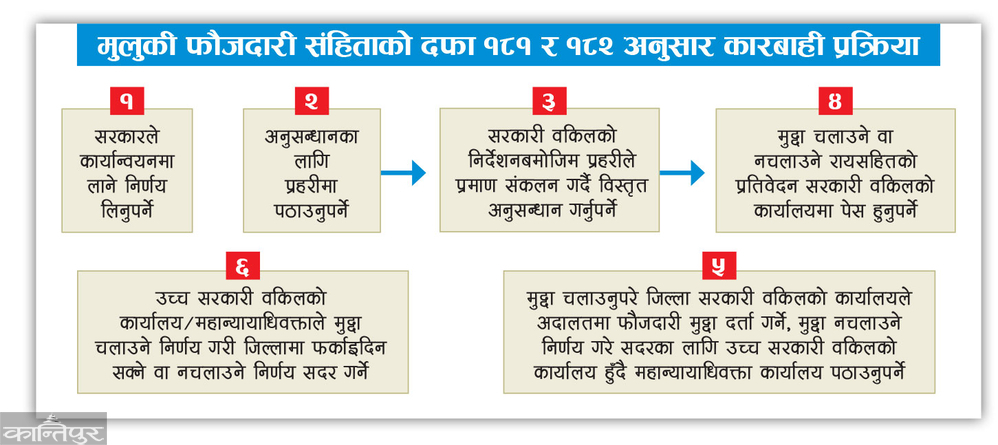
As suggested by the report, the government should decide and direct the relevant bodies to implement the report. For example, if Oli, Lekhak and others are to be prosecuted as per the report’s recommendations, the police should first conduct a criminal investigation against them. According to legal experts, the recommendations of the Karki Commission or other similar inquiry commissions are not directly implemented like court decisions. Their only limitation is that such recommendations are only information for the government. Constitutional expert Purnaman Shakya says that this report is only an opinion and consultation for the government. ‘The report is not binding on any government,’ he said, ‘it will not be implemented by itself. Whether it will be implemented or not depends on the government.’
The government should decide and direct the relevant bodies to implement the report as recommended by the report. For example, if Oli, Lekhak and others are to be prosecuted as recommended by the report, the police should first conduct a criminal investigation against them. If there is evidence of their involvement, the investigation report with the opinion to prosecute should be submitted to the government prosecutor's office, and then the government prosecutor should decide whether to prosecute or not. 'The commission should not find anyone guilty and then prosecute or decide on the basis of that,' said senior advocate Satish Krishna Kharel, a criminal law expert.
Former Chief Attorney of Madhesh Province, Dipendra Jha, says that the commission's report itself has accepted that this recommendation is only a complaint-like information. 'It is written in the report - it is recommended to investigate further and prosecute,' he said. 'This is how the commission gave the information, now the government should investigate further and decide on prosecution.' According to Jha, no criminal case can be filed against anyone based on the commission's recommendation alone. Even in cases where someone is said to have died due to negligence and carelessness, the personal responsibility of the officials should be established.
Former Chief Justice Jha said that a decision should be made to prosecute or not only after determining what crime each person has committed and what evidence is there to show that such a crime was committed. ‘There is a lot of public pressure on the new government to implement the report,’ he said, ‘In a hurry to prosecute the case, it should not be like throwing stones at the first bite. The investigation and prosecution bodies should be allowed to work independently and make decisions only according to the evidence.’ Stating that personal bias should not be seen in the government’s decision, he said that it would be appropriate to form a group of police and government lawyers in Kathmandu to investigate the issues and individuals suggested by the commission.
The day after the report was ‘leaked’, the newly elected MPs took oath on Thursday. Balendra Shah, who was declared the prime ministerial candidate by the Rashtriya Swayamsevak Sangh (RSS) party, has been elected the leader of the parliamentary party and it is scheduled to take oath as the prime minister and form a new government on Friday.
Shah has been standing up against the use of excessive force on 23 Bhadra since before he resigned as mayor of Kathmandu Metropolitan City and contested the election. He, who compared the violence committed by the state on that day to an act of terrorism, has been responsible for implementing the Karki Commission report as per his own prior commitment. On the other hand, the families of those who died during the protests are also protesting demanding justice. All of their hopes are on the new government.
Senior advocate Kharel also says that the government is under pressure to fulfill its earlier promise to take action against the perpetrators of those incidents. He said, ‘If the government wanted, it could have conducted an investigation and prosecuted even if there was no report. Now, how the report will be implemented depends on how the government takes ownership.’
The government was unable to form an opinion on various aspects of the report after it was ‘leaked,’ said the constitutional expert Adhikari. ‘The Prime Minister who is about to be appointed should have first studied it and said that he would take a policy decision on the report,’ he said, ‘He (Shah) said that this government would have made it public. They have so much public opinion capital, if they do not know how to keep it in a bag, there is a risk of political legitimacy being lost in two months.’
Commissions were formed earlier to investigate violent incidents and abuse of power. The report of the commission formed under the chairmanship of retired Supreme Court judge Girish Chandra Lal after more than 40 people died during the Madhesh movement in 2072 has not been made public to this day and has not been implemented.
Commissions were formed earlier to investigate violent incidents and abuse of power. The people found responsible by the Rayamajhi Commission, formed to investigate the incident in which 22 people died and more than 5,000 civilians were injured in the 2062/063 people’s movement, have not been investigated and prosecuted yet. The Mallik Commission was formed after the 2046 people’s movement. Even the report of the commission that held those responsible for violent repression in the movement was suppressed.
The International Commission of Jurists (ICJ), which studied the commissions formed after the restoration of democracy in 2047, has said, ‘The lack of implementation of the commission’s reports and recommendations has fostered a culture of impunity. It has encouraged repeated human rights violations and widespread corruption.’
Jha, former Chief Attorney of Madhesh Province, comments that commissions in Nepal have ‘come and gone’. ‘The new party (RSVP) has said that it will implement (the Karki Commission report). If the will is shown, an environment will be created.’


