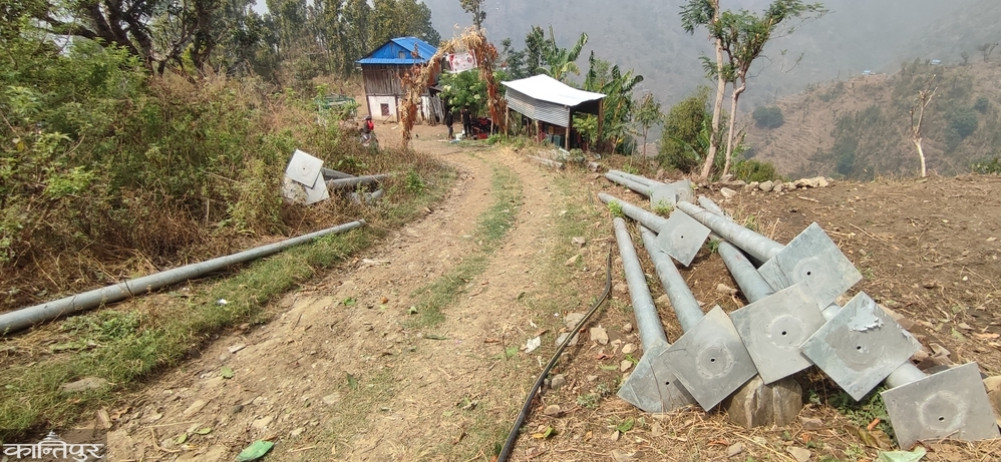
No house in Ward No. 13 of Rapti Municipality, Chitwan has a light yet. Poles have been erected in various places to provide electricity. In some places, poles have been erected but wires have yet to be installed, while in others, wires appear to have been installed.
We use Google Cloud Translation Services. Google requires we provide the following disclaimer relating to use of this service:
This service may contain translations powered by Google. Google disclaims all warranties related to the translations, expressed or implied, including any warranties of accuracy, reliability, and any implied warranties of merchantability, fitness for a particular purpose, and noninfringement.
Ait Bahadur Praja Chepang's house is still not lit. He has not even done the wiring for electricity in his house. His house is near Kalitar in Rapti Municipality-13 Lothar in the northern hilly region of Chitwan. Even though it is in the municipality, his house is not the only one that does not have electricity in this place. No house in Rapti-13 has electricity.
Wards 10, 11, 12 and 13 of Rapti Municipality, which has a total of 13 wards, are in the hilly region. Of these wards in the hilly region, electricity is partially available in others. But no house in ward number 13 has lights yet. Poles have been erected in places to provide electricity. In some places, poles have been erected but wires have yet to be hung, and in others, wires appear to have been hung.
In some places, poles have been reached but they have yet to be buried. Poles are visible in the fields and fields. ‘We are eager to light the lights. But why are we not able to light them?’ Those who have a little money have lit solar panels here and there. Otherwise, they light small lamps. Some people do not light small lamps but live on the ashes of the fire,’ said Ait Bahadur.
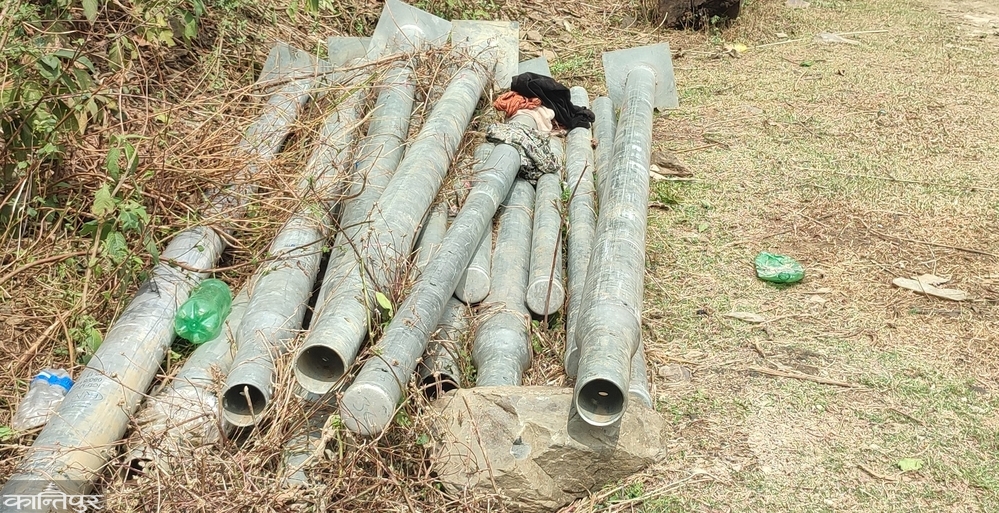
Ram Kumar Chepang had walked up to the village for three hours carrying poles in the hope of lighting electricity. ‘The car is not running. The road we are walking on is very difficult. It was difficult for two or three people to carry poles on a road where one person can walk while carrying a heavy load. The villagers above us carried poles for four or five hours. When will they bury them? After burying the poles, the electricity will come after laying the wires,’ said 32-year-old Ram Kumar of Rapti-13 Kanda. He said that the poles were brought before the elections. He said that he was hoping that the electricity would light up his house.
‘They say that when electricity comes, you can do many things, but what else can you do? I think that the house with the same lights will be as bright at night as it is during the day,’ said Ramkumar.
The pole has reached the house of Harilal Chepang of Kumitar, Rapti-13, but the wire has yet to be hung. He does not expect the lights to come on immediately because the wire has not reached even though it is a year. It has been three years since the efforts to light up this area began.
One day, after burying the pole, hanging the wire and installing the transformer at Kalitar, where the ward office of Rapti-13 is located, the lights flickered. ‘I saw MP Hari Dhakal come and light up the lights.’ There was a light on the pole near the ward office. How long did that lamp last for a day or two? Now, there is only a holder on the pole,' said Harilal. Hari Dhakal has been lighting the lamp like this for two years.
Pritam Raj Bista, head of the distribution center of Nepal Electricity Authority in Ratnanagar Tandi, said that the electrification work in the hilly areas of Rapti Municipality should have been completed last Asoj. 'But there was a delay. Even though the pole reached, the work could not be completed due to the lack of wires. I came in Mangsir. I have asked to work after I came. The first thing to do is to arrange the wires,' said Bista. 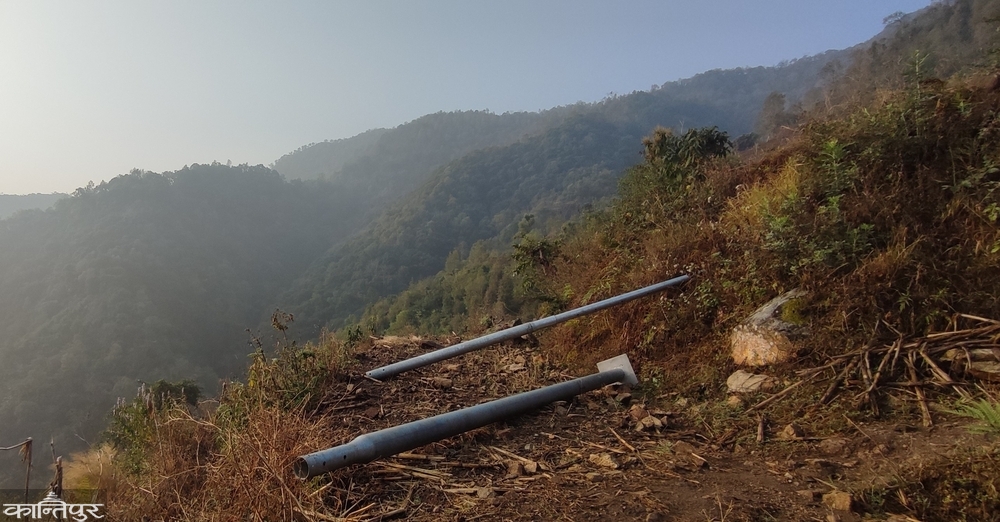
About 80 kilometers of wires are required for that area. But only a very small amount of wires are available. 'I have asked the higher authorities for more wires. If 10 kilometers of wires are pulled out here and there, the work will move forward,' he said. He said that in addition to the wires, a suitable transformer is also being arranged for reliable electricity service. He said that electricity will be turned on as soon as possible.
He said that he has planned to turn on electricity at least in the ward office and the adjacent Kalitar school in Ward No. 13 of Rapti soon. Rapti-13 Ward Chairman Ashok Praja Chepang said that it was not possible to turn on electricity before the elections even though he requested the concerned contractor and the electricity office.
The hilly areas of Rapti Municipality are densely populated by the indigenous Chepang community, which is a very marginalized group. Ward No. 13 is mostly inhabited by Chepangs. Ward No. 13 has 647 households, according to the 2078 BS census. ‘So far, no house has electricity.’ He said that he is trying to get the work done quickly.