Senior meteorologist at the department, Raju Pradhananga, informed that such a plan has been taken forward with the aim of making the forecast more reliable, technology-friendly and effective.
We use Google Cloud Translation Services. Google requires we provide the following disclaimer relating to use of this service:
This service may contain translations powered by Google. Google disclaims all warranties related to the translations, expressed or implied, including any warranties of accuracy, reliability, and any implied warranties of merchantability, fitness for a particular purpose, and noninfringement.
The Department of Hydrology and Meteorology has started preparations to expand the weather forecast, which is currently being issued for only three days, to seven days in the near future.
Senior Meteorologist Raju Pradhananga of the department informed that such a plan has been taken forward with the aim of making the forecast more reliable, technology-friendly and effective.
According to him, forecasting based on quality data is essential to reduce the loss of property and lives due to weather-related disasters. Disasters such as heavy rain, wind, hail and fires cause great damage in Nepal every year. Currently, the department has been collecting data through satellites, radar, radiosondes and ground-based centers.
The department has been regularly making public three-day forecasts through the 'Numerical Weather Modeling' system. The data has been made available to various agencies including roads, mining and geology, agriculture for preparation and decision-making.
 According to Pradhananga, special forecasting services targeting mountaineering, aviation, agriculture and urban areas are in operation. The aerial weather service has been digitized and 'Impact Based Forecasting' (IBF) has been started at 21 local levels. Stating that there has been significant improvement in weather technology since 2010, he said that preparations are underway to develop a seven-day forecast system, a mobile app and its own 'decision support system'.
The department has also been regularly providing daily, monthly, seasonal and annual reports, heavy rainfall-temperature monitoring, drought monitoring and information on climate change. Analysis of rainfall, temperature and humidity is also made public on a weekly basis in the agricultural sector.
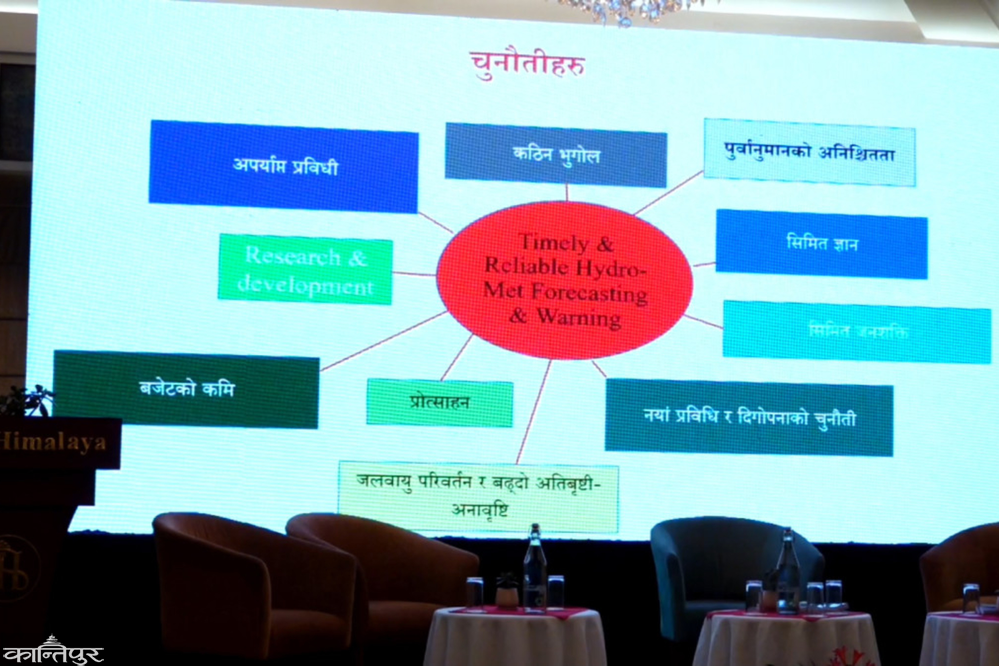
Speaking at the program, Senior Divisional Hydrologist Rambikesh Rai said that despite significant progress in the field of hydrology, lack of technology and budget is the main challenge. According to him, 206 out of 230 water level measurement centers across the country have been automated. The department has been collecting data through radar level sensors, staff gauges and discharge measurements.
Rai said that the department has been providing data verification services required for insurance claims related to hydropower projects, academic research and floods and landslides. Flood forecasting is done through various models based on real-time rainfall, water level and soil moisture, the information of which is disseminated through bulletins, social media, SMS, radio, television and toll-free number 1155.
According to him, the accuracy of flood forecasting in the Narayani Basin region has reached about 90 percent. Early warning systems have been installed in Chorolpa and Imja glaciers, and there are plans to expand similar systems to four more glaciers.
Rai mentioned that problems such as difficult geography, limited manpower, lack of technology, budget cuts and weaknesses in research still exist. He said that increasing heavy and dry rainfall due to climate change has added uncertainty to the forecast. He stressed the need to develop an effective early warning system through sirens or loudspeakers for communities outside the reach of information.
The department said that it is expanding the forecasting service by strengthening data collection and analysis through modern equipment and digital systems. It is believed that such efforts will help in reducing the damage caused by natural disasters.