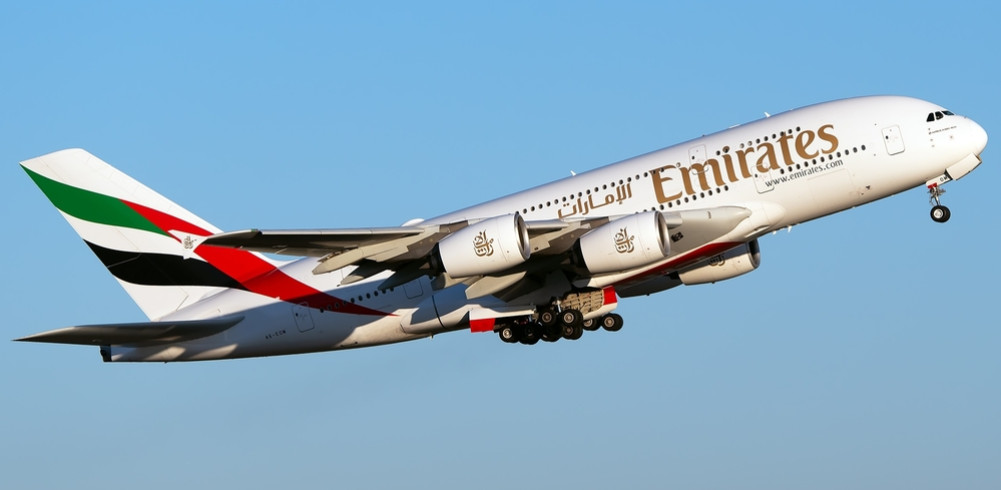
Data released on Sunday by world-renowned aircraft tracking website Flightradar shows that major Gulf airlines are gradually emerging from a serious crisis, despite the sudden onset of it.
We use Google Cloud Translation Services. Google requires we provide the following disclaimer relating to use of this service:
This service may contain translations powered by Google. Google disclaims all warranties related to the translations, expressed or implied, including any warranties of accuracy, reliability, and any implied warranties of merchantability, fitness for a particular purpose, and noninfringement.
Major Middle Eastern airlines Emirates, Qatar Airways, Etihad, FlyDubai and Air Arabia are showing signs of improvement by mid-March after an unusual decline in flight activity towards the end of February.
Data released by world-renowned aircraft tracking online FlightRadar on Sunday showed that the major Gulf airlines are gradually emerging from a serious crisis, despite the sudden crisis.
All these airlines were operating at full capacity between February 23 and 27. In particular, there was a competition for leadership between Emirates and Qatar Airways. While Qatar Airways had reached a high level for a few days, Emirates was steadily operating more than 500 daily flights. Etihad and FlyDubai were stable at a moderate level, while Air Arabia was also significantly active. It was clear that the Middle East was establishing itself as a major hub for international aviation.
But from February 28, the situation changed abruptly. Following the joint military strikes by the United States and Israel on Iran, all major Gulf airlines saw their flights fall dramatically. Some companies almost ground to a halt. According to data from Flightradar, FlyDubai fell to zero, while Emirates and Qatar Airways were also reduced to very low numbers. Such a sudden decline suggested that the problem was caused by external factors affecting the entire region, not just one company.
Geopolitical tensions, airspace restrictions or sudden operational disruptions were the main factors.
After March 3, a gradual recovery began. Emirates was the fastest, increasing its flight numbers significantly within a few days. FlyDubai also showed a rapid recovery in the initial phase, which shows its operational flexibility. Etihad, on the other hand, has been slowly but steadily expanding its capacity. Air Arabia has gradually recovered from zero, while Qatar Airways has been a bit slower to recover than the others.
The situation seems to be stabilizing somewhat as we approach mid-March. Emirates appears to be heading back to higher levels, while Etihad is also growing significantly and strengthening its presence.
Flydubai and Air Arabia are stabilizing at a moderate level. Qatar Airways is also improving, but it seems that it will take some time to fully return to its previous level.
This overall development shows the struggle of the Gulf aviation sector. External shocks can affect the entire operating system in a matter of days, but the large and well-established airlines in the same region also show the ability to recover quickly. In addition, this event has also brought about some changes in the competitive balance, where Emirates seems to have strengthened its lead while other companies are gradually returning to the competition.
Overall, the Middle Eastern aviation sector is going through a period of severe decline and then recovery in a short period of time. Whether stability will remain or there will be further fluctuations in the coming days will depend on the international situation, passenger demand and policy decisions.
Qatar, Air Arabia, and Fly Dubai are trying to continue flights to Nepal. Qatar has also announced that it will start serving passengers from third countries from March 18.