Attorney General Savita Bhandari had decided on 10 December 2005 to amend the charge sheet against Lamichhane in the cases filed against him in the Kaski, Kathmandu, Rupandehi and Parsa district courts, so that the claims of 'organized crime' and 'money laundering' no longer stand.
We use Google Cloud Translation Services. Google requires we provide the following disclaimer relating to use of this service:
This service may contain translations powered by Google. Google disclaims all warranties related to the translations, expressed or implied, including any warranties of accuracy, reliability, and any implied warranties of merchantability, fitness for a particular purpose, and noninfringement.
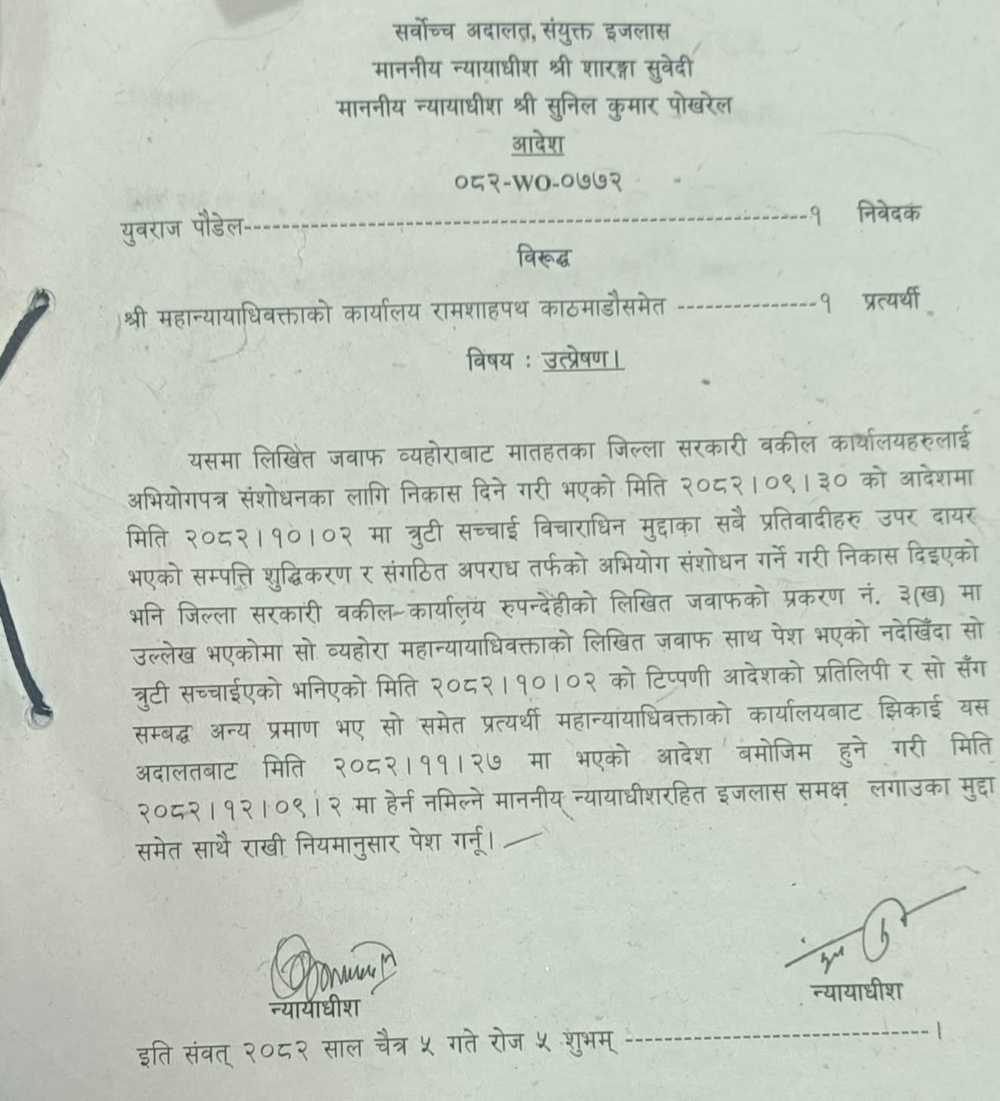
The Supreme Court has ordered the summoning of files in the case of National Independent Party President Ravi Lamichhane. The Supreme Court has given this order in a writ petition against Attorney General Savita Bhandari's decision to amend the charge sheet related to money laundering and organized crime involving Ravi. A bench of Justices Sharanga Subedi and Sunil Kumar Pokharel has ordered the submission of the decision made by the Attorney General on 2 Falgun to amend the charge sheet of 50 defendants including Ravi. The bench has asked for the next hearing to be held separately by the bench of the judge who cannot attend on 9 Chaitra. The hearing of the case, which began on Sunday, was held for 3 days
'watching and listening' . The writ petition filed by senior advocate Dinesh Tripathi, law students Ayush Badal and Yubaraj Poudel Safal sought to quash the decision of the Attorney General's Office, calling it 'prima facie illegal, malicious and arbitrary'.
Attorney General Savita Bhandari had decided on 30 Poush 2082 to amend the charge sheet in the cases filed against Lamichhane in the Kaski, Kathmandu, Rupandehi and Parsa district courts, so that the claims of 'organized crime' and 'wealth laundering' would no longer be upheld.
In that decision, the argument was presented that Lamichhane was charged on the basis of political vendetta and that the interests of the savers should be given priority. Although Section 36 of the Criminal Procedure Code was used as the basis for amending the charge, the writ petitioner claims that this is effectively an act of 'withdrawing the case' It was .
It was claimed in the writ petition that such a decision was wrong when Section 116 of the Code prohibits the withdrawal of a money laundering case.