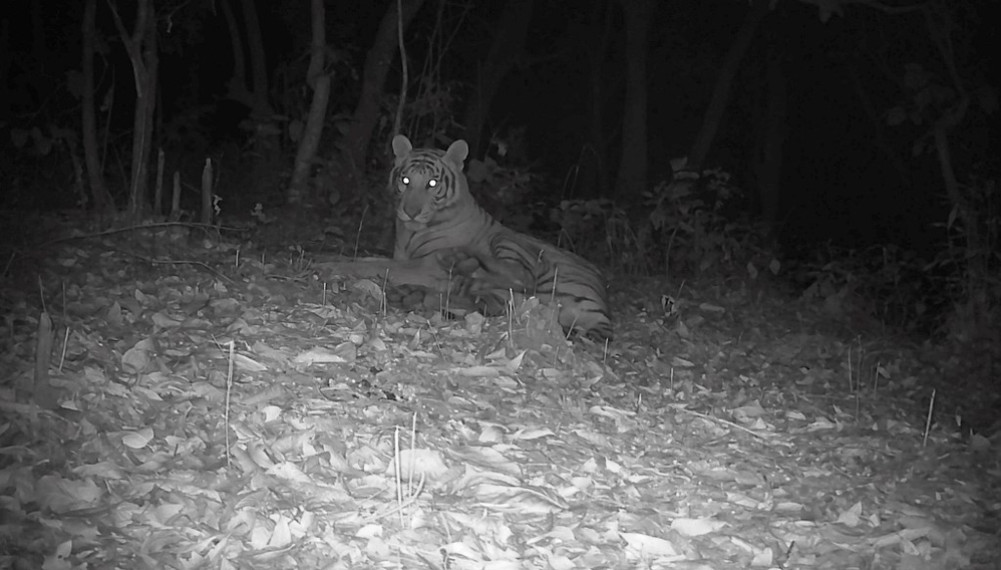
A tiger has been spotted at an altitude of 1,110 meters near Mathagadhi Fort in Palpa and at an altitude of 934 meters near Rajiya in Shitganga Municipality of Arghakhanchi.
We use Google Cloud Translation Services. Google requires we provide the following disclaimer relating to use of this service:
This service may contain translations powered by Google. Google disclaims all warranties related to the translations, expressed or implied, including any warranties of accuracy, reliability, and any implied warranties of merchantability, fitness for a particular purpose, and noninfringement.
While there is a debate about the management of tiger numbers, which are considered indicators of a healthy ecosystem in the forest, three tigers have been recorded in Palpa and Arghakhanchi. All three tigers found here are adults.
The recording was made after a tiger was caught in a camera trap conducted by the Central Department of Zoology, Tribhuvan University in Palpa and Arghakhanchi. The tigers were seen in these two districts in a study conducted by the department to determine the condition of wildlife in Lumbini Province.
A tiger has been found at an altitude of 1,110 meters near the Mathagadhi Fort in Mathagadhi Rural Municipality of Palpa. Similarly, a tiger was also caught in a camera trap at an altitude of 536 meters above the Jhumsa Khola in Tinau Rural Municipality of Palpa, according to TU professor and study team coordinator Dr. Hari Prasad Sharma.
A tiger camera trap has also been recorded near Rajiya, Shitganga Municipality of Arghakhanchi. The tiger was found at an altitude of 934 meters. The tiger found here was found on a human-made road in the area around the settlement.
Cameras were placed in the national forest, community forest and mountains of the Chure region. Cameras were placed on potential paths for wildlife movement, river banks, and double-lane firelines. Cameras were placed on mountain paths, bridle tracks, salt and water sources.
44 camera traps were placed in Palpa and 50 in Arghakhanchi. 94 cameras were installed in about 800 square kilometers. A grid of five square kilometers was made and 4 cameras were placed in 25 square kilometers. Field coordinator Bachan Prasai said that the camera traps were set at a distance of one kilometer from one camera to another.
A team of 4 technicians had set up camera traps in Palpa on Magh 29 and 30 and reached Arghakhanchi. The team had set up cameras in Arghakhanchi on Falgun 4 and 5 and monitored them. Another field coordinator, Sagar Khadka, said that three tigers were found in the forest area for 21/21 days in both places. The technical team has taken out cameras in Palpa and reached Arghakhanchi to take out cameras.
Tigers were seen in Mathagadhi, Palpa, at night on Falgun 3 and 4, two days apart. However, field coordinator Prasai said that work is underway to determine whether they are the same or different. Similarly, in Arghakhanchi, two tigers were seen in two cameras on Falgun 30, but it is estimated that the same tiger was seen twice.
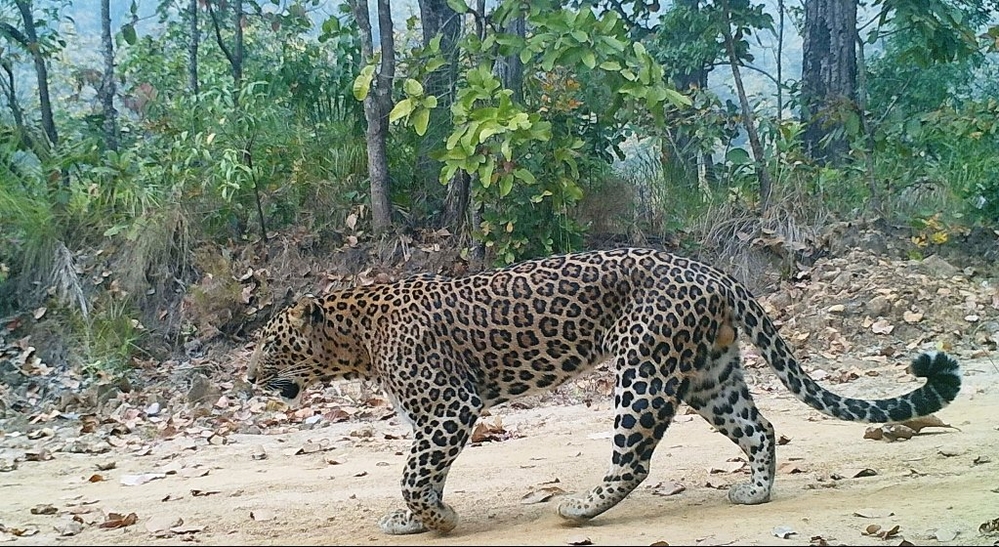
Similarly, in Shitganga, a leopard was also caught in a camera trap along with a tiger in a single camera. 18/19 leopards have been caught in the camera traps placed in Palpa and 19/20 in Arghakhanchi. It is yet to be investigated whether the tigers found in the Chure area, mountains and forests are native or have come from outside. Chure is connected to Banke, Dang, Kapilvastu, Arghakhanchi and Palpa.
WWF Nepal Representative Dr. Ghanshyam Gurung said that the results of the camera trapping will help in working on the status of wildlife, forest management and conservation policy plans. He also said that it will help in planning the development of wildlife habitats and ecotourism. Conservationists say that this study will also help reduce illegal wildlife poaching and human-wildlife conflict.
Tiger censuses are currently being conducted in parks and protected areas in Nepal . The recording of tigers in non-protected areas is expected to further increase the number of tigers . However, the recent increase in human-tiger conflict has increased fear in society . Senior Forest Officer at the Ministry of Forests and Environment, Tolkraj Chapagain, said that all parties should work together to resolve this issue in a timely manner .
Earlier, in 2018, a tiger was seen for the first time in the border area of Rupandehi, Kapilvastu and Palpa . A joint study conducted by the President's Chure Terai-Madhesh Conservation Development Board and the National Nature Conservation Trust on biodiversity in the Chure region showed that there are tigers in Rupandehi and Palpa along with Kapilvastu .
A female tiger was seen in more than one place on the border of Rupandehi and Palpa, and a male tiger was seen about 40 kilometers west of that in the northern area of Kapilvastu, said tiger expert Dr. Baburam Lamichhane, who participated in the study. In Kapilvastu, for the second time in 2080 Pus, two tigers were caught in camera traps in Buddhabhumi Municipality and one in Vijayanagar Rural Municipality.