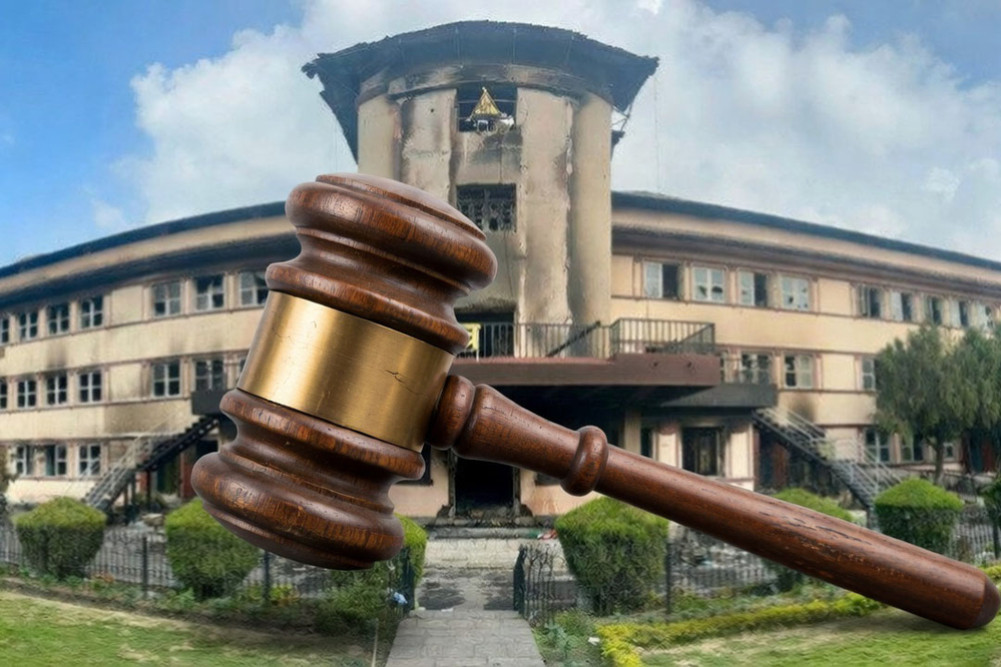
Supreme Court Justice Sunil Pokharel, who had previously defended Rashtriya Swayamsevak Sangh (RSS) President Lamichhane in a citizenship case as a legal practitioner, has now raised questions about his decision not to separate the hearing of the petition related to the money laundering charges against Lamichhane.
We use Google Cloud Translation Services. Google requires we provide the following disclaimer relating to use of this service:
This service may contain translations powered by Google. Google disclaims all warranties related to the translations, expressed or implied, including any warranties of accuracy, reliability, and any implied warranties of merchantability, fitness for a particular purpose, and noninfringement.
When RSP President Ravi Lamichhane was in the previous parliament, his citizenship case was defended by Sunil Pokharel, now a legal practitioner of the Supreme Court. Justice Pokharel has decided not to recuse himself from the hearing of a public interest litigation (PIL) related to the charges of cooperative fraud, organized crime and money laundering against Lamichhane, even though
Attorney General Savita Bhandari's decision to withdraw the charges of organized crime and money laundering from the cases pending against Lamichhane in various courts was challenged by legal practitioners Dinesh Tripathi, Yubaraj Poudel, Abhas Regmi, and others. The case can be amended only after the concerned district courts approve the Attorney General's decision. However, after the petition was filed in the Supreme Court before the district court made a decision, the Rupandehi and Kaski district courts have not given a decision on it, waiting for the Supreme Court's order.
The Supreme Court has been holding the final hearing on this dispute since this Friday. The bench of Justices Pokharel and Saranga Subedi will also hear the petition on Tuesday. After the hearing, the Supreme Court will decide whether the Attorney General has the right to amend the case or not.
At the beginning of the argument on Sunday, senior advocate Surendra Bhandari, representing the petitioner, suggested that Judge Pokharel recuse himself from the case. Pokharel then said that he had not heard the case he was involved in after a two-year 'cooling period' and started hearing it after two years. Less than two years later, Judge Pokharel had not heard the petition filed against the High Court's order to detain Lamichhane and send him to prison.
 However, after two years of his appointment, he heard another case involving Lamichhane, filed by the then General Secretary of the Rashtriya Swayamsevak Sangh (RSS) Mukul Dhakal, against the action taken against him. 'He decided not to recuse himself from the hearing, saying that the cooling period had expired and that the current dispute was not related to the case he had argued earlier,' said a lawyer participating in the debate.
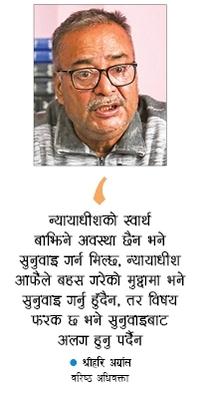
Senior advocate Srihari Aryal said that judges should recuse themselves only from cases where there is a conflict of interest. ‘If there is no conflict of interest of the judge, then the hearing can be held,’ he said. ‘A case that the judge himself has argued should not be heard, but if the subject is different, then there is no need to recuse (retire from the hearing).’
‘Reticence’, i.e. the process of a judge recusing himself from the hearing of a case, is a basic concept of the judicial system. It states that not only should a judge not hear a case in which he has a conflict of interest, but there should also be no suspicion that he is biased. It is believed that justice is not enough, it is equally important to appear to be fair. This international norm that if there is a suspicion that a case is being heard by a judge, the concerned judge should recuse himself from the bench has been in practice in Nepal as well. However, due to the lack of clear criteria, this issue has repeatedly caused public controversy.
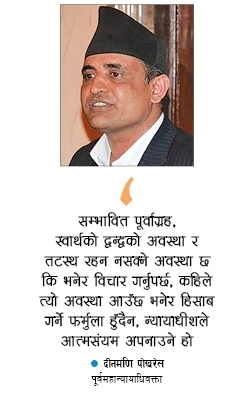
Former Attorney General Dinmani Pokharel says that a judge should theoretically consider three things when deciding to recuse himself from the hearing of a case or to participate in the hearing. ‘We should consider whether there is a potential bias, a conflict of interest, and a situation where we cannot remain neutral,’ he said. ‘There is no formula to calculate when that situation will arise. The judge himself must exercise self-restraint.’
 There is no uniform practice on when and how to exercise such self-restraint. During the tenure of former Chief Justice Sushila Karki, the then head of the CIAA, Lokman Singh Karki, had filed a petition not to hear the case from her bench, citing his relationship with her. Sushila Karki had heard the case stating that she did not know Lokman and had no relationship with him. In another controversy regarding the dissolution of the House of Representatives by then Prime Minister KP Sharma Oli, Justice Harikrishna Karki, whom Oli had previously appointed as the Attorney General, was removed from the bench by issuing a written order after questions were raised about him.
In another case regarding the dissolution, there was a voice raised that Justices Tej Bahadur KC and Bam Kumar Shrestha should not be involved in the hearing of that case based on the orders they had previously made. However, both judges had ordered that they could be heard. Then, saying that the issue of the judge recusing himself from the hearing of the case was not only a matter of concern to the judge concerned but also to the entire bench, the other two members of the constitutional bench, Deepak Karki and Anand Mohan Bhattarai, who were involved in the case, had ordered that they would recuse themselves if KC and Shrestha did not recuse themselves.
‘To be seen as having done justice, the result alone is not enough to be fair and impartial, fairness and impartiality must also be guaranteed in the process,’ the order said, ‘Not only should the judge not appear biased, but there should be no suspicion of bias in his actions from the perspective of a prudent observer. The judge himself should keep an eye on whether the judge’s impartiality is in doubt or not.’
Even after such an order, the dispute did not settle. The Attorney General and the government prosecutor insisted that Judges Karki and Bhattarai, who made such an order, should recuse themselves. Ultimately, the bench involved them ruled. In the final verdict, the Supreme Court said that the government was trying to engage in ‘bench shopping’ (trying to select the judge to hear the case), which was against the concept of an independent judiciary. The verdict stated, ‘It could not be considered appropriate and decent from the perspective of the concept of an independent judiciary to present itself in a way that appeared to be trying to select judges by raising questions about the formation of the court bench from officials who have public responsibilities representing the executive.’
Thus, on the one hand, there is room for the parties to raise questions on the basis that a fair decision cannot be made unless a judge is detached from a case, and on the other hand, there is also a concern that such questions cannot be misused by the parties concerned as a weapon to select judges.
Deputy Attorney General Sanjeev Raj Regmi says that in our country, the concerned judge has a tradition of deciding on the issue of separation from the bench. ‘The judge himself decides to recuse himself because his decision may not be fair in the event of any vested interest,’ he said. ‘The judge should be sensitive so that his own and the court’s impartiality are not questioned. It does not mean that he should leave as soon as the question arises.’
Former dean of Kathmandu University School of Law Hrishikesh Wagle also said that the judge himself should pay attention to whether he can be influenced while hearing the matter. ‘If the judge has no direct or indirect benefit, and no vested interest, then it is possible to see,’ he said. ‘If there is a situation that can be seen, it is also the judge’s duty to not deviate from it and bring the case to a conclusion.’
The issue of recusing himself from the hearing is also covered by the code of conduct for judges. In Nepal, the Judicial Council initially formulated the code of conduct for judges in 2055. After 10 years, it was improved and the code of conduct for judges 2074 is currently in force with further amendments. The code specifies the situations in which a judge should recuse himself from the case. Accordingly, if a judge has a specific request or bias towards any party to the case, if he has prior knowledge of the disputed matter in his personal capacity, if he has previously worked as a legal practitioner or was a witness in the same dispute, or if the judge or his family has a direct financial interest in the outcome of the case, he must recuse himself from the hearing or adjudicating the case.
However, the Code is not limited to this, in addition to these listed situations, he must recuse himself from hearing or adjudicating such a dispute if ‘a prudent observer sees that he cannot decide impartially in resolving such a dispute’. Article 100 (2) of the Constitution also makes it a constitutional obligation for judges to comply with the code of conduct.
In ‘A Study on Judicial Conduct and the Code of Conduct for Judges’ published by the National Judicial Institute, it is stated that a judge should not be prevented from hearing a case ‘if someone accuses him of being impartial’, but he should recuse himself if ‘he cannot remain impartial and there is a suspicion that he is not impartial’. Nepal Bar Association President Vijay Prasad Mishra says that judges should consider whether their decisions could affect the credibility of the entire judiciary when deciding whether to hear a case or recuse themselves from the hearing. “We should consider that our neutrality is not affected,” he said, “so that no one can question us when we exercise our discretion.”