According to the corporation's data, 9,755 tons more gas has been imported in the same period of this year compared to the same period of the previous fiscal year, but gas sellers, industrialists, and oil corporation officials say that due to the psychological fear of fuel shortages amid ongoing tensions in West Asia, there has been an artificial shortage in the market as consumers stock up unnecessarily.
We use Google Cloud Translation Services. Google requires we provide the following disclaimer relating to use of this service:
This service may contain translations powered by Google. Google disclaims all warranties related to the translations, expressed or implied, including any warranties of accuracy, reliability, and any implied warranties of merchantability, fitness for a particular purpose, and noninfringement.
Although Nepal Oil Corporation claims that there is no problem in gas import so far, consumers in various parts of the country have said that they have not received gas. People are seen standing in queues with empty cylinders. Due to the gas shortage, citizens and small business owners in the capital Kathmandu as well as many other places are facing hardship.
Sabina Dangol, a resident of Tokha-2 in Kathmandu, has not been able to find gas despite her many searches. She says that whenever she goes to the place where she gets it, she is always told that there is no gas. ‘She has searched in other places in Tokha, but she has not found gas anywhere. The cylinder at home is running out, if she asks at the shop, it is already empty, and they say it will come in a few days,’ she said.
She said that her neighbors also have the same problem. ‘If we don’t get gas now, we will have to find firewood to cook,’ says Dangol. Deepa Pariyar, a resident of Greenland in Tokha, is worried about when her house’s gas cylinder will run out. ‘One cylinder is half full. I am worried about when it will run out. The other cylinder is empty,’ she said, ‘They just say they haven’t gone to get gas.’
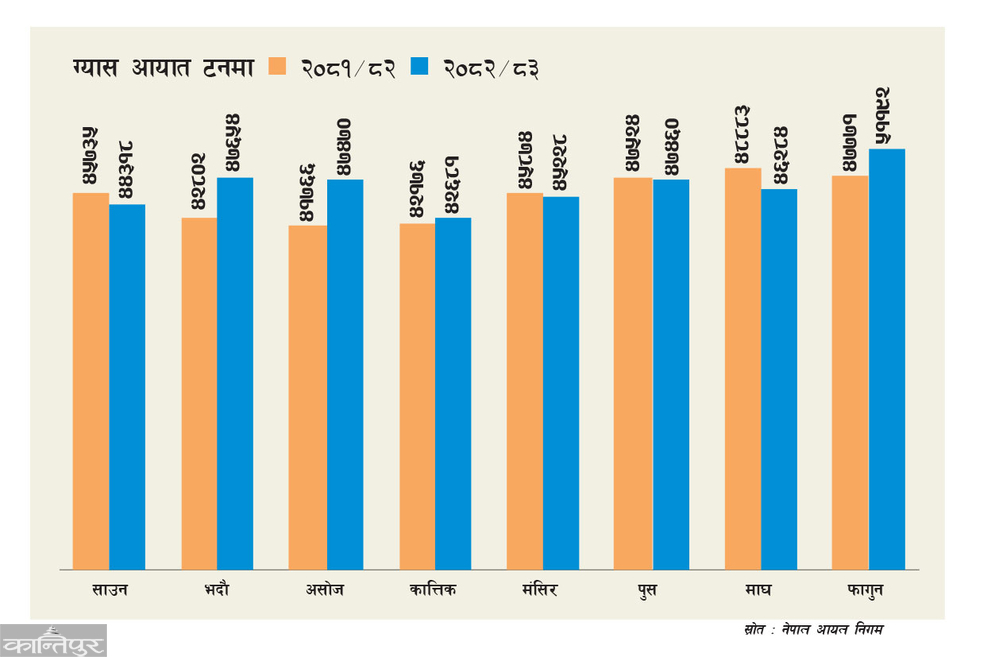
The gas shortage has also affected the operations of small restaurants and eateries. At other times, Sadhana Eatery in Buddhanagar, Kathmandu, used to always cook breakfast as ordered by customers. However, for the past few days, the owner Navina Raut said that she has not been able to cook due to lack of sufficient gas. 'We have not received gas. It is not always available at the place where we get it. They have said that they will give it to us today,' she said.
Some empty cylinders are visible outside the Koirala store in Tokha Saibaba Chowk. The store owner, Rajkumar Koirala, of Dhading Thakre-9, says that there is not much gas in his store because one person has taken many cylinders. 'The ones who are suffering now are those who have only one cylinder. Those who have 2/3 cylinders at home have taken one from me and one from another shop, saying they do not have one,' he said. Rajkumar says that the dealer has said that the gas will be delivered in a few days.
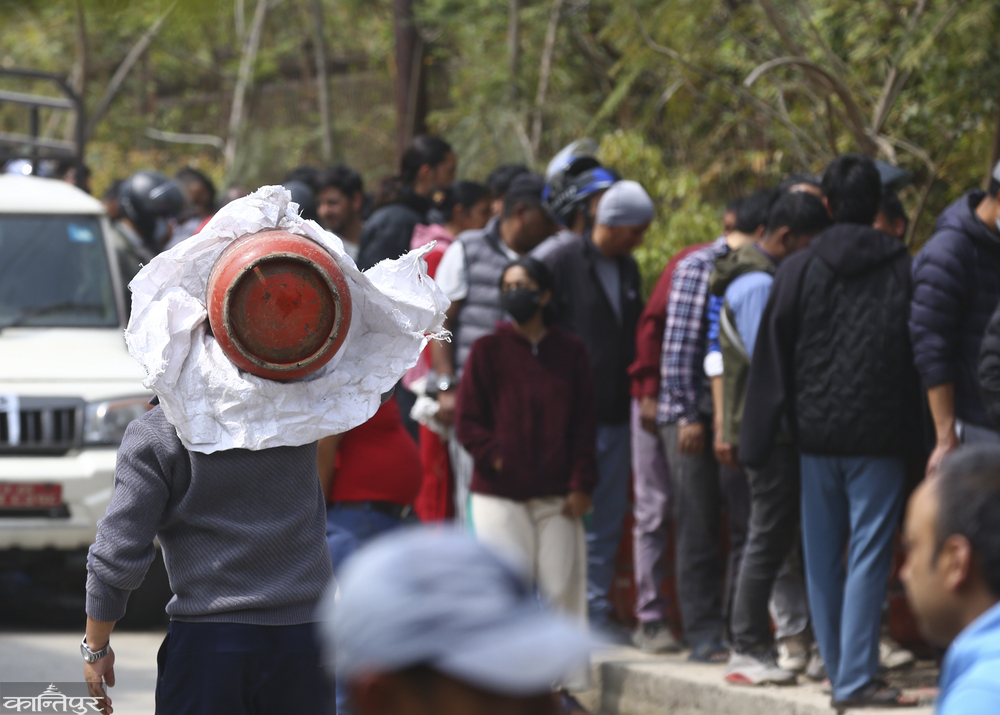
Samjhana Aryal, of Pokhara Metropolitan City-32, was confused about not getting gas. 'The gas is full, but it is not available in the store.' They said it would arrive in 2-3 days,' she said, 'I bought an electric stove after I couldn't cook.'
Meena Chapagain, a resident of Malepatan, Pokhara-5, has been running a grocery store for 22 years. She has a grocery store, Deepa, in Malepatan Chowk. She has also been selling gas. But now she said she has not been able to sell it because the dealer has not provided it. 'Customers say they have not been able to provide gas every day. What can I do when the dealer has not provided it,' she said.
Similarly, Pragati Regmi of Rambha Rural Municipality-3 in Palpa is currently stressed because she has not received gas. Since she has only one cylinder, she used to fill it as soon as it ran out, but she said she has not received it now. 'I have bought an electric stove after not receiving gas,' she said.
***
Experts say that one of the reasons for the shortage in the market despite regular gas imports is the psychological fear among consumers. After the US and Israel launched a joint attack on Iran on February 28, the fear of a crisis in the global market for fuel and gas spread, the impact of which was seen in Nepal.
After the Iran war and tensions in West Asia, gas prices increased in some areas of neighboring India, and consumers started lining up to buy gas. Since Nepal is also dependent on India for gas, consumers started buying gas in droves. As demand increased, a shortage began to appear. The Oil Corporation issued a statement saying that gas imports were regular and did not follow the rumors. Meanwhile, the House of Representatives elections were being held in Nepal on February 21. Consumers started buying gas, fearing that prices would increase during the elections.
Although Nepal has been importing gas from India, there is no storage system. On the other hand, there is no rule on how many gas cylinders an individual, family, or small restaurant or large five-star hotel can keep. Therefore, when the issue of fuel shortages arises, consumers who keep only one cylinder and buy it when it runs out are being affected.
Gehendra Rijal, owner of Nepal Gas dealer Ichangu Enterprises in Sanobharyang, Kathmandu, says that while 100 cylinders were sold per day earlier, the demand is now up to 200. ‘But it is still not enough. Just to name a few, there are more than 500,’ he said. ‘In the months of February and March, less gas came from the industry, it was not that there was not enough gas to sell at that time,’ he said. ‘After 15 Falgun, gas has been coming easily. But the demand has not been met. When the gas arrives, we give it to the consumers according to their names.’
***
Gas sellers and the Oil Corporation claim that the shortage is due to consumers hoarding more than required. For this reason, the corporation has started selling half-cylinders, i.e. 7.1 kg gas filled cylinders, to prevent excessive hoarding and to make it easy for consumers to get it. Earlier, there was a 14.2 kg gas cylinder.
Even though daily imports do not decrease, the shortage in the market has increased due to consumers hoarding unnecessary gas out of fear of shortage, said the managing director of the corporation, Chandika Prasad Bhatta. 'There has been unnecessary storage. But there is no shortage. No hotels/restaurants have closed. As much gas as is consumed at other times,' he said.
According to the corporation, as there is no government storage house, the imported gas reaches the industries directly. The country does not even have a 'bullet' vehicle for importing gas. For that, we have to depend on Indian vehicles. According to the corporation's data, 9,755 tons more gas has been imported in the same period this year compared to the same period of the previous fiscal year. 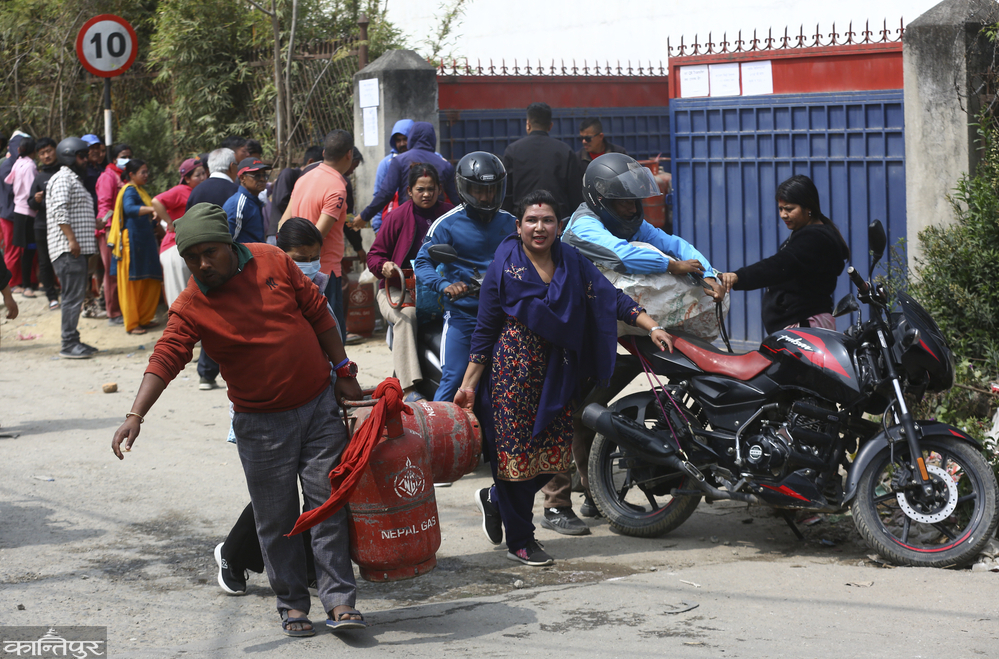
372,287 tons of gas have been imported in the same period of the current fiscal year. While 362,532 tons were imported in the same period of the previous fiscal year. According to the corporation, the highest number of gas imports was 51,192 tons in the month of Falgun. In the last fiscal year, 47,771 tons were imported.
The Gas Sellers Federation issued a notice on 26th Falgun, saying that it is natural for consumers to be concerned about the lack of gas due to the unrest in West Asia and demanded action against industrialists and sellers who cheat consumers. Federation President Dnyaneshwor Aryal said that he is selling gas to all consumers who come with empty cylinders. ‘Gas is being sold and distributed, it is coming from the industry, we are selling it,’ he said, ‘There is a shortage because consumers are hoarding more.’
According to him, there are families who have one cylinder and some who have five cylinders. ‘No matter how many cylinders they have, they would normally use them and when they run out, they would order another gas, because at that time, gas would easily reach their homes in 15-20 minutes,’ he said, ‘But after the war in West Asia, those who could afford it started filling up all the cylinders they had.’
He said that this situation is created because there is no provision for how many cylinders a family can keep. ‘It’s not that gas has not arrived, but the demand has increased significantly. There is no telling who the real consumer is,’ he said.
Like the corporation, industrialists also say that there has been no decrease in gas imports. As the same amount of gas is being imported every day, the impact of the war in West Asia on gas supply in Nepal has not been seen until Sunday, said Shiva Ghimire, former president of the LP Gas Industry Association. ‘It may be a 2/4 percent decrease, but an average of 100 bullets of gas is being imported regularly,’ he said. ‘During the blockade, wealthy families hoarded cylinders. Now many have started filling all the empty cylinders they have. That’s why those who have only one gas have not received it. An artificial shortage has been created in the market.’
Ghimire said that they currently do not have gas stock. ‘In normal times, there would have been at least a month’s worth of stock. Now we have no stock. We imported, distributed. That’s all that has happened now. Neither the industry nor the seller has been able to keep it in stock,’ he added.
Recalling that in previous years, there was no shortage of gas in the Kathmandu Valley and other cities, but there was no shortage in the Terai, Nepal LP Gas Industry Association President Diwan Chand said, "This time, the situation is different. There is a shortage of gas in the Terai as well. After the Indian government tightened gas distribution to restaurants along with the Iran war, its impact has also been felt in the Nepali territory in the border areas." He said that even though gas is being imported at the same rate as usual, there is a shortage in the market as consumers have increased their storage due to the fear of shortage.
Gas distribution cycle, industry and capacity
There are 59 gas industries in the country. All these industries have been allowed to import gas. An average of about 100 bullets (gas-carrying tanker trucks) are coming in daily. These bullets also belong to India. Nepal does not have bullets to carry gas. Gas is coming from Mathura in UP, Barauni in Bihar, Haldia in West Bengal, and Paradip in Odisha in India.
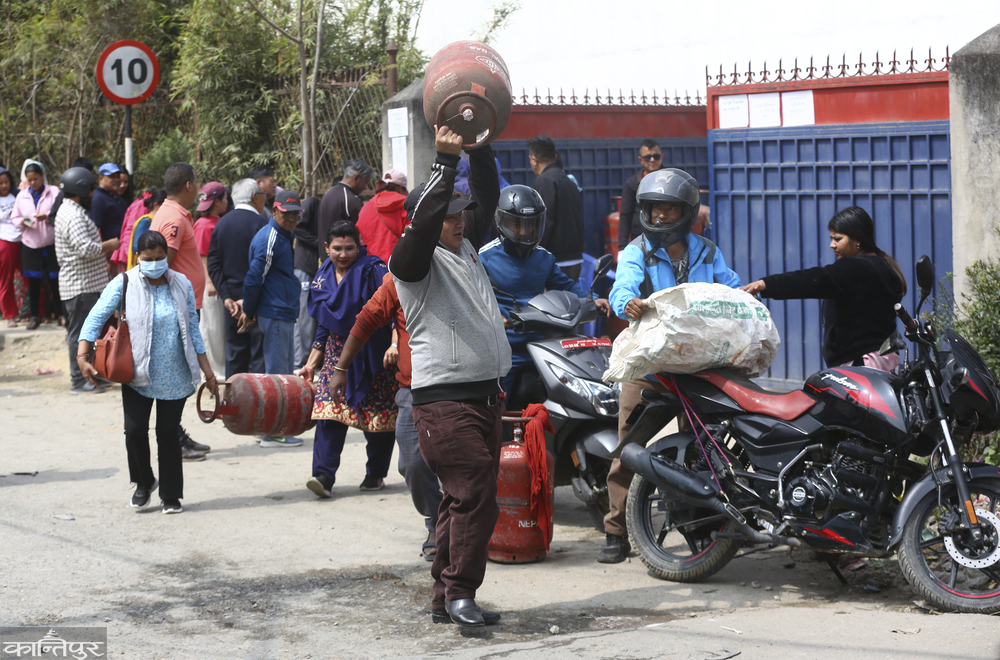
The gas supplied to the western region including Dang comes from Mathura. However, since Barauni is the closest area to Kathmandu, the supply is from there. The corporation grants import permits and industrialists have been importing gas accordingly. The imported gas reaches the industries directly. Industrialists ‘package’ the gas, distribute it and deliver it to dealers.
Gas reaches retail and wholesale shops from dealers. Consumers can purchase gas directly from dealers or from retail and wholesale shops. Hotels, party palaces and large consumers who consume a lot of gas have been purchasing gas directly from industries or distributors. Those who do not have industries in the valley supply gas to dealers through distributors, said Corporation spokesperson Manoj Kumar Thakur. ‘Those who have industries in the valley supply gas directly to consumers through dealers,’ he said. He said that the capacity of the industries is 10,000 tons.
Distribution from Teku, the four gas stations with the highest shortage,
After gas shortages were observed in the market, industries are distributing gas from the building of the former Oil Corporation in Teku, Kathmandu. Nepal LP Gas Industry Association President Chand informed that four types of gas are being distributed in the market, namely Nepal, HP, Sugam and Everest, which are in great shortage. “We are selling gas from 4/5 industries by setting up outlets in Teku due to the severe shortage. Nepal Gas is also distributing from its industry in Balaju,” he said. “Those who bring empty cylinders to those places can get gas.”

