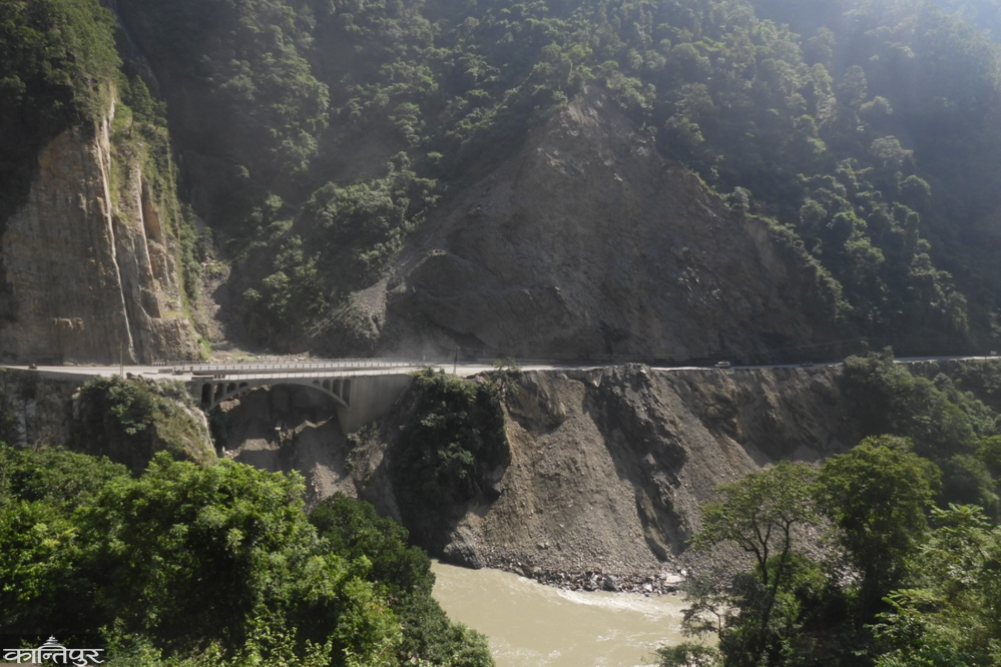
Narayan Prasad Lamichhane, Division Chief of the Bharatpur Division Road Office, informed that preparations are underway to issue a notice for the contract as soon as possible.
We use Google Cloud Translation Services. Google requires we provide the following disclaimer relating to use of this service:
This service may contain translations powered by Google. Google disclaims all warranties related to the translations, expressed or implied, including any warranties of accuracy, reliability, and any implied warranties of merchantability, fitness for a particular purpose, and noninfringement.
During the last rainy season, the landslide in Tuinkhola on the Narayangadh-Muglin road caused a lot of trouble for the passengers. The fear of this landslide, which had been forgotten during the winter, has started again with the light rain that came last week. Last Friday evening, stones started falling in Tuinkhola along with the rain. The road division had to remove the stones with a machine. On Saturday, work was done to install lights there for lighting.
The Bharatpur Division Road Office has installed two floodlights there so that landslides or stone falls can be seen clearly from a distance at night. What work has been done this winter to control the landslide in Tuinkhola, which blocked the road for 58 hours continuously during the last rainy season? Road office officials say that the budget has been arranged but the work in the field has not started yet.
‘A budget of Rs 250 million has been ensured.’ This entire amount cannot be used only for the work of Tuinkhola. Work will also have to be done elsewhere, said Narayan Prasad Lamichhane, Division Chief of the Division Road Office of Bharatpur. He informed that the office has prepared to issue a notice for the contract as soon as possible. The budget for two fiscal years has been ensured. Lamichhane said that not all the work will be completed this year.
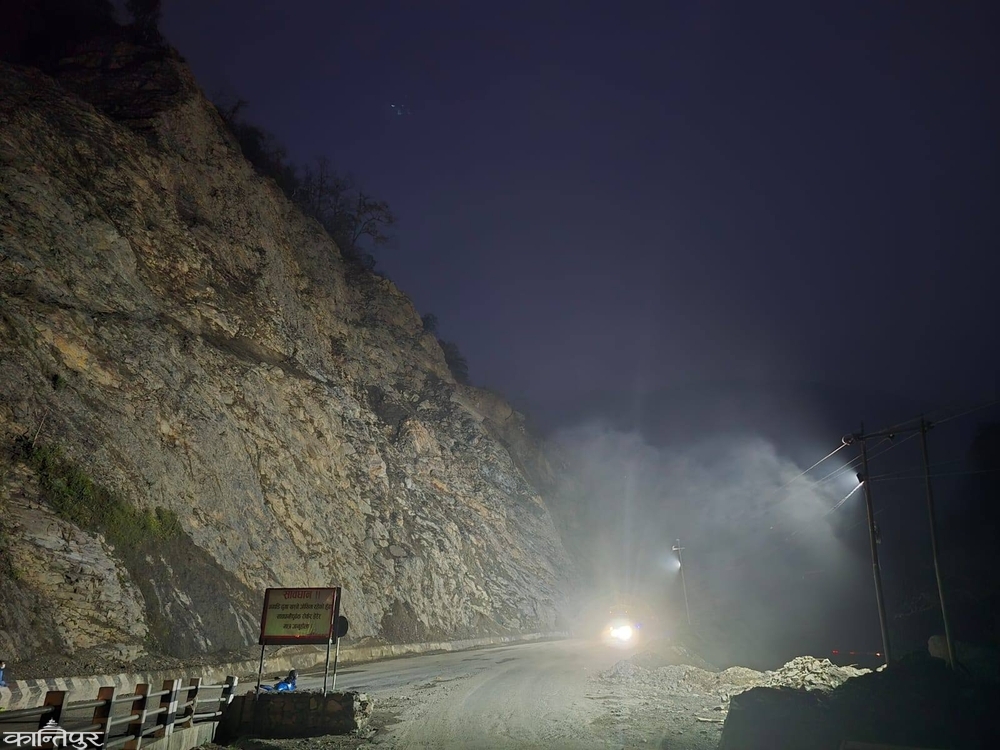 The Narayangadh-Muglin road is the main road connecting the capital Kathmandu and the tourist city Pokhara with the east-west region of the country. The hill has been completely bare due to continuous landslides near Muglin on this road in Tuinkhola. The length of the landslide is 165 meters. The landslide has fallen from up to 105 meters above. This area is high-risk in Bakha.
Landslides and long-term road closures started in this place two years ago. Division Road Office Engineer Arjun Ghimire informed that landslides started in Tuinkhola from Ashad 3rd last monsoon. He said that since then, the road has been blocked for 184 hours due to landslides in Tuinkhola repeatedly. The biggest landslides occurred on Ashoja 3rd and 7th.
Engineer Ghimire said that the landslide on Ashoja 3rd blocked the road for 46 hours continuously and the landslide on 7th blocked the road for 58 hours continuously. This road, where more than 10,000 small and large vehicles, buses and trucks transporting goods ply daily, is the lifeline of the capital. When such a road is closed for a long time, it not only inconveniences the passengers but also affects the supply system of the capital.
The outer layer of the mountain is weak due to continuous landslides. Large and small stones can fall on the road at any time and there is a risk of another major landslide during the monsoon. Lamichhane, the head of the Division Road Office, said that 'rock anchoring' and 'rock netting' should be done to prevent this. The Road Department team had conducted an on-site study on October 21 to control the landslide of Tuin Khola.
Anchoring is the method of piercing the rocks visible outside and connecting them to the hard part of the mountain by placing strong steel rods and concrete so that they do not fall on the road. Similarly, netting is the method of covering the mountainside with a special type of metal net or mesh to prevent small stones from falling down. Technicians estimate that Tuin Khola will not cause problems only after these two works are done.
Officials of the Road Office said that the Ministry of Finance had given budget approval last month as recommended by the National Council for Disaster Risk Reduction and Management to control the landslide of Tuin Khola. This information was received at the Division Road Office in Bharatpur on Magh 2 through the Road Department. In which it is mentioned that Rs 250 million should be spent in two financial years.
After this information, the Road Office prepared a procurement master plan and sent it to the Road Department for approval on Magh 23. Narayan Prasad Lamichhane, Chief of the Division Road Office, said that the notice for the contract will be published after the procurement master plan is approved by the department through the ministry.
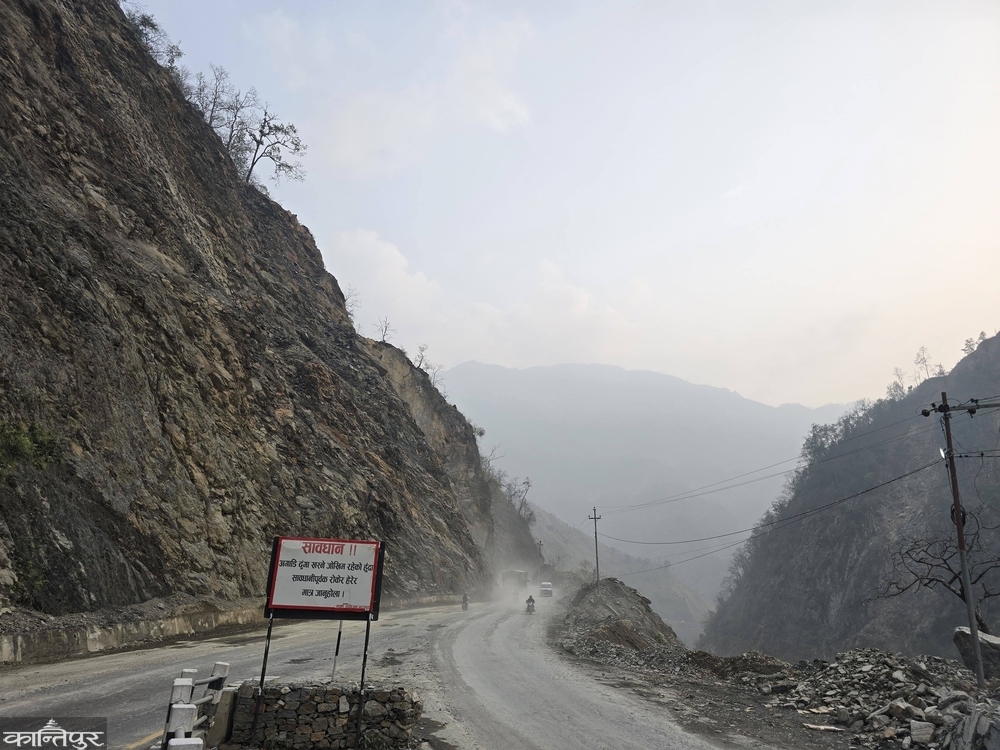 It may take up to two months to start the work in the field after the notice is issued and the contract agreement is signed. Even if the notice for the contract is issued in the beginning of Chaitra, the work may start in Jestha. Since the landslides started since Asar last year, there is pressure to complete the work before the onset of the monsoon. Before doing 'rock anchoring' and 'rock netting', all the soil, rocks and gravel that are likely to fall easily should be removed and cleaned.
Officials of the Road Office say that for this, the road may have to be closed for work. The risk of landslides remains high not only in the Tuin River on the Narayangadh-Muglin road but also in other places. Along with Tuin, there is a very high risk of landslides in Namsi. In addition, rocks have started falling from above near Jalbire. There are 51 places with moderate to very high risk.
Two places in Tuin and Namsi are very high risk areas. There are 26 moderate, 14 normal and nine areas with high risk of landslides.