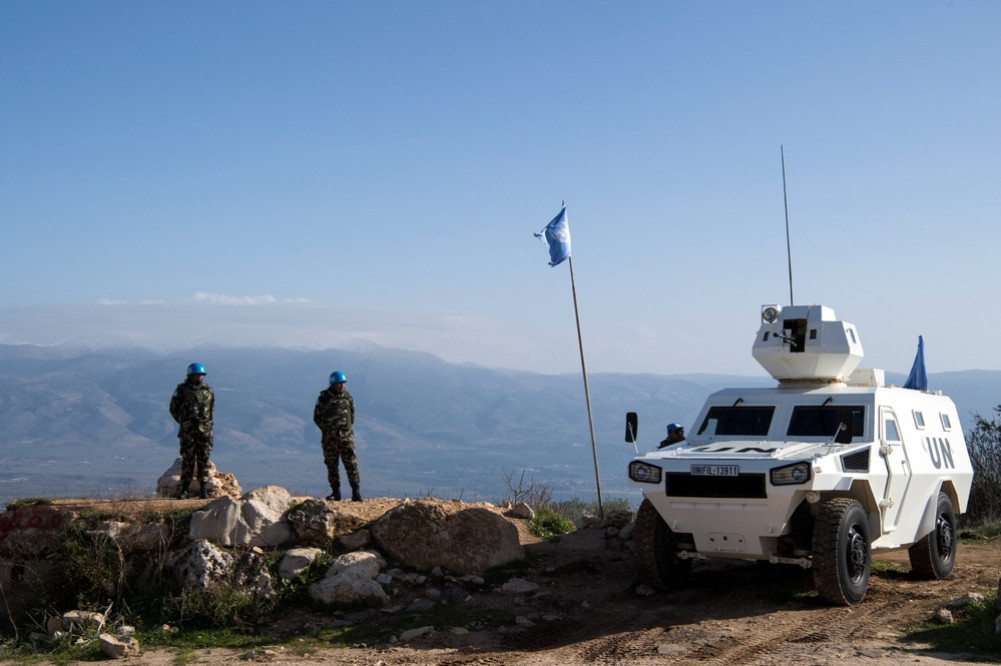
UN Secretary-General Antonio Guterres says, ”Attacks on peacekeepers and their bases are completely unacceptable and must stop immediately.”
We use Google Cloud Translation Services. Google requires we provide the following disclaimer relating to use of this service:
This service may contain translations powered by Google. Google disclaims all warranties related to the translations, expressed or implied, including any warranties of accuracy, reliability, and any implied warranties of merchantability, fitness for a particular purpose, and noninfringement.
An airstrike has hit the battalion headquarters of Nepali peacekeepers deployed in Lebanon under the UN peacekeeping mission. The incident occurred while UN Secretary-General Antonio Guterres was on a visit to Lebanon.
After the UN implemented ‘Security Level-3’, the Nepali army had started living in bunkers a week ago in accordance with ‘UN Protocol’. The UN changes this ‘protocol’ depending on the security situation. According to Nepali Army spokesperson Rajaram Basnet, a ‘several explosions’ suddenly occurred on Friday evening in Mais al-Jabal, where Nepali peacekeepers are stationed. ‘A house in the battalion headquarters in southern Lebanon has been damaged, and personal belongings have also been destroyed,’ he said, ‘However, there has been no human casualty, all Nepali peacekeepers are safe.’
There are 540 Nepali soldiers and 13 staff officers working in Lebanon. It is not clear how many of them were at the scene of the attack. ‘Soldiers are constantly coming and going at the battalion headquarters, everyone was in the bunker on Friday evening,’ said Spokesperson Basnet. Currently, Nepali Army Lieutenant Colonel Man Bahadur Mahara is the ‘Deputy Force’ Commander in the Lebanon peacekeeping mission.
After the UN implemented ‘Security Level-3’, the Nepali Army had started staying in the bunker a week ago as per the ‘UN Protocol’. The UN changes this ‘protocol’ according to the security situation.
‘According to the external situation, the UN Headquarters divides security protocols into 1, 2 and 3, and there are standards for what can and cannot be done,’ said another senior Nepali Army officer. ‘Accordingly, when the number is 3, the troops are not allowed to go out, when the number is 2, they are only allowed to walk outside for a certain period as prescribed.’ In both cases, ‘operational’ activities remain suspended.
Military Spokesperson Basnet said that the UN is investigating the source of the explosion. The National, a Dubai-based newspaper that focuses on the Middle East, reported that Lebanon's state news agency accused Israel of carrying out the attack, but the UN has not yet found anyone guilty.
"We have launched an investigation into the incident and would like to remind all parties to fulfill their responsibilities to ensure the safety of peacekeepers," a UNIFIL statement said. Three Ghanaian peacekeepers were also injured in an attack on a post in the southern Lebanese town of Kouzah last week. It was not clear who carried out the attack, but Lebanese President Joseph Aoun said Israel was responsible.
According to the information released by the Emergency Operations Center under the Lebanese Ministry of Health on Friday evening, 773 people have been killed and 1,933 injured since the Israeli attack began on 18 Falgun as of Friday. UN Secretary-General Guterres met with the injured Ghanaian soldiers on Friday to discuss the situation. "Attacks on peacekeepers and their bases are completely unacceptable and must stop immediately," he said. He also noted that a ceasefire agreement between Lebanon and Israel signed nearly a year ago had failed to fully end the violence. He said that both Hezbollah and the Israeli army then violated the ceasefire terms.
Earlier, the Israeli Defense Forces (IDF) had launched a ground operation on 15 Ashoban 2081 to eliminate the Lebanese Islamic rebel organization Hezbollah. At that time, Israeli Prime Minister Benjamin Netanyahu had even warned that the UN mission would be removed from southern Lebanon. However, the UN responded that the soldiers deployed for peacekeeping would not be withdrawn. At that time, two Sri Lankan peacekeepers were injured in an airstrike. The Nepali Army has been deployed to maintain peace in the Lebanese border area since 1978, as per the instructions of the UN.
According to the details released by the Emergency Operations Center under the Lebanese Ministry of Health on Friday evening, 773 people have been killed and 1,933 injured since the Israeli attack began on February 18.
Earlier, on February 3, 2002, Nepali Army Lieutenant Colonel Chowk Bahadur Dhakal was attacked while returning home after completing his two-year assignment in the Lebanese mission. While returning home after completing his assignment, protesters stopped his vehicle at night and abused him and set the vehicle on fire. He suffered a head injury in the process. The four Nepali peacekeepers in the vehicle were later taken to the hospital by the Lebanese Army. Later, Lebanon took 25 people into custody on charges of involvement in the incident.
Apart from Lebanon, Nepali peacekeepers also sometimes stay in bunkers in Syria, where Nepali peacekeepers are deployed. “There too, the team stays in different conditions according to UN protocols,” said a military officer. Nepal has long been the number one contributor to peacekeeping missions, and is now ranked second in the world with 4,497 troops.
Rwanda, which is in first place, has deployed 4,848 peacekeepers. This is followed by Bangladesh with 2,327, India with 4,267, Pakistan with 2,414, Indonesia with 2,084, Ghana with 2,027, and China with 1,662 troops.
Going on a UN mission is considered an attractive opportunity in the security sector. However, the number of people going on missions has been continuously decreasing after the UN itself cut its budget recently.